

English Proficiency in Asia
These Asian countries are the best in English.

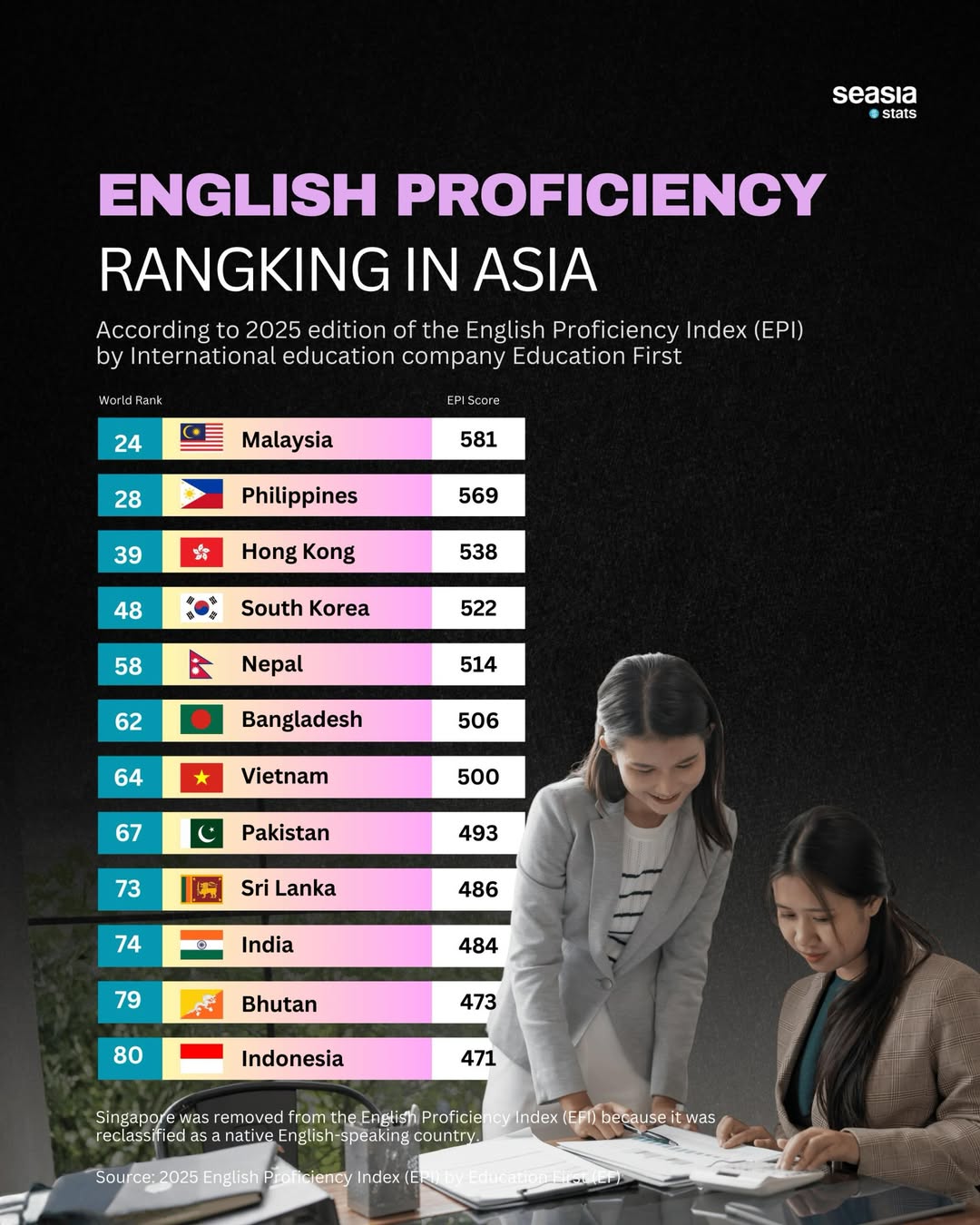
The EF English Proficiency Index (EPI) 2025 provides a valuable snapshot of English-language skills across Asia, highlighting significant differences among countries in the region.
As English continues to serve as a global language for business, education, technology, and international communication, proficiency in the language has become an important indicator of a country's competitiveness in the global economy.
According to the 2025 EF EPI rankings, Malaysia leads Asia with a score of 581, demonstrating a high level of English proficiency. Malaysia’s strong performance can be attributed to its multilingual environment, widespread use of English in education, and its role in international trade and business.
Following closely is the Philippines, which scored 569. English has long been an official language in the Philippines, making it a key medium of instruction and communication throughout the country.
Hong Kong ranks third among the listed Asian economies with a score of 538. Its status as an international financial center and its historical connection to English-language administration have contributed to strong English skills among its population.
South Korea follows with a score of 522, reflecting sustained investments in English education and growing international engagement.
Several Asian countries occupy the middle range of the rankings. Nepal scored 514, while Bangladesh achieved 506 and Vietnam reached 500.
These results suggest steady progress in English education and increasing recognition of the language’s importance for economic development and global connectivity.
Pakistan recorded a score of 493, followed by Sri Lanka at 486 and India at 484. Despite English playing an important role in government, higher education, and business in some of these countries, disparities in access to quality language instruction continue to affect overall proficiency levels.
At the lower end of the group are Bhutan and Indonesia, with scores of 473 and 471 respectively. While both countries have expanded English-language education in recent years, the results indicate that further improvements are needed to strengthen communication skills and enhance workforce competitiveness.
Overall, the EF English Proficiency Index 2025 reveals both achievements and challenges across Asia. Countries with stronger English proficiency often benefit from greater access to international opportunities, including foreign investment, higher education, and global employment markets.
For nations seeking to improve their global standing, continued investment in language education, teacher training, and practical English usage will remain essential. As globalization accelerates, English proficiency is likely to remain a crucial asset for individuals and societies throughout Asia.