

Female Representation in Southeast Asian Politics
Timor-Leste has the highest rate of female representation in politics in Southeast Asia.

The representation of women in national legislatures is an important measure of political inclusion and gender equality. Greater female participation in politics can broaden perspectives in policymaking and help ensure that legislative bodies better reflect the populations they serve.
Across Southeast Asia, the proportion of women serving in parliament varies considerably, illustrating different levels of progress toward gender-balanced political representation.
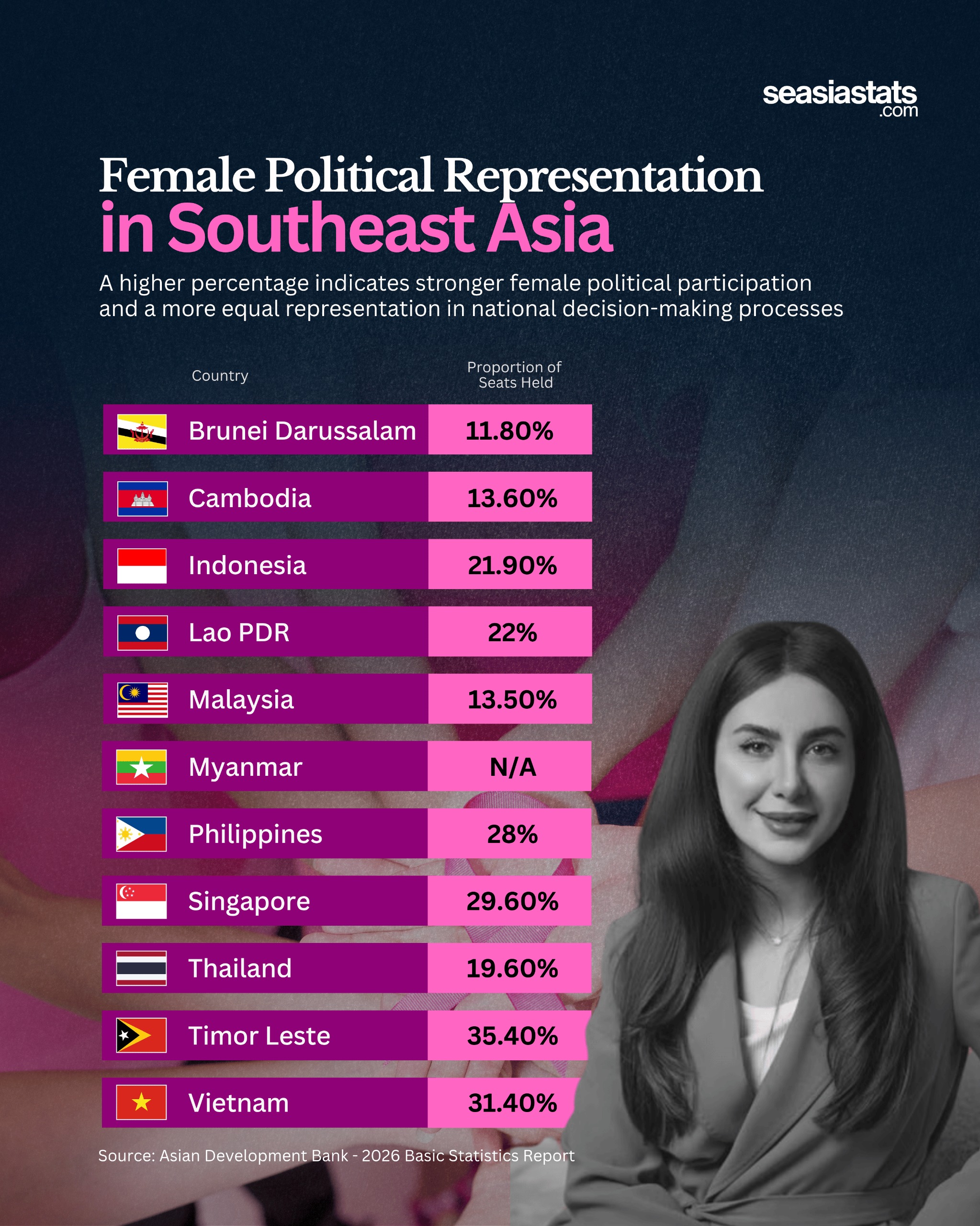
Among Southeast Asian countries, Timor-Leste has the highest level of female representation in politics, with 35.40% of parliamentary seats held by women. This places the country among the regional leaders in promoting women's participation in national decision-making and demonstrates sustained efforts to increase gender inclusivity in public office.
Vietnam follows with 31.40%, while Singapore records 29.60%. Both countries have relatively high levels of female representation compared with many of their regional neighbors, reflecting continued progress in increasing the presence of women in legislative institutions.
The Philippines also performs well, with women holding 28.00% of parliamentary seats. Filipino women have long played significant roles in politics, government, and public administration, contributing to the country's comparatively strong record of female political participation.
In the middle of the regional rankings are Laos, with 22.00%, and Indonesia, with 21.90%. These figures indicate that women make up roughly one-fifth of each country's legislature. While this represents meaningful participation, women remain underrepresented relative to their share of the overall population.
Thailand records 19.60% female representation, placing it slightly below the regional average among the countries listed. Continued efforts to encourage women's political participation may help increase representation in future elections.
Lower levels of female representation are observed in Cambodia, with 13.60%, Malaysia, with 13.50%, and Brunei, with 11.80%. These figures highlight opportunities for further progress in expanding women's roles in national politics through leadership development, candidate recruitment, and broader political participation.
For Myanmar, there is no official record included in this comparison. Ongoing political developments and institutional changes have made it difficult to provide a current, comparable measure of women's representation in the country's national legislature.
Overall, the data reveal a diverse political landscape across Southeast Asia. Female representation ranges from 11.80% in Brunei to 35.40% in Timor-Leste, demonstrating that countries in the region are at different stages of achieving gender balance in political institutions.
Although the percentages differ, many Southeast Asian countries continue to pursue initiatives that encourage women to participate in public life and seek elected office.
Increasing female representation can strengthen democratic governance by bringing a wider range of experiences and perspectives into legislative decision-making, benefiting both governments and the societies they serve.