

Fertility Rates Across Southeast Asia
Timor-Leste has the highest fertility rate in Southeast Asia.

Fertility rates are an important demographic indicator that measure the average number of children a woman is expected to have during her lifetime based on current birth patterns.
These rates influence population growth, workforce development, healthcare planning, and long-term economic policies. Across Southeast Asia, fertility rates vary considerably, reflecting differences in economic development, urbanization, education, and family planning.
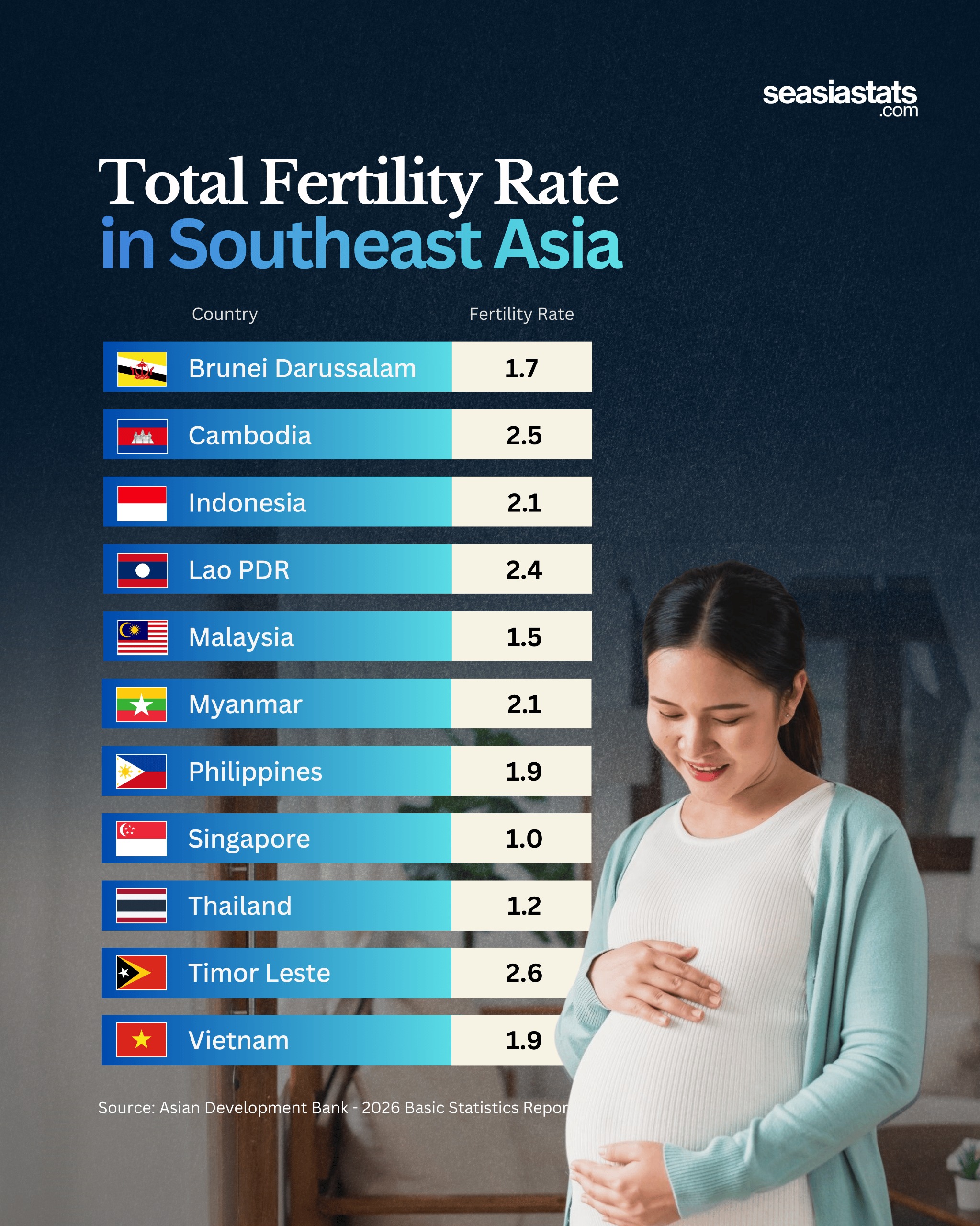
Among the countries in the region, Timor-Leste records the highest fertility rate at 2.6 children per woman, followed closely by Cambodia at 2.5 and Laos at 2.4.
These figures remain above the replacement level of approximately 2.1 children per woman, indicating that, in the absence of significant migration, these populations are likely to continue growing naturally.
Indonesia and Myanmar each have a fertility rate of 2.1, placing them at about the replacement level. This suggests that their populations are relatively stable over the long term, assuming mortality and migration patterns remain consistent.
Indonesia, the region's most populous nation, has experienced a gradual decline in fertility over recent decades as education, healthcare, and urbanization have expanded.
The Philippines and Vietnam both have fertility rates of 1.9, slightly below the replacement level. Although population growth may continue due to demographic momentum, these countries are moving toward slower long-term population growth as family sizes become smaller.
Brunei has a fertility rate of 1.7, while Malaysia records 1.5. Both countries have experienced declining birth rates associated with rising living standards, greater participation of women in higher education and the workforce, and delayed marriage and parenthood.
The region's lowest fertility rates are found in Thailand and Singapore. Thailand records 1.2 children per woman, while Singapore has the lowest rate at 1.0.
These very low fertility levels present long-term demographic challenges, including population aging, shrinking workforces, and increasing pressure on healthcare and pension systems. In response, both governments have introduced various policies aimed at encouraging marriage and childbearing, although raising fertility has proven difficult.
Overall, Southeast Asia demonstrates a diverse demographic landscape. Countries such as Timor-Leste, Cambodia, and Laos continue to experience relatively high fertility, while Singapore, Thailand, and Malaysia face the realities of sustained low birth rates.
Meanwhile, nations including Indonesia, Myanmar, the Philippines, and Vietnam occupy the middle ground, reflecting ongoing demographic transitions.
As fertility rates continue to evolve, governments throughout Southeast Asia will need to adapt their economic, social, and healthcare policies to meet the changing needs of their populations. Understanding these demographic trends is essential for planning sustainable development and ensuring long-term national prosperity.