

Food Waste in Southeast Asia
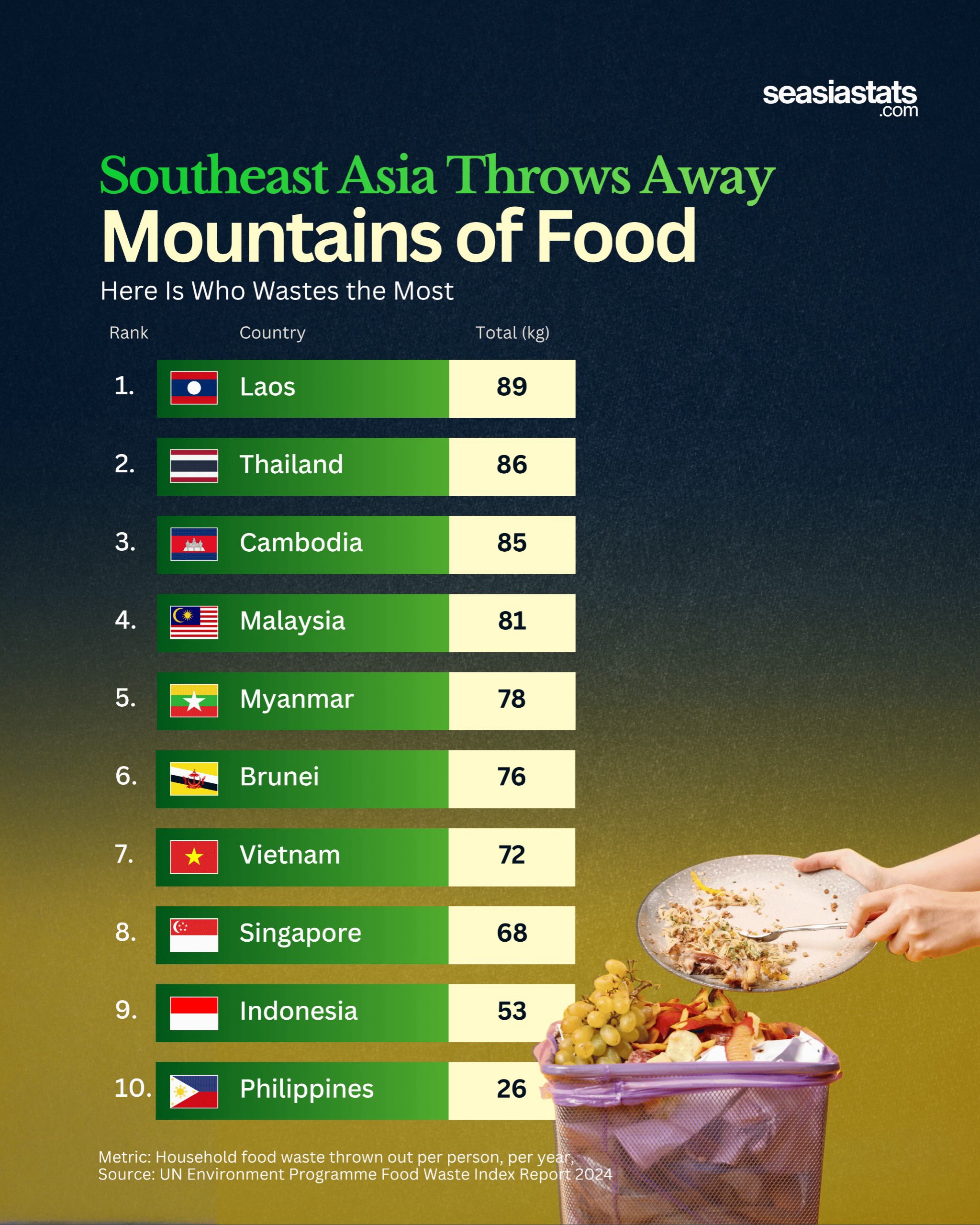
Laotians throw away 89 kilograms of food per person every year, the most in Southeast Asia.

Food waste is a growing environmental and economic challenge across Southeast Asia. Every year, millions of tonnes of food are discarded, contributing to environmental pollution, greenhouse gas emissions, and the unnecessary loss of valuable resources.
According to the United Nations Environment Programme (UNEP) Food Waste Index Report 2024, significant differences exist in the amount of food wasted per person among Southeast Asian countries.
Among the ten countries in the region, Laos records the highest estimated food waste, at 89 kilograms per person per year. Thailand follows closely with 86 kilograms, while Cambodia ranks third with 85 kilograms. These figures highlight the scale of household food waste in these countries and the importance of improving food consumption habits.
Malaysia ranks fourth, with an estimated 81 kilograms of food waste per person annually. Myanmar follows with 78 kilograms, while Brunei records 76 kilograms. Vietnam and Singapore also contribute considerably to the region's food waste problem, with 72 kilograms and 68 kilograms per person per year, respectively.
Meanwhile, Indonesia produces approximately 53 kilograms of food waste per person annually, placing it ninth among the ten countries listed. Although its per-person figure is lower than those of several neighbouring countries, Indonesia's large population means that its total food waste remains a significant concern.
The Philippines records the lowest amount among these countries, at 26 kilograms per person per year.
The differences between these figures may be influenced by various factors, including household consumption patterns, food purchasing habits, food storage practices, and awareness of food waste.
Food is often discarded because people buy more than they need, prepare excessive portions, or fail to store ingredients properly. However, food waste is not only a household issue; businesses, restaurants, supermarkets, and other parts of the food supply chain also play important roles.
Reducing food waste requires cooperation between governments, businesses, and individuals. Governments can strengthen public awareness campaigns and improve waste management policies, while businesses can introduce better inventory management and food donation programmes.
Individuals can contribute by planning meals, buying only what they need, storing food correctly, and using leftovers creatively.
Ultimately, the UNEP figures demonstrate that food waste remains an important challenge throughout Southeast Asia. Regardless of their position in the ranking, all countries have opportunities to improve their food management practices.
Reducing food waste is not simply about saving money; it is also an essential step towards protecting the environment, conserving natural resources, and building a more sustainable future for the region.