

Foreign Investment in Southeast Asia
Singapore leads foreign investment in Southeast Asia with astonishing gap between Indonesia on second place.

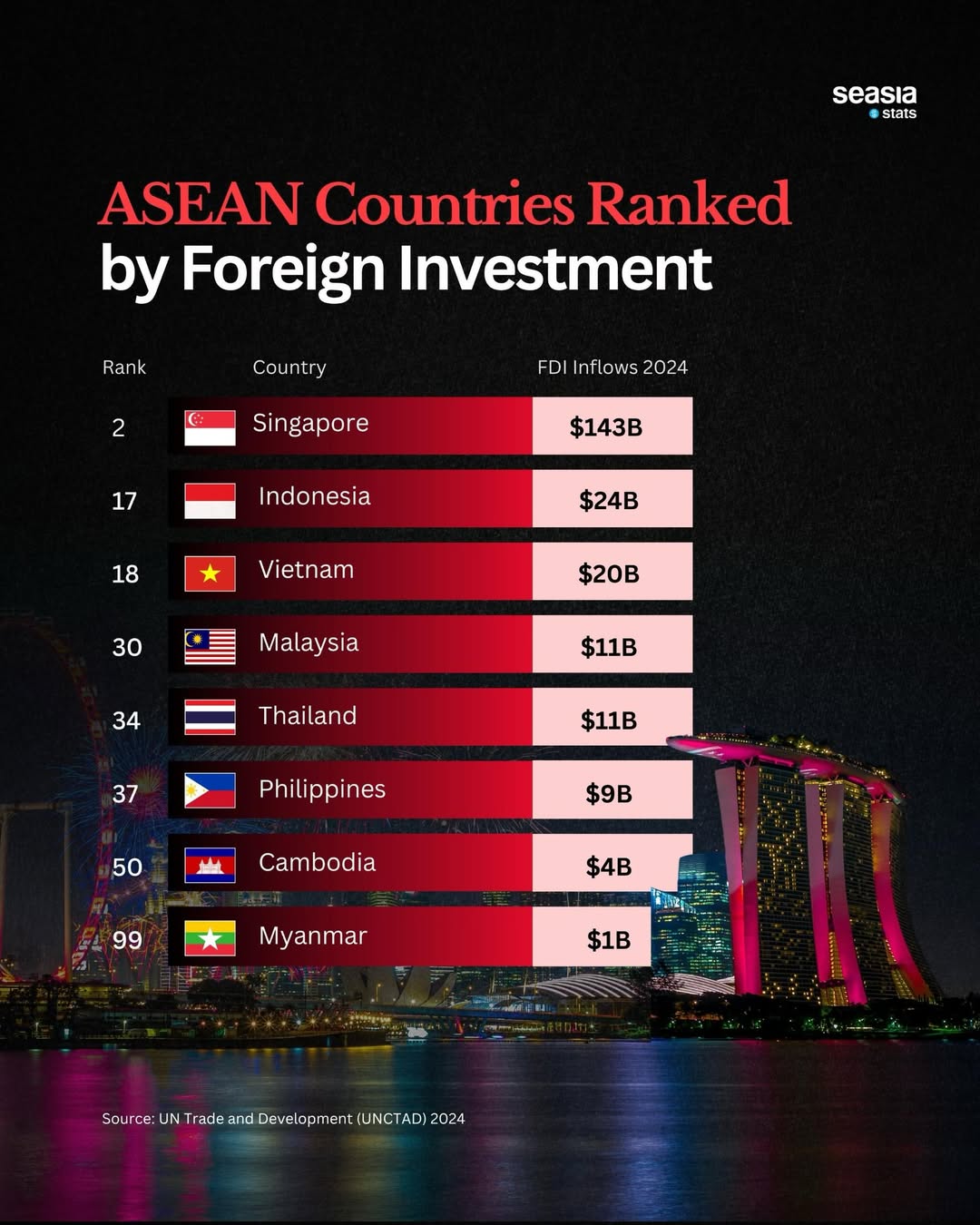
Foreign direct investment (FDI) remains one of the most important indicators of economic competitiveness, investor confidence, and growth potential. According to data from the United Nations Conference on Trade and Development (UNCTAD), ASEAN continued to attract substantial foreign investment in 2024 despite global economic uncertainties.
The region’s strategic location, expanding consumer markets, and growing manufacturing and digital sectors have made it a key destination for international investors.
Singapore ranked first among ASEAN countries, receiving approximately $143 billion in foreign investment. The city-state maintained its position as the region’s leading financial and business hub, benefiting from a highly developed economy, strong regulatory environment, and advanced digital infrastructure.
Singapore’s inflows were significantly higher than those of all other ASEAN members combined, highlighting its dominant role in attracting global capital.
Indonesia secured second place with $24 billion in foreign investment. As Southeast Asia’s largest economy, Indonesia continued to attract investors through its abundant natural resources, large domestic market, and industrial development initiatives.
The country has also benefited from growing investments in downstream mineral processing and manufacturing sectors.
Vietnam followed in third place with $20 billion. The country’s strong manufacturing base, export-oriented economy, and integration into global supply chains have strengthened its appeal to multinational corporations seeking alternatives within Asia. Vietnam has become a major destination for technology, electronics, and industrial investments.
Malaysia and Thailand shared fourth place, each attracting $11 billion in foreign investment. Malaysia benefited from growing digital economy investments and infrastructure development, while Thailand continued to attract capital in manufacturing, automotive production, and energy-related industries.
The Philippines ranked sixth with $9 billion in FDI inflows. Although the country remains one of the region’s fastest-growing economies, challenges such as infrastructure gaps and regulatory hurdles have limited its ability to attract investment at the same scale as some of its neighbors.
Among the smaller ASEAN economies, Cambodia received $4 billion, reflecting continued investor interest in construction, manufacturing, and tourism-related sectors. Myanmar recorded $1 billion, the lowest among the countries listed, largely due to ongoing political and economic challenges that have affected investor confidence.
Overall, the 2024 rankings demonstrate ASEAN’s continued importance in the global investment landscape, with countries competing to attract capital through economic reforms, infrastructure development, and participation in international supply chains.