

Forest Coverage of Southeast Asian Countries
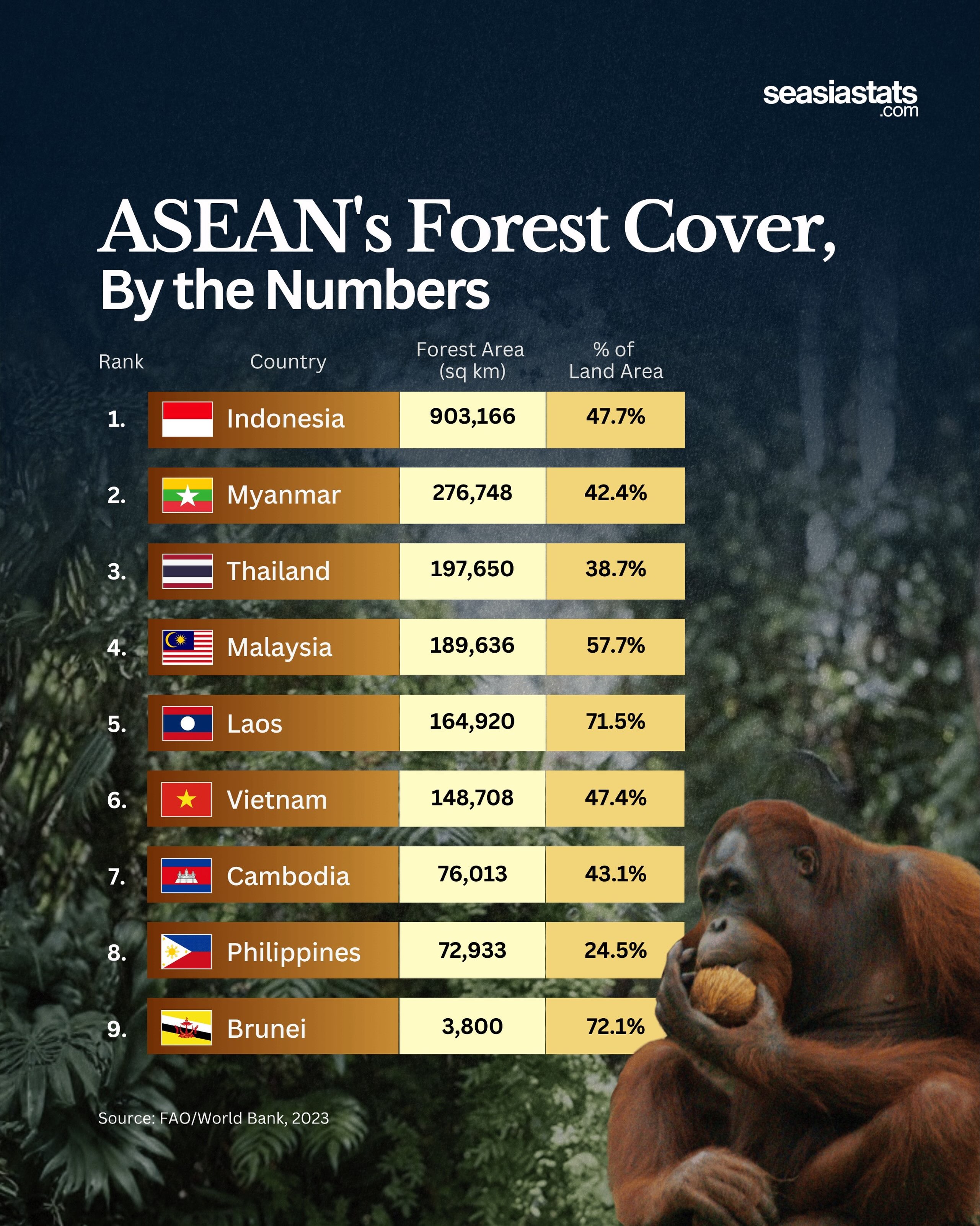
Indonesia has the largest forest coverage in Southeast Asia with 903,166 square kilometers.

Southeast Asia is one of the world's most important regions for tropical forests, which play a vital role in conserving biodiversity, regulating the climate, storing carbon, and supporting millions of people's livelihoods. While the extent of forest cover varies significantly among countries, the region collectively contains some of the largest remaining rainforests on Earth.
Indonesia has the largest forest area in Southeast Asia, with approximately 903,166 square kilometers of forests, representing 47.7% of its total land area. Spread across thousands of islands, Indonesia's forests include vast tropical rainforests in Kalimantan, Sumatra, Papua, and Sulawesi, making the country a global biodiversity hotspot.
Myanmar ranks second with 276,748 square kilometers of forest, covering 42.4% of the country's land. Its forests range from tropical rainforests to montane woodlands and provide important habitats for elephants, tigers, and countless other species.
Thailand possesses around 197,650 square kilometers of forests, accounting for 38.7% of its territory. Although forest cover declined significantly during the twentieth century, conservation efforts and protected-area expansion have helped preserve many of the country's remaining forests.
Malaysia has approximately 189,636 square kilometers of forests, equal to 57.7% of its land area. Despite having a smaller total forest area than Thailand, Malaysia has a considerably higher proportion of forest cover, reflecting the extensive rainforests found in both Peninsular Malaysia and the island of Borneo.
Laos stands out for its exceptionally high forest coverage. Its 164,920 square kilometers of forests represent 71.5% of the nation's land area, making it one of the most heavily forested countries in Southeast Asia.
Vietnam contains about 148,708 square kilometers of forests, covering 47.4% of its land. Large-scale reforestation and conservation programs have contributed to increasing forest cover over recent decades.
Cambodia maintains approximately 76,013 square kilometers of forests, equal to 43.1% of its territory. These forests include important lowland rainforests and the biologically rich Cardamom Mountains.
The Philippines has around 72,933 square kilometers of forests, representing 24.5% of its land area. Although it has the lowest percentage among the countries listed, its forests remain globally significant because of their extraordinary levels of endemic wildlife.
Finally, Brunei possesses about 3,800 square kilometers of forests. Despite its relatively small size, forests cover an impressive 72.1% of the country, giving Brunei the highest proportion of forest cover in Southeast Asia.
Together, these figures demonstrate the remarkable diversity of Southeast Asia's forest resources. Protecting these forests is essential for conserving wildlife, combating climate change, safeguarding water supplies, and ensuring sustainable development for generations to come.