

GDP Growth in Southeast Asia from 1994 to 2025
Vietnam has the largest growth of GDP from 1994 to 2025.

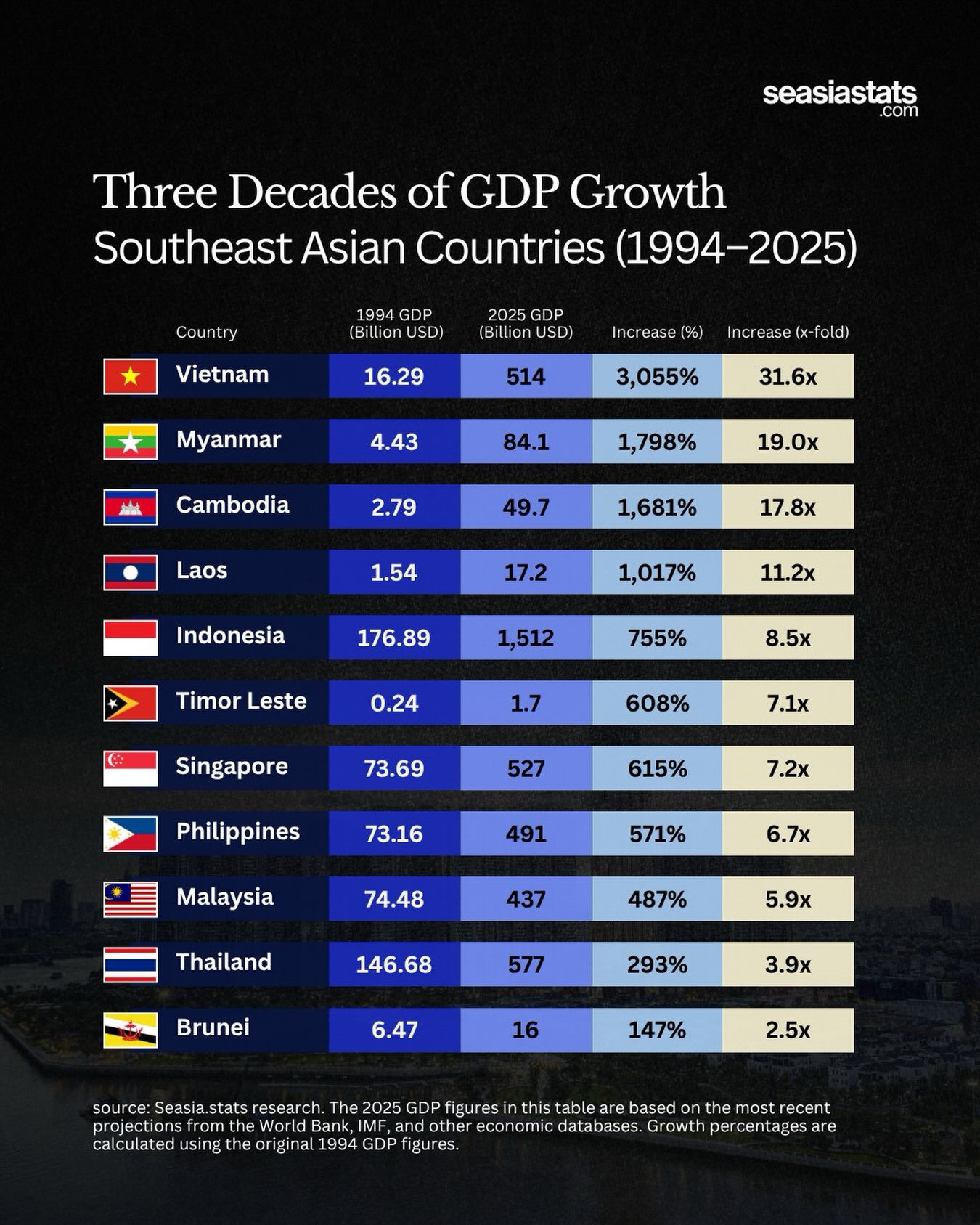
Over the past three decades, Southeast Asia has experienced remarkable economic transformation. From rapidly industrializing economies to emerging markets expanding their manufacturing, services, and trade sectors, the region has seen substantial increases in gross domestic product (GDP).
Using the figures provided, the comparison of GDP in current U.S. dollars from 1994 to 2025 shows that Vietnam recorded the largest percentage increase, while Indonesia remained by far the largest economy in absolute terms. World Bank data also show Indonesia leading Southeast Asia in GDP, with 2025 constant-dollar GDP estimated at about $1.30 trillion.
Vietnam's GDP rose from $16.24 billion in 1994 to $514 billion in 2025, representing an extraordinary 3,055% increase.
This reflects the country's long-term economic transformation, supported by manufacturing, exports, foreign investment, and expanding domestic consumption. The World Bank's latest data similarly put Vietnam's current-dollar GDP at around $514.7 billion in 2025.
Myanmar followed with an increase from $4.43 billion to $84.1 billion, equivalent to 1,798%, while Cambodia grew from $2.79 billion to $49.7 billion, or 1,681%. These figures highlight the rapid expansion of two previously smaller economies, although their economic trajectories have been affected by political and structural challenges.
Laos recorded a 1,017% increase, rising from $1.54 billion to $17.2 billion. Meanwhile, Indonesia, Southeast Asia's largest economy, increased from $176.89 billion to approximately $1.512 trillion, a 755% increase. World Bank data confirm Indonesia's dominant economic scale, with current-dollar GDP reaching about $1.45 trillion in 2025.
Timor-Leste grew from $0.24 billion to $1.7 billion, an increase of 608%, while Singapore expanded from $73.69 billion to $527 billion, representing 615% growth. Despite its small population, Singapore has become one of the region's most prosperous economies, driven by finance, trade, technology, and international business.
The Philippines increased from $73.16 billion to $491 billion, or 571%, while Malaysia rose from $74.48 billion to $437 billion, equivalent to 487%. Thailand grew from $146.68 billion to $577 billion, a 293% increase, and Brunei recorded the smallest percentage increase, rising from $6.47 billion to $16 billion, or 147%.
Overall, the figures illustrate the dramatic economic expansion of Southeast Asia since 1994. While percentage growth was strongest along countries such as Vietnam, Myanmar, Cambodia, and Laos, larger economies such as Indonesia, Thailand, Singapore, and the Philippines continue to account for a substantial share of the region's total economic output.