

GDP Growth of ASEAN 6 in Q2 2026
Vietnam shows the biggest GDP growth in the second quarter of 2026.

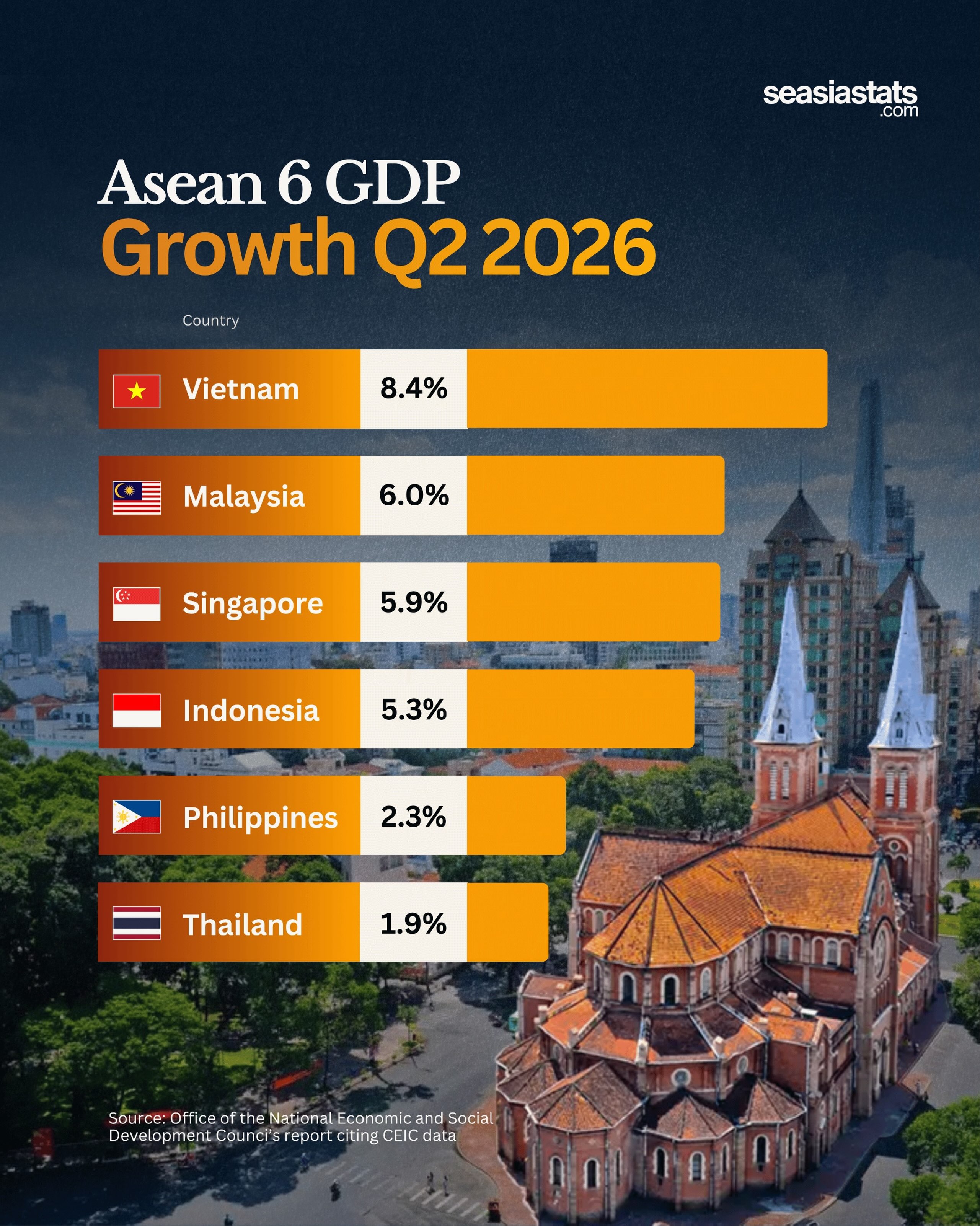
Southeast Asia’s economic performance in the second quarter of 2026 showed a clear divergence among its six major economies. Vietnam emerged as the fastest-growing economy, while Malaysia and Singapore also recorded strong expansions.
Indonesia maintained steady growth, whereas the Philippines and Thailand experienced considerably weaker momentum. Together, these figures highlight the different strengths and challenges facing the region.
Vietnam led the group with GDP growth of 8.4% year-on-year in Q2 2026. Official Vietnamese data put the increase at 8.39%, supported particularly by industry and construction, which grew 10.51%, while services expanded 7.87%. Manufacturing, investment, exports, and foreign direct investment continued to provide important support for economic activity.
Malaysia ranked second with approximately 6.0% growth. Strong external demand, particularly for semiconductors and technology-related products, helped boost exports.
Malaysia’s growing role as a regional data-center hub also benefited from rising demand connected to artificial intelligence. Domestic consumption and employment provided additional support, making the country one of Southeast Asia’s stronger performers.
Singapore followed closely, recording 5.9% year-on-year GDP growth. The country’s performance was strongly influenced by the global technology cycle, especially AI-related investment and semiconductor demand.
Manufacturing performed particularly well, helping Singapore’s economy expand despite geopolitical and supply-chain uncertainties. The government subsequently raised its 2026 growth forecast to 4.5%–5.5%.
Indonesia posted 5.3% growth, with official statistics showing a more precise rate of 5.29%. Government consumption was a major contributor, rising 15.97%, while electricity and gas recorded the fastest production-side growth. Indonesia therefore continued to demonstrate relatively stable domestic economic momentum.
At the lower end, the Philippines grew by only 2.3%, its slowest growth since 2021. Weak investment and construction activity, together with slower household spending, weighed on the economy, although education, trade, manufacturing, and exports provided some support.
Thailand recorded the weakest growth among the six at 1.9%, reflecting continued pressure from subdued domestic consumption, high household debt, and challenges affecting tourism and external demand.
Overall, Q2 2026 demonstrates that Southeast Asia is growing at different speeds. Vietnam’s manufacturing and trade strength, Malaysia and Singapore’s technology-driven expansion, and Indonesia’s resilient domestic economy contrast sharply with the slower recoveries of the Philippines and Thailand.
The region’s outlook will depend heavily on global trade, technology investment, domestic consumption, and geopolitical conditions during the remainder of 2026.