

Global Births in 2026: Asia and Africa Dominate the World’s Newborn Population
Asia and Africa would be responsible for more than 80% of the world's newborns in 2026.

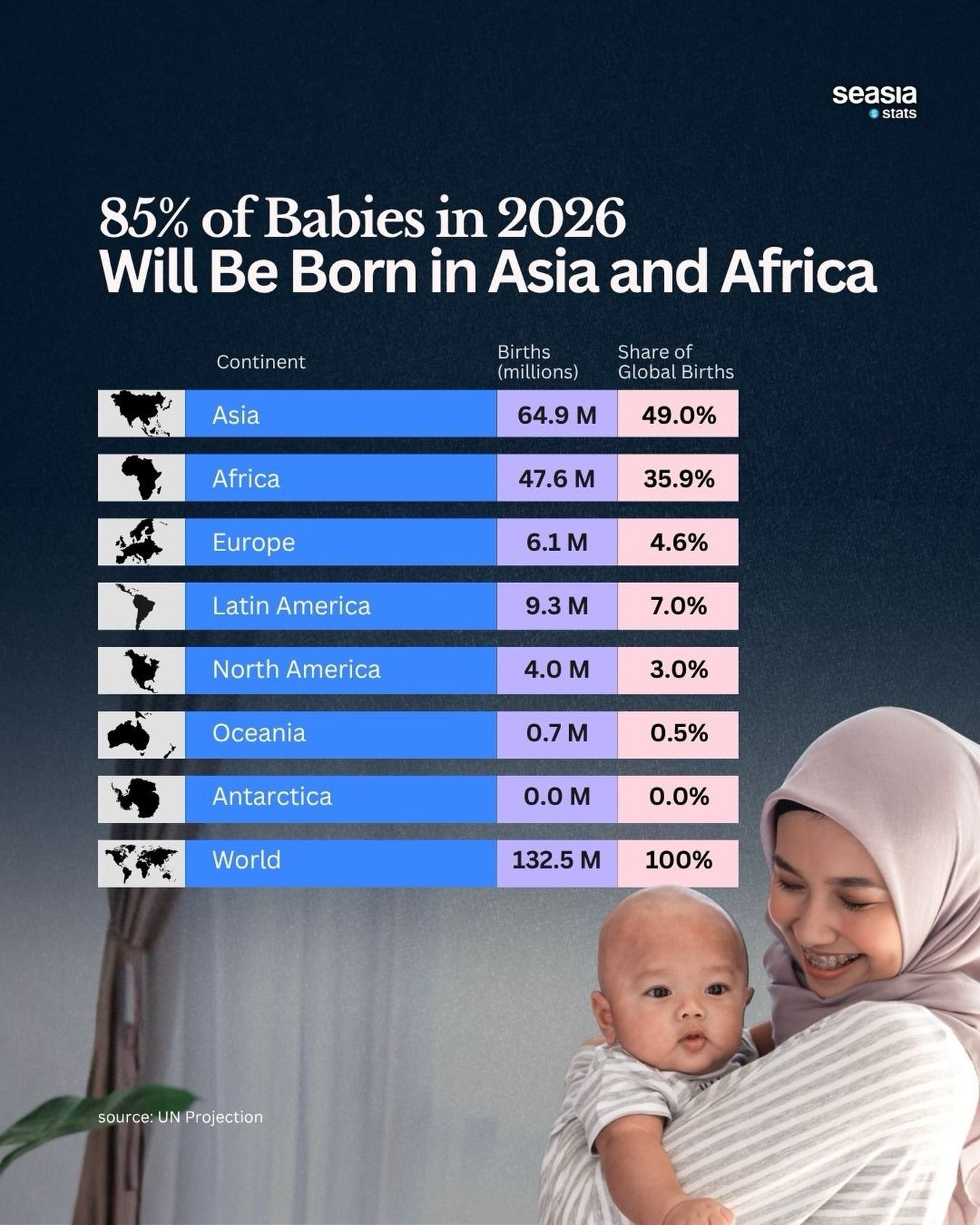
According to projections based on the United Nations World Population Prospects 2024, approximately 132.5 million babies are expected to be born worldwide in 2026.
The distribution of these births varies dramatically between continents, reflecting major differences in population size, age structure, and fertility rates. The United Nations’ World Population Prospects is its official population projection framework, covering 237 countries and areas and extending projections through 2100.
Asia is projected to have the largest number of births in 2026, with approximately 64.9 million, representing 49.0% of global births. This means that nearly one out of every two babies born around the world is expected to be born in Asia.
Although fertility has declined significantly in several Asian countries, the continent's enormous population means that it continues to account for the largest share of newborns.
Africa ranks second, with an estimated 47.6 million births, equivalent to 35.9% of all births worldwide. Together, Asia and Africa are therefore expected to account for about 84.9% of global births, or roughly five out of every six babies born in 2026.
Africa's large share is closely associated with its young population and comparatively high fertility levels. The United Nations expects many African populations to continue growing strongly over the coming decades.
The remaining continents account for much smaller portions of global births. South America is projected to record 9.3 million births, or 7.0% of the worldwide total. Europe follows with 6.1 million births, representing 4.6%. Europe's relatively small share reflects decades of declining fertility and population aging across many countries.
North America is expected to have approximately 4.0 million births, accounting for 3.0% of global births. Oceania contributes an estimated 0.7 million births, or 0.5%. Finally, Antarctica is projected to have 0.0 million births, representing effectively 0.0%, because it has no permanent resident population.
These figures illustrate a major shift in the geography of global population growth. While many developed regions are experiencing low birth rates and aging populations, Asia and particularly Africa continue to generate the majority of new births.
The pattern highlights the continuing importance of demographic change in shaping the world's future population, economies, and societies