

Global Distribution of Sovereign Nations by Continents
The world map may look fixed, but the way humanity divides it is anything but simple.

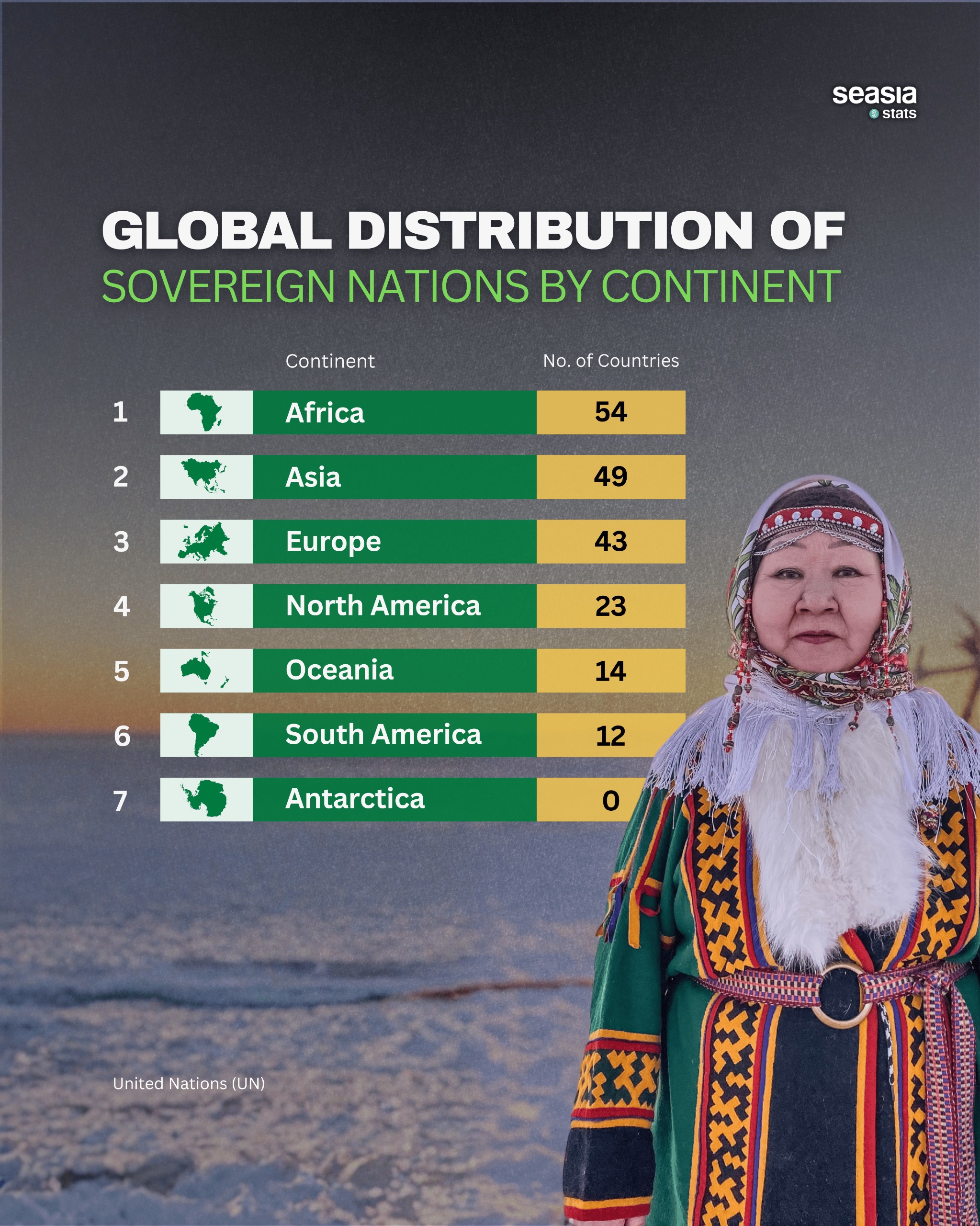
The world map may look fixed, but the way humanity divides it is anything but simple. Behind every border is a story—of colonial legacies, cultural identities, wars, negotiations, and the long pursuit of sovereignty. This global snapshot of sovereign nations by continent offers more than just numbers; it reveals how history has shaped the political geography we recognize today.
Where Most of the World’s Countries Are
At first glance, one pattern stands out clearly: Africa leads the world with 54 sovereign nations, followed by Asia with 49 and Europe with 43. Together, these three continents make up the overwhelming majority of independent states on Earth.
Africa’s high number reflects the legacy of decolonization in the mid-20th century, when dozens of nations emerged from European rule within a relatively short period. Many of today’s borders were drawn during that era, often without regard to ethnic or linguistic boundaries—something that continues to influence politics across the continent.
Asia, meanwhile, combines vast geographic scale with deep civilizational diversity. From the Middle East to Southeast Asia to East Asia, the continent’s 49 countries represent a mix of ancient states, post-colonial nations, and modern economic powers.
Europe’s 43 nations reflect a different kind of fragmentation—one shaped by centuries of shifting empires, wars, and evolving identities. As one analyst from the United Nations once noted, “Europe’s borders are a living archive of its history.”
The Americas and Oceania: Fewer but Larger States
Beyond these three regions, the numbers drop noticeably. North America has 23 countries, while South America has 12, and Oceania just 14.
This doesn’t mean these regions are less diverse—far from it. Instead, it reflects how land and governance are organized. In the Americas, particularly in South America, countries tend to be geographically larger, with vast territories consolidated into fewer states.
Oceania presents a different picture. While it has fewer countries overall, it includes many small island nations scattered across the Pacific. These states—such as Fiji, Samoa, and Vanuatu—play an outsized role in global discussions on climate change and maritime sovereignty despite their size.
Antarctica: The Continent Without Countries
Then there is Antarctica, the only continent with zero sovereign nations.
This is not an accident of geography, but a deliberate political choice. Governed under the Antarctic Treaty System, the continent is reserved for scientific research and peaceful cooperation. Territorial claims are effectively frozen, and no new sovereignty is recognized.
In a world defined by borders, Antarctica remains the exception—a rare example of international agreement overriding national ambition.
Southeast Asia’s Place in the Global Map
Within Asia’s 49 countries lies one of the most dynamic and diverse subregions: Southeast Asia.
Home to 11 countries, including Indonesia, Vietnam, Thailand, Malaysia, and the Philippines, the region reflects both fragmentation and unity. On one hand, it is politically divided into multiple sovereign states. On the other, it is connected through shared history, trade routes, and regional cooperation under ASEAN.
Indonesia, the world’s largest archipelagic state, alone consists of more than 17,000 islands—yet forms a single sovereign nation. Compare that with mainland Southeast Asia, where borders often follow colonial-era lines drawn by European powers.
The region’s diversity is also cultural and linguistic, making its political organization particularly complex. As noted in regional analyses, Southeast Asia is often described as “a crossroads of civilizations,” shaped by Indian, Chinese, Arab, and Western influences over centuries.
A World Defined by History, Not Just Geography
Ultimately, the distribution of countries across continents is not just about land—it is about history.
Why does Africa have so many nations? Why does South America have so few? Why does Antarctica have none? The answers lie in colonization, conflict, diplomacy, and global agreements.
These numbers remind us that sovereignty is not static. It is negotiated, contested, and constantly evolving. And as Southeast Asia continues to grow in economic and geopolitical importance, its place within this global map will only become more significant.
Because in the end, a “country” is more than a line on a map—it is a story of how people choose to define themselves in the world.