

Global Maritime Fleet by Flag of Registration in 2024
Liberia led the global maritime trade in 2024 with 408.4 million deadweight tons.

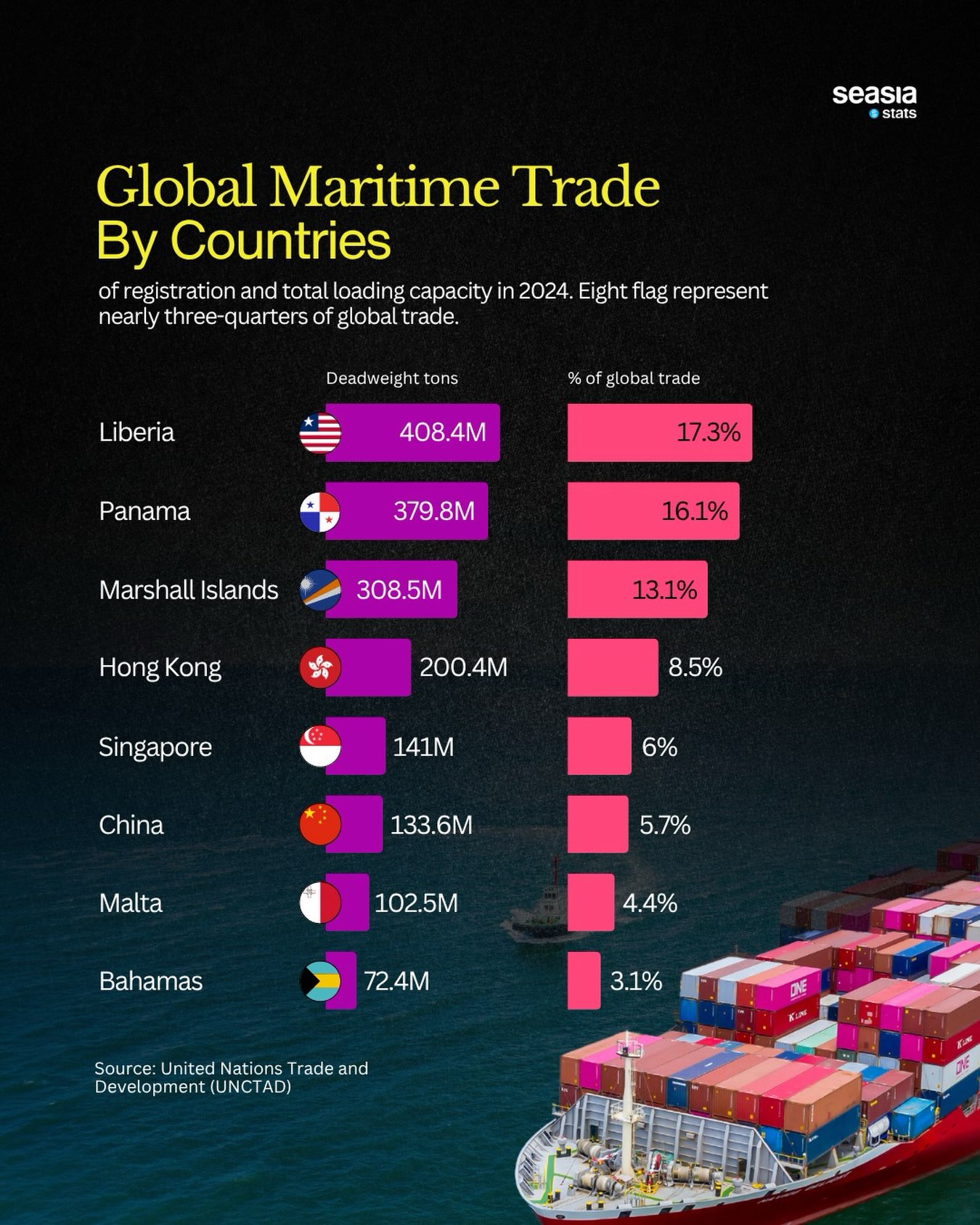
In 2024, the structure of the world’s merchant fleet continued to reflect the long-standing dominance of a handful of flag states, according to data from the United Nations Conference on Trade and Development (UNCTAD).
Measured by deadweight tonnage (DWT)—the total carrying capacity of ships—these registries play a central role in facilitating global seaborne trade, which moves the vast majority of international goods by volume.
Liberia led the rankings with a fleet of 408.4 million deadweight tons, equivalent to 17.3 percent of the global total. Close behind was Panama, with 379.8 million tons or 16.1 percent. The Marshall Islands ranked third at 308.5 million tons (13.1 percent).
Together, these three open registries alone accounted for nearly half of the world’s merchant fleet capacity. Their prominence stems from attractive regulatory, tax, and administrative frameworks that encourage shipowners from many countries to register vessels under these flags.
Hong Kong followed with 200.4 million tons (8.5 percent), while Singapore held 141 million tons (6 percent). China’s registered fleet stood at 133.6 million tons (5.7 percent), reflecting both its growing domestic shipping interests and the broader expansion of its maritime industry.
Malta contributed 102.5 million tons (4.4 percent), and the Bahamas 72.4 million tons (3.1 percent). Collectively, these eight flag states represented approximately 74 percent of global deadweight tonnage.
This concentration highlights the continued importance of open registries, often called flags of convenience, in the modern shipping industry. Shipowners seek efficient registration processes, competitive fees, and internationally recognized standards for safety and environmental compliance.
While the beneficial ownership of many vessels remains with companies in major trading nations such as Greece, China, Japan, and others, the flags under which they sail are frequently those of Liberia, Panama, or the Marshall Islands.
The distribution of fleet capacity has significant implications for global trade logistics, maritime safety regulation, and environmental oversight. UNCTAD’s figures underscore how a relatively small number of registries underwrite the physical capacity that keeps supply chains moving.
As world trade volumes evolve and pressures mount for greener shipping practices, the policies and performance of these leading flag states will remain closely watched by industry stakeholders, regulators, and trading nations alike.
These 2024 statistics confirm that the architecture of maritime transport continues to rest on a concentrated set of registries whose combined tonnage enables the bulk of international commerce.