

Global Transportation Usage, 2024
A recent study from The ABC of Mobility, published in Environment International 2024, provides a comprehensive look at global transportation trends, analyzing d

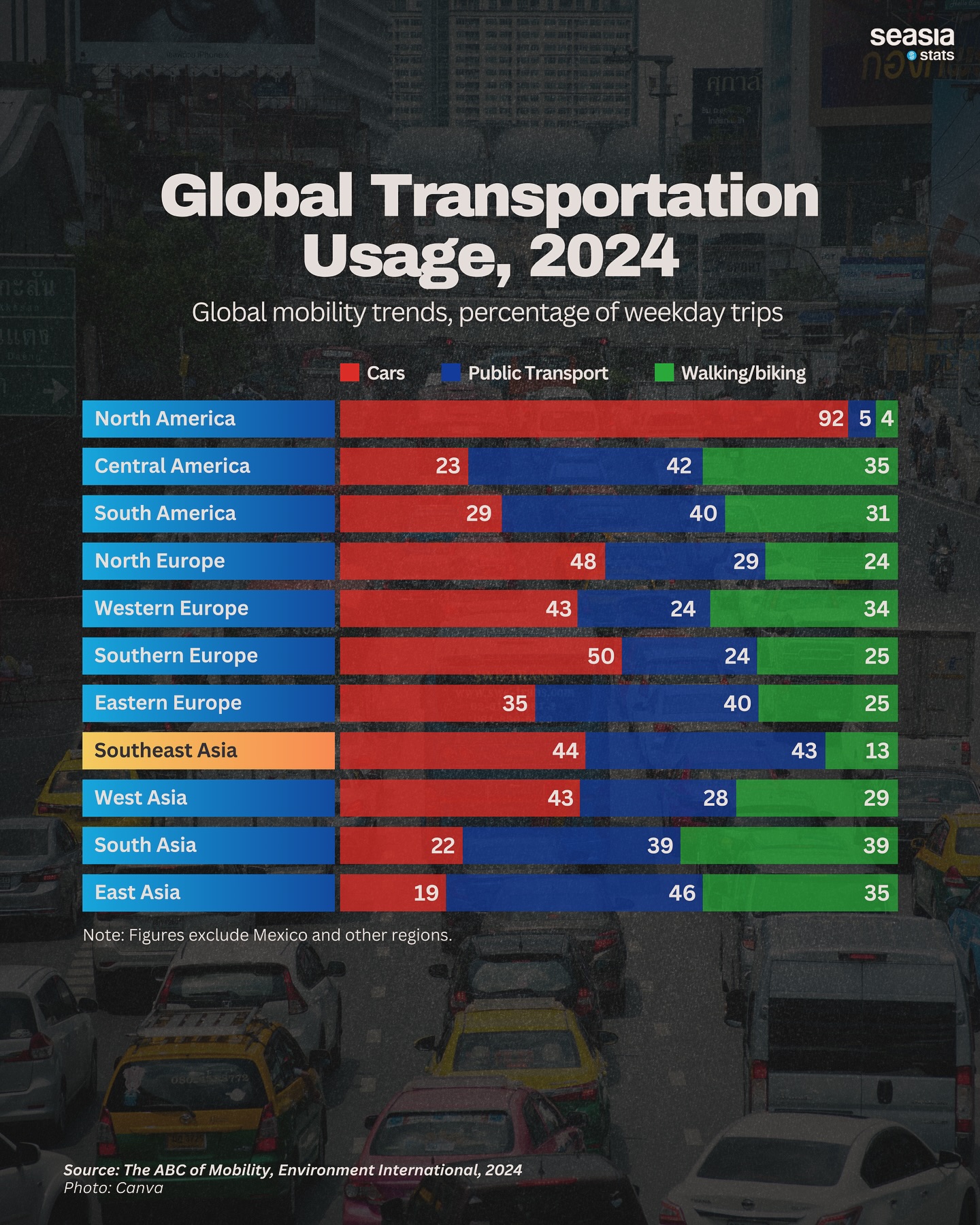
A recent study from The ABC of Mobility, published in Environment International 2024, provides a comprehensive look at global transportation trends, analyzing data from 800 cities across 61 countries. This research highlights the varying modes of transportation used for weekday commuting, revealing significant differences across regions. By categorizing transportation into three primary types—cars, public transport, and walking/cycling—the study offers insights into how different populations navigate their daily lives.
In Southeast Asia, the landscape of transportation usage reflects both urban development and cultural preferences. Car usage stands at 44%, with public transport closely trailing at 43%. Walking and biking account for a modest 13%. These figures indicate a relatively balanced reliance on both private and public transport, suggesting that while personal vehicles are prevalent, there is also significant use of public transportation systems.
Southeast Asia: A Closer Look at Transportation Modes
The high percentage of car usage in Southeast Asia can be attributed to rapid urbanization and economic growth, leading to increased car ownership. As cities expand and populations grow, many individuals opt for the convenience of personal vehicles, which provide flexibility in travel. However, this trend also raises concerns about traffic congestion and environmental sustainability, prompting discussions around better urban planning and public transport development.
On the other hand, the robust public transport system in many Southeast Asian cities reflects efforts to provide accessible commuting options. With an increasing focus on sustainability and reducing urban traffic, governments are investing in improving public transportation infrastructure. This commitment aims to encourage more residents to utilize buses, trains, and other forms of public transport, thereby alleviating some of the pressure caused by rising car usage.
Comparing Global Trends in Transportation
When comparing Southeast Asia to other regions, distinct patterns emerge. For instance, North America shows an overwhelming reliance on cars, accounting for 92% of weekday trips, with minimal public transport usage. In contrast, regions like Central and South America exhibit a stronger inclination towards public transport, with usage rates of 42% and 40%, respectively. These differences highlight the cultural and infrastructural factors that shape transportation habits worldwide.
In Europe, the trend varies significantly across subregions. Northern and Western Europe exhibit a notable balance between public transport and car usage, with public transport capturing a significant share of weekday commuting. This is indicative of well-established transit systems and a societal preference for sustainable transportation options. Meanwhile, regions like South Asia and East Asia show mixed results, with varying levels of reliance on public transport and personal vehicles.
Implications for Future Mobility
Understanding these transportation trends is crucial for policymakers and urban planners as they strive to create efficient, sustainable, and accessible transit systems. The insights from the ABC of Mobility study can inform decisions on infrastructure investments, public transport enhancements, and initiatives aimed at reducing car dependency.
As urban populations continue to grow, the need for effective transportation solutions becomes more pressing. Encouraging the use of public transport and non-motorized commuting options can significantly contribute to reducing traffic congestion, lowering emissions, and improving overall quality of life in urban areas. In Southeast Asia, as in many regions globally, the challenge lies in striking a balance between car usage and public transport accessibility, ensuring that the needs of all commuters are met while fostering sustainable mobility practices.