

GNI per Capita in Southeast Asian Countries and Their World Bank Income Classification
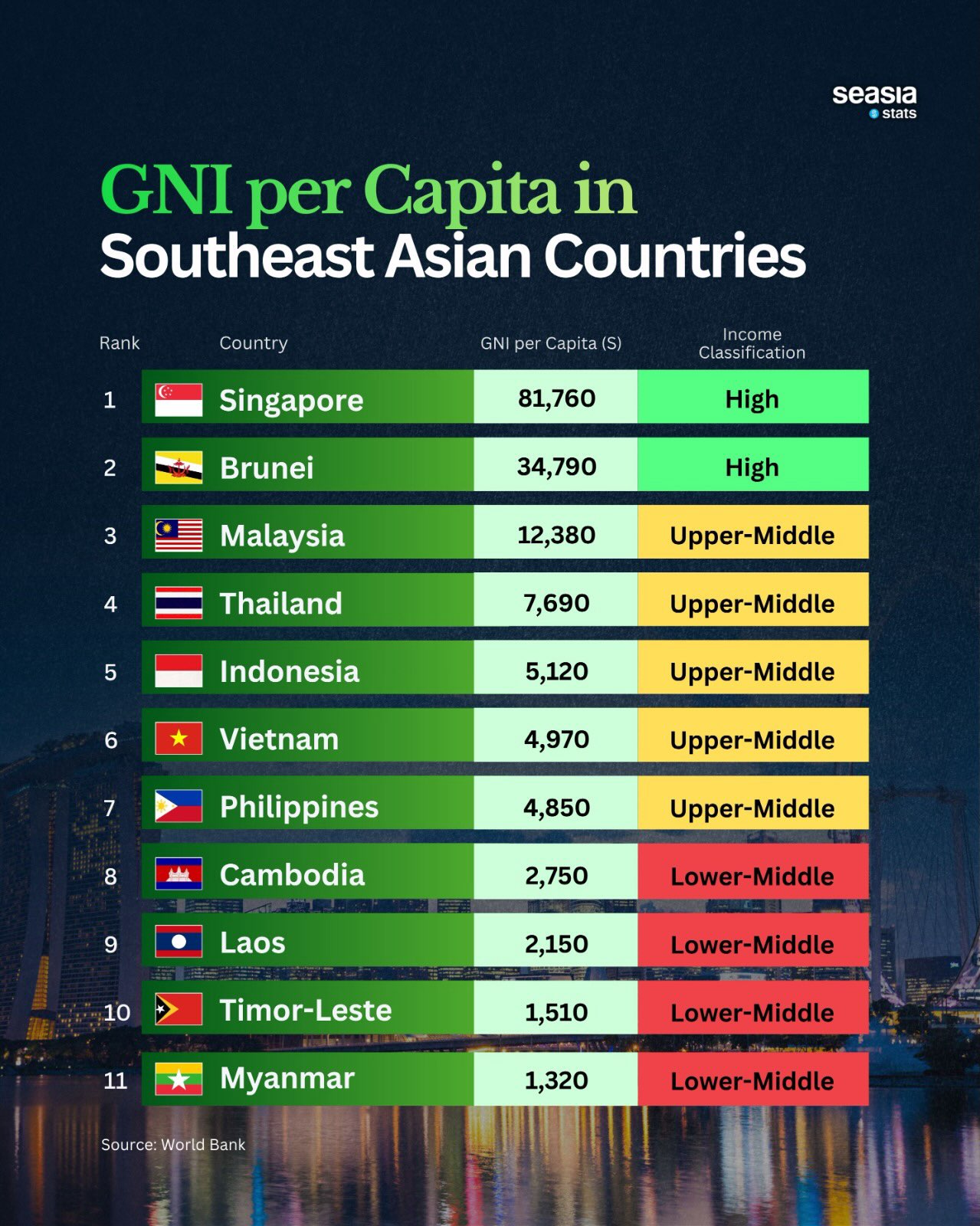
Singapore has the highest GNI in Southeast Asia, while Myanmar has the lowest.

Gross National Income (GNI) per capita is an important economic indicator that measures the average income earned by a country's residents in a year. Expressed in US dollars, it is widely used by the World Bank to classify economies into different income groups.
These classifications help governments, businesses, and international organizations better understand a country's level of economic development and living standards.
Among Southeast Asian countries, Singapore has the highest GNI per capita at US$81,760, placing it firmly in the high-income category. Its strong financial sector, advanced technology industries, and global trade connections contribute to its exceptional economic performance.
Brunei follows with a GNI per capita of US$34,790, which also qualifies as a high-income economy. The country's wealth is largely supported by its abundant oil and natural gas resources.
Several Southeast Asian nations fall into the upper-middle-income category. Malaysia records a GNI per capita of US$12,380, reflecting its diversified economy and well-developed manufacturing sector. Thailand follows with US$7,690, while Indonesia has US$5,120.
Vietnam reports US$4,970, and the Philippines closely follows at US$4,850. These countries have experienced sustained economic growth over recent decades, driven by industrialization, exports, foreign investment, and expanding domestic markets.
The remaining countries in the region are classified as lower-middle-income economies. Cambodia has a GNI per capita of US$2,750, followed by Laos at US$2,150.
Timor-Leste records US$1,510, while Myanmar has the lowest GNI per capita among the listed countries at US$1,320. Although these economies continue to face development challenges, many have made progress through investments in infrastructure, education, agriculture, and manufacturing.
Overall, Southeast Asia demonstrates considerable economic diversity, ranging from some of the world's wealthiest economies to countries that are still in earlier stages of development. The wide variation in GNI per capita reflects differences in industrial capacity, natural resources, governance, productivity, and economic structure.
While Singapore and Brunei have already achieved high-income status, several upper-middle-income countries continue striving toward that goal through economic reforms and innovation. Meanwhile, lower-middle-income countries are working to improve productivity, reduce poverty, and expand opportunities for their populations.
Understanding these differences provides valuable insight into the region's economic landscape and highlights both the achievements and the development potential of Southeast Asia.