

Head to Head: Largest Companies in Indonesia vs Malaysia (2026)
The latest market capitalization data from April 2026 highlights a clear shift in Southeast Asia’s corporate landscape. Indonesia has taken a commanding lead at

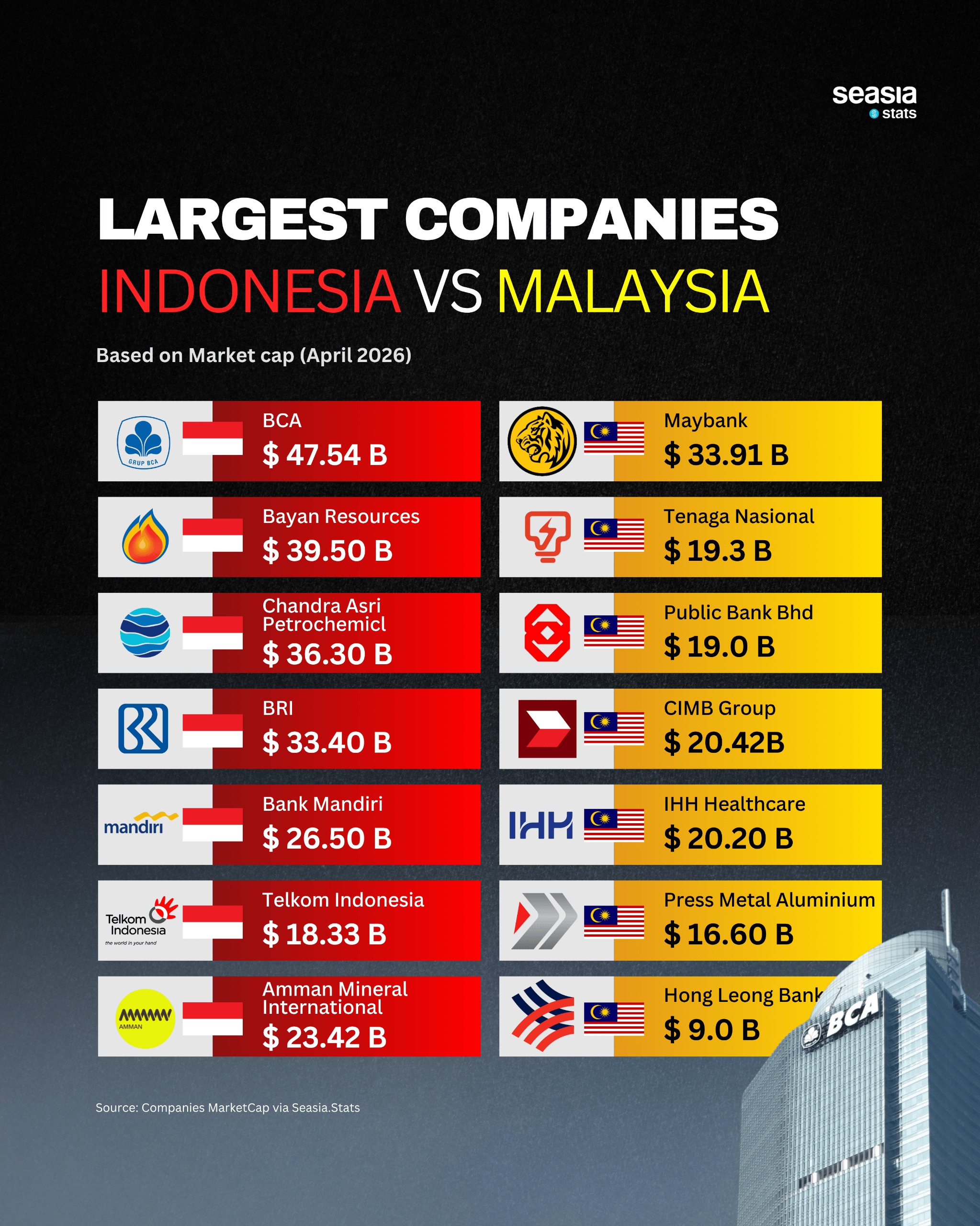
The latest market capitalization data from April 2026 highlights a clear shift in Southeast Asia’s corporate landscape. Indonesia has taken a commanding lead at the top, with its largest companies outperforming their Malaysian counterparts in overall valuation and dominance in key sectors.
Bank Central Asia stands as the most valuable company in the comparison, reaching a market capitalization of 47.54 billion dollars. It is followed by Bayan Resources at 39.50 billion and Chandra Asri Petrochemical at 36.30 billion. This places Indonesia firmly in control of the top three positions, supported by strong performances in banking, energy, and resource-based industries. Other major Indonesian players such as BRI, Bank Mandiri, Amman Mineral International, and Telkom Indonesia further reinforce the country’s depth across sectors.
Malaysia presents a solid but comparatively lower tier of corporate valuations. Maybank leads its group with 33.91 billion dollars, followed by CIMB Group and IHH Healthcare, both slightly above 20 billion dollars. Companies like Tenaga Nasional, Public Bank, and Press Metal Aluminium maintain stable positions, reflecting Malaysia’s strength in financial services, utilities, and industrial sectors. However, none of these firms reach the valuation levels seen at the top of Indonesia’s list.
The contrast reveals a structural difference in growth drivers. Indonesia benefits from a combination of large domestic demand and strong commodity exposure, which continues to lift valuations. Malaysia, on the other hand, shows consistency in services and finance, but with less momentum in scaling to the highest market cap levels.
Current data indicates that Indonesia holds the upper hand in the regional hierarchy of corporate giants. Future shifts will likely depend on commodity cycles, regional expansion strategies, and how both countries adapt to changing global economic conditions.