

How Chess Pieces Are Called in Southeast Asia
Chess pieces have different names in Southeast Asian countries.

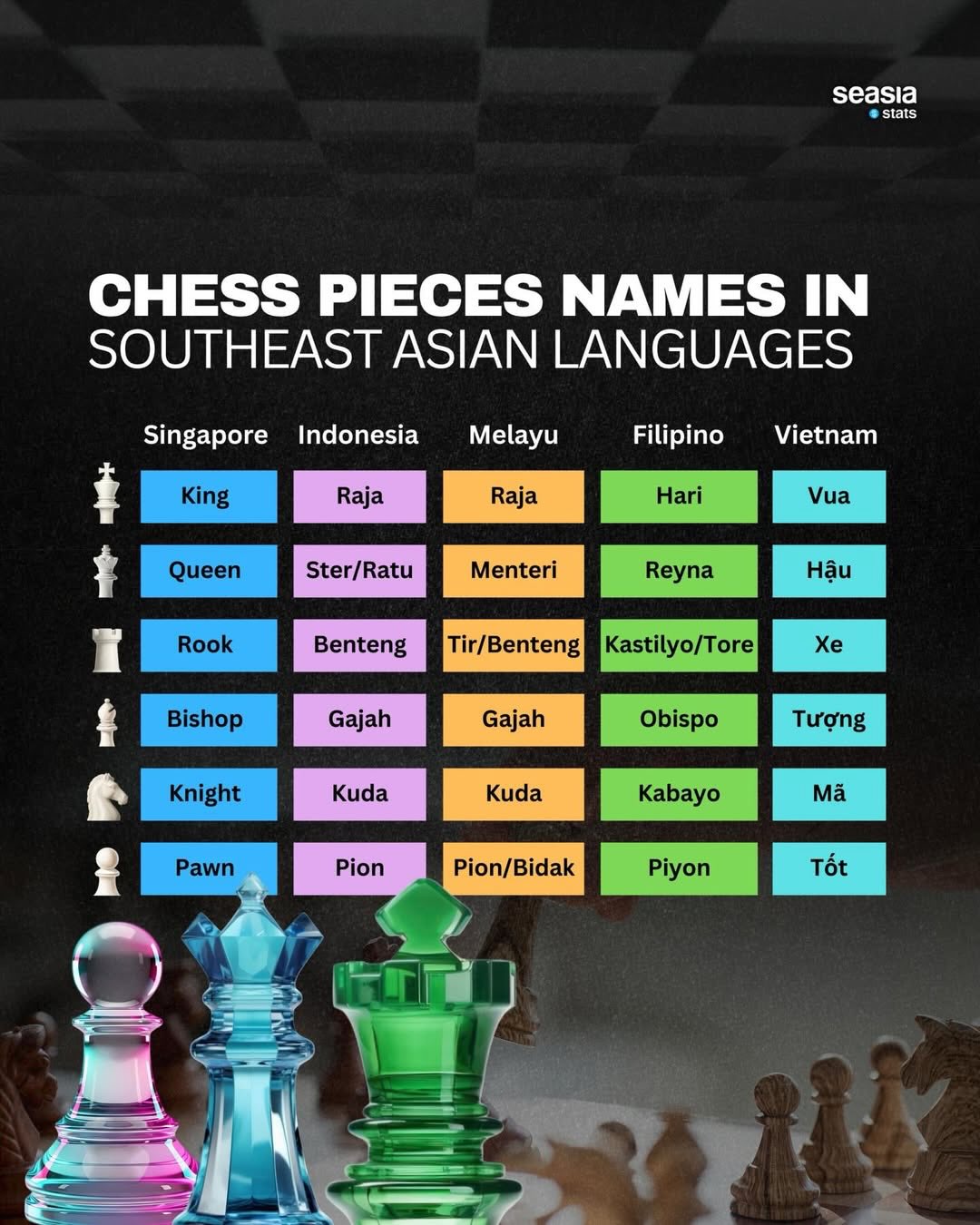
Chess is played throughout Southeast Asia, but the names of the pieces often reflect each country’s language, history, and cultural influences. Although the rules of international chess remain the same, the terminology used for the pieces can vary greatly from one nation to another.
A comparison of Singapore, Indonesia, Malaysia, the Philippines, and Viet Nam shows how local languages and historical experiences shape the vocabulary of chess.
In Singapore, English is widely used, so the chess pieces are generally called king, queen, rook, bishop, knight, and pawn. These names follow the standard English terminology used in international tournaments and chess literature.
Because Singapore has strong historical connections to the British education system, English chess terms became dominant and remain the most common today.
Indonesia uses a mixture of local and adapted foreign terms. The king is called “raja,” which directly means king in Indonesian. The queen is known as “ster,” while the rook is called “benteng,” meaning fortress or castle.
The bishop is uniquely called “peluncur,” which can be translated as launcher or glider, giving the piece a more dynamic image. The knight is “kuda,” meaning horse, and the pawn is “pion,” a loanword similar to the European term “pawn.”
Malaysia shares several similarities with Indonesia because both countries use related Malay languages. The king is also called “raja,” while the queen becomes “menteri,” meaning minister or advisor. The rook may be called either “tir” or “benteng.”
The bishop is especially interesting because Malaysians often call it “gajah,” meaning elephant, reflecting regional influences from traditional Asian chess games where elephant-like pieces are common. The knight is “kuda,” and the pawn is called either “pion” or “bidak.”
In the Philippines, Spanish colonial history strongly influenced chess terminology. The king is “hari,” and the queen is “reyna,” directly derived from the Spanish word “reina.” The rook is called “kastilyo” or “tore,” both connected to the idea of a castle or tower.
The bishop is “obispo,” meaning bishop in Spanish, while the knight is “kabayo,” meaning horse. The pawn is “piyon,” another term with Spanish roots.
In Viet Nam, chess vocabulary reflects Sino-Vietnamese linguistic traditions. The king is “vua,” the queen “hau,” the rook “xe,” the bishop “tuong,” the knight “ma,” and the pawn “tot.” Many of these terms resemble names used in Chinese-influenced strategy games, demonstrating how regional history and cultural exchange shaped Vietnamese chess language.
Overall, chess piece names in Southeast Asia reveal a fascinating blend of local traditions, colonial influence, and regional identity.