

How Do Asians View Life After Death?
In Asia, the view on life after death vary with Bangladeshi believe it the most and Chinese the less.

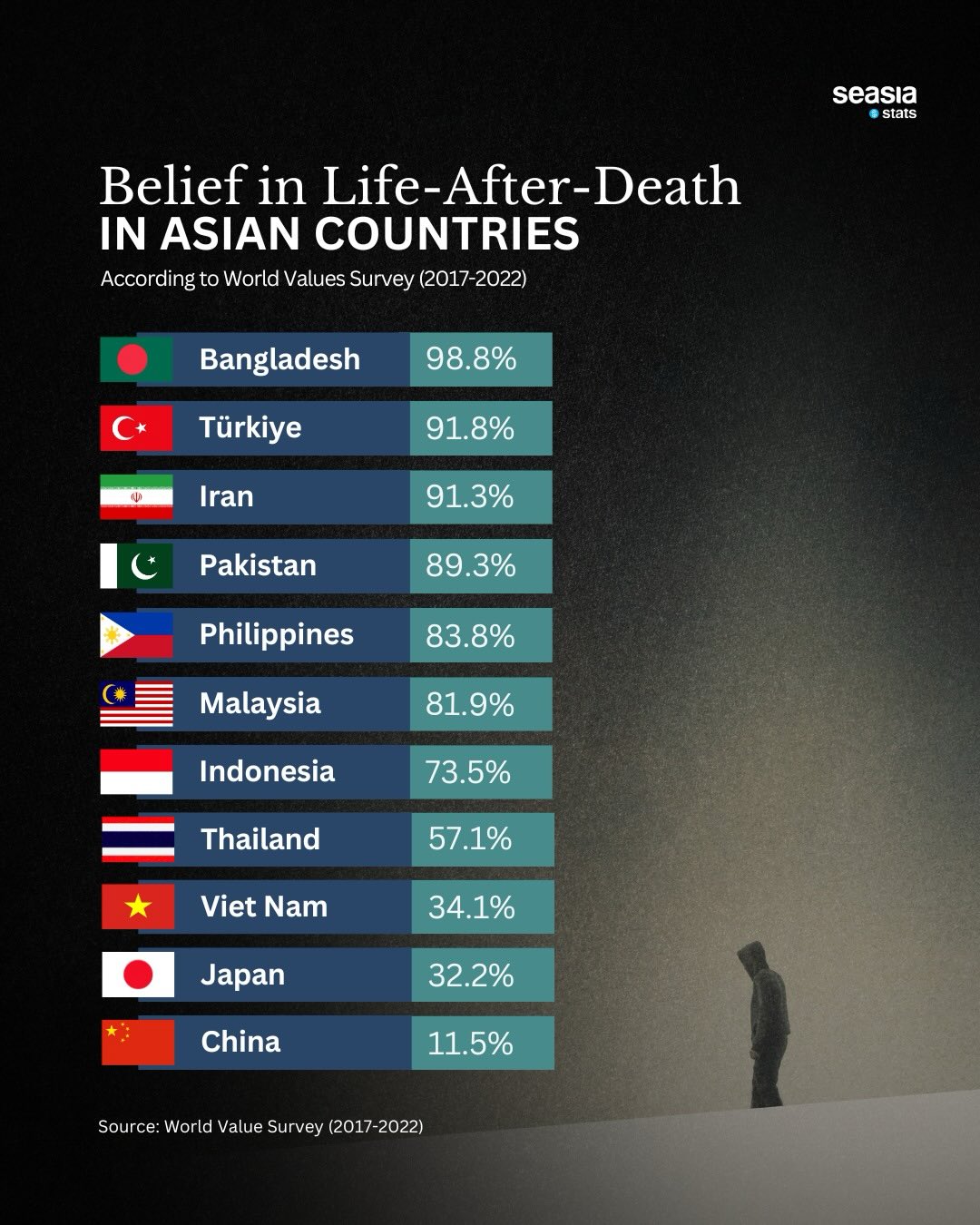
Belief in life after death remains an important part of spiritual and cultural life across Asia, although the level of belief differs greatly from one country to another.
According to data from the World Values Survey conducted between 2017 and 2022, some Asian societies show nearly universal belief in an afterlife, while others are far more secular in outlook. These differences are shaped by religion, history, education, and social traditions.
Bangladesh records the highest level of belief in life after death in Asia, with 98.8% of respondents expressing belief in an afterlife. The country’s strong Islamic traditions and deeply religious society contribute to this overwhelming figure.
Turkey follows with 91.8%, while Iran stands close behind at 91.3%. In all three countries, religion plays a central role in public and private life, and belief in the afterlife is closely connected to Islamic teachings. Pakistan also shows a very high percentage at 89.3%, reflecting similar religious and cultural influences.
In Southeast Asia, belief in life after death also remains widespread. The Philippines records 83.8%, influenced largely by Christianity and Catholic traditions introduced during the Spanish colonial era.
Malaysia follows with 81.9%, while Indonesia, the world’s largest Muslim-majority country, records 73.5%. These figures show that spiritual beliefs continue to be significant even in rapidly modernizing societies.
Thailand presents a more moderate figure at 57.1%. Although Buddhism strongly shapes Thai culture, Buddhist interpretations of rebirth and reincarnation may influence how people respond to questions about “life after death.”
Viet Nam records 34.1%, while Japan stands at 32.2%. In both countries, modernization, secular education, and less formal religious affiliation may help explain the lower percentages. However, cultural traditions related to ancestors and spirituality still remain important in daily life.
China records the lowest level among the countries listed, with only 11.5% of respondents believing in life after death. Decades of state-promoted secularism and atheism have contributed to lower levels of formal religious belief. Nevertheless, traditional practices related to ancestors and spirituality continue in many communities.
Overall, the World Values Survey highlights the remarkable diversity of Asia’s spiritual landscape. While belief in life after death remains central in many Muslim and Christian societies, more secular countries in East Asia tend to show lower levels of belief, reflecting different historical and cultural paths.