

How Long Do Asians Sleep?
The Chinese sleep the longest in Asia, while the South Koreans sleep the shortest.

Sleep is essential for physical health, mental well-being, concentration, and overall quality of life. Across Asia, sleep duration varies according to work schedules, lifestyle habits, cultural practices, and living environments.
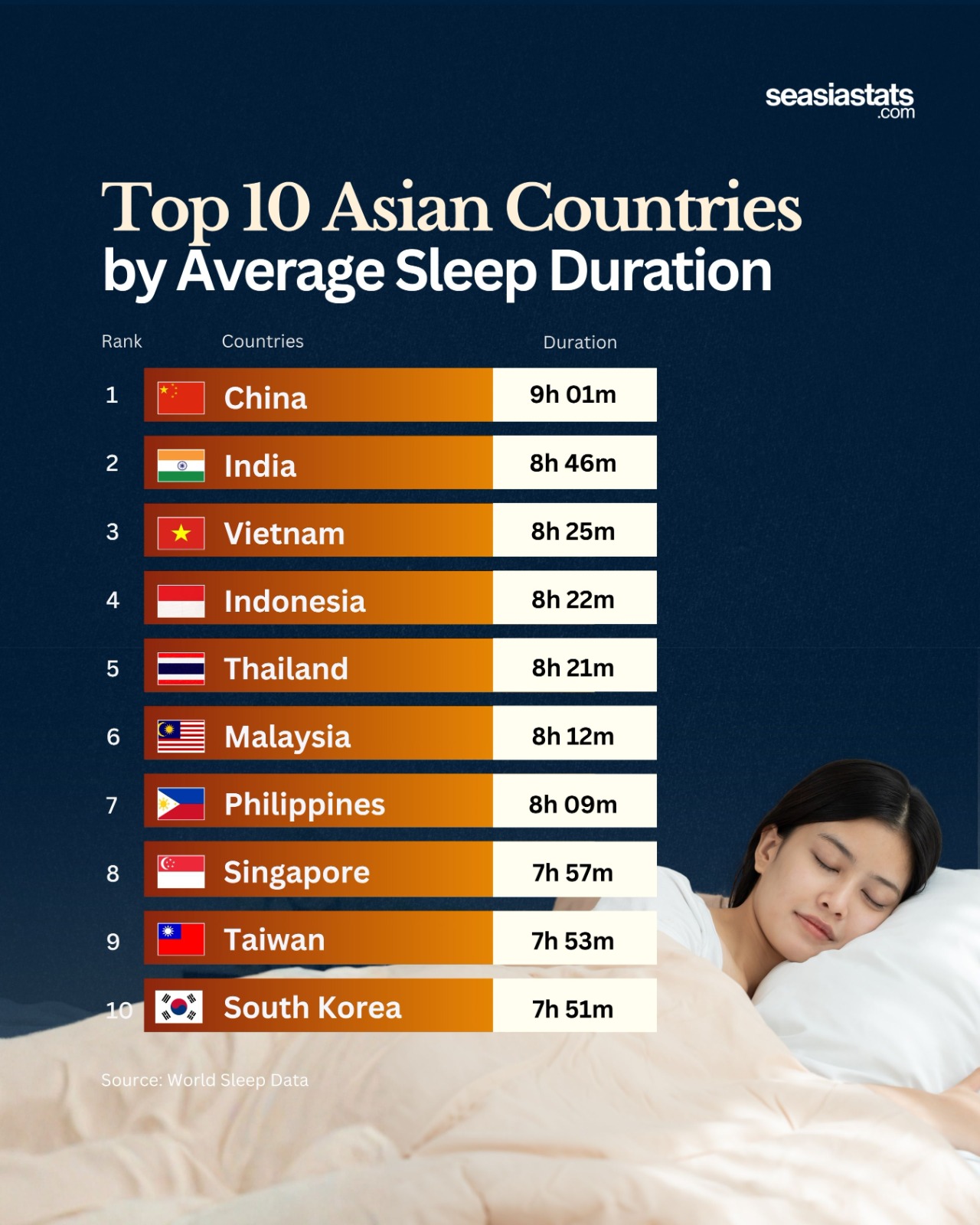
According to World Sleep Data, the reported sleep durations across ten Asian countries and territories reveal interesting differences, with China recording the longest average sleep duration and South Korea ranking tenth among the entries.
China ranks first, with an average sleep duration of 9 hours and 1 minute. This figure places China at the top of the ranking, suggesting that its reported sleep duration exceeds those of the other countries listed. However, the amount of sleep people obtain can vary considerably depending on age, occupation, and daily routines.
India occupies second place, with an average of 8 hours and 46 minutes. Its large and diverse population encompasses a wide range of sleeping patterns shaped by working conditions, family responsibilities, and regional lifestyles. Vietnam ranks third, recording 8 hours and 25 minutes of sleep per day.
Indonesia follows closely in fourth place, with an average of 8 hours and 22 minutes. Sleep is an important aspect of well-being in the country, where daily schedules differ between urban centers, rural communities, and various occupational groups. Thailand ranks fifth, with 8 hours and 21 minutes, just one minute behind Indonesia.
Malaysia occupies sixth place, recording an average sleep duration of 8 hours and 12 minutes. Its position reflects the variety of lifestyles across the country, where work demands and personal routines may influence sleeping patterns. The Philippines follows in seventh place, with 8 hours and 9 minutes.
Singapore ranks eighth, with an average of 7 hours and 57 minutes. As a highly urbanized city-state, Singapore faces many of the scheduling pressures associated with modern working life. Nevertheless, individual sleep patterns vary, and national averages cannot explain the experiences of every resident.
Taiwan takes ninth place, with 7 hours and 53 minutes, while South Korea completes the top ten with 7 hours and 51 minutes. Both societies have demanding educational and professional environments, although it would be inaccurate to attribute their reported sleep durations to work or study pressures alone without further evidence.
Overall, the World Sleep Data figures show a difference of 1 hour and 10 minutes between China, the highest-ranked entry, and South Korea, the lowest-ranked entry.
The results provide a useful comparison of reported sleep durations across Asia, but the figures should be interpreted in light of the underlying data collection methods and population samples. They should not automatically be treated as nationally representative measurements without further methodological information.
Ultimately, sleep quality matters alongside duration. Maintaining consistent sleep schedules, creating comfortable sleeping environments, and allowing sufficient time for rest can support better health and daily performance across the region.