

How Many Southeast Asian Senior National Team Players Are Competing Overseas?
Indonesia leads in Southeast Asia with nine players competing abroad.

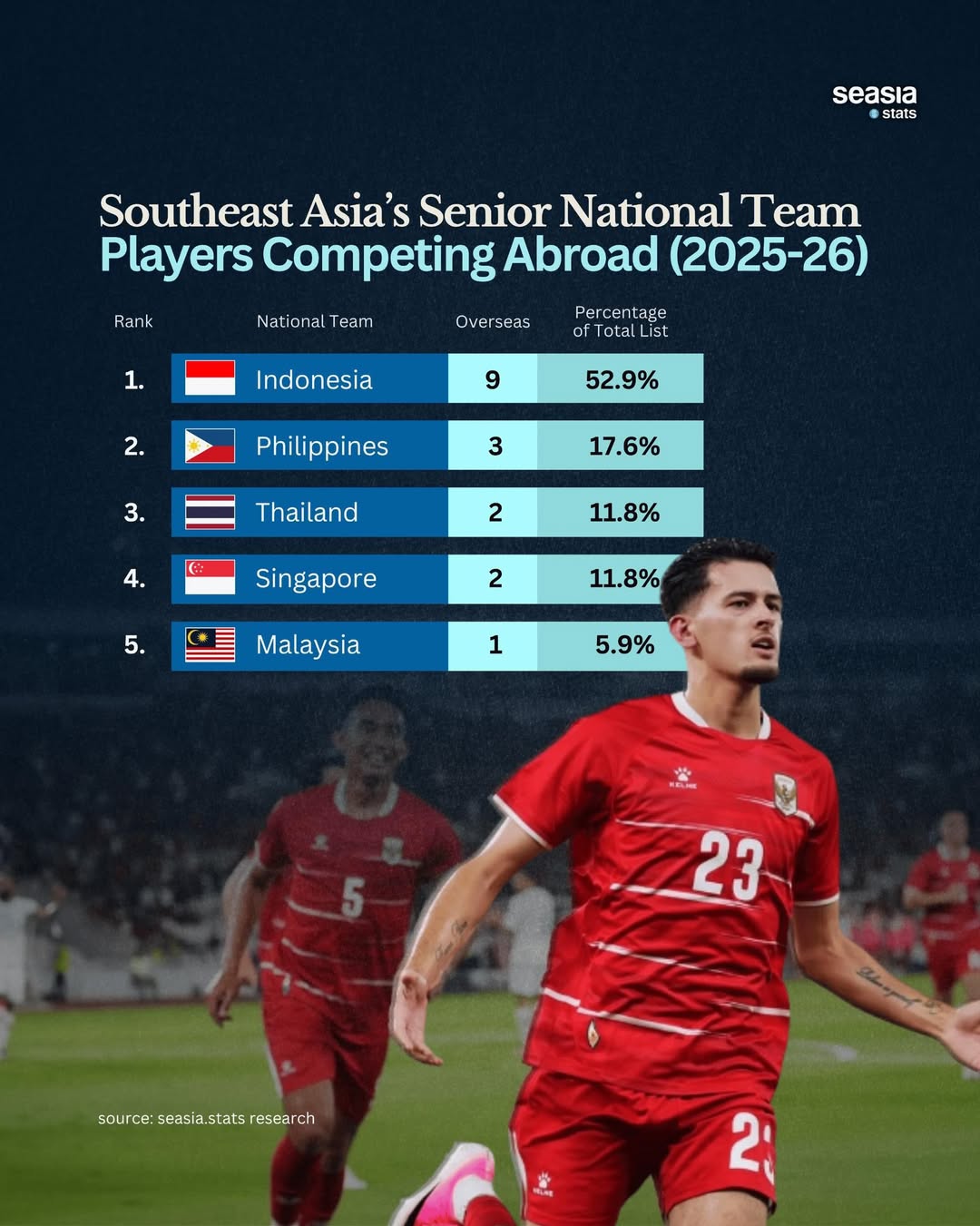
The 2025–2026 period highlights a growing trend in Southeast Asian football: more senior national team players are building their careers abroad. Playing in foreign leagues provides valuable experience, exposes players to higher levels of competition, and often contributes to the overall improvement of national teams.
Among Southeast Asian nations, Indonesia has emerged as the clear leader in this category, accounting for more than half of the region’s overseas-based senior internationals.
Based on the latest data, Indonesia has 9 senior national team players competing abroad, representing 52.9% of the total overseas-based players from the four leading Southeast Asian nations. This dominant share reflects Indonesia’s increasing success in placing players in European and other international leagues.
The presence of players competing in countries such as the Netherlands, Italy, and Belgium has strengthened the national team’s competitiveness and raised the profile of Indonesian football on the continental stage.
The Philippines ranks second with 3 players, accounting for 17.6% of the total. The country has long benefited from a large diaspora community, allowing Filipino players to develop in football environments outside Southeast Asia. Overseas experience continues to be an important component of the Philippine national team’s development strategy.
Thailand occupies third place with 2 players, representing 11.8%. While Thailand possesses one of the strongest domestic leagues in the region, a select number of national team players continue to seek opportunities abroad to gain additional experience and compete at higher levels.
This balance between domestic development and overseas exposure remains a key feature of Thai football.
Singapore also records 2 overseas-based senior internationals, matching Thailand’s total and percentage share of 11.8%.
While Singapore’s football ecosystem remains relatively small compared to some of its regional neighbors, the presence of players in foreign leagues demonstrates a growing ambition to seek higher levels of competition and professional development outside the country.
Malaysia follows with 1 player, equivalent to 5.9% of the total. Although the number is relatively small, Malaysian football has increasingly explored pathways for players to gain international experience, particularly through heritage and overseas-based talent pools.
Overall, the distribution of overseas-based senior national team players demonstrates Indonesia’s growing influence in Southeast Asian football. With 52.9% of the total, Indonesia holds a significant advantage over its regional rivals.
As more players pursue opportunities abroad, the quality and competitiveness of Southeast Asian football are expected to continue improving, strengthening the region’s presence in Asian and international competitions.