

How Many Southeast Asians Are Living Abroad?
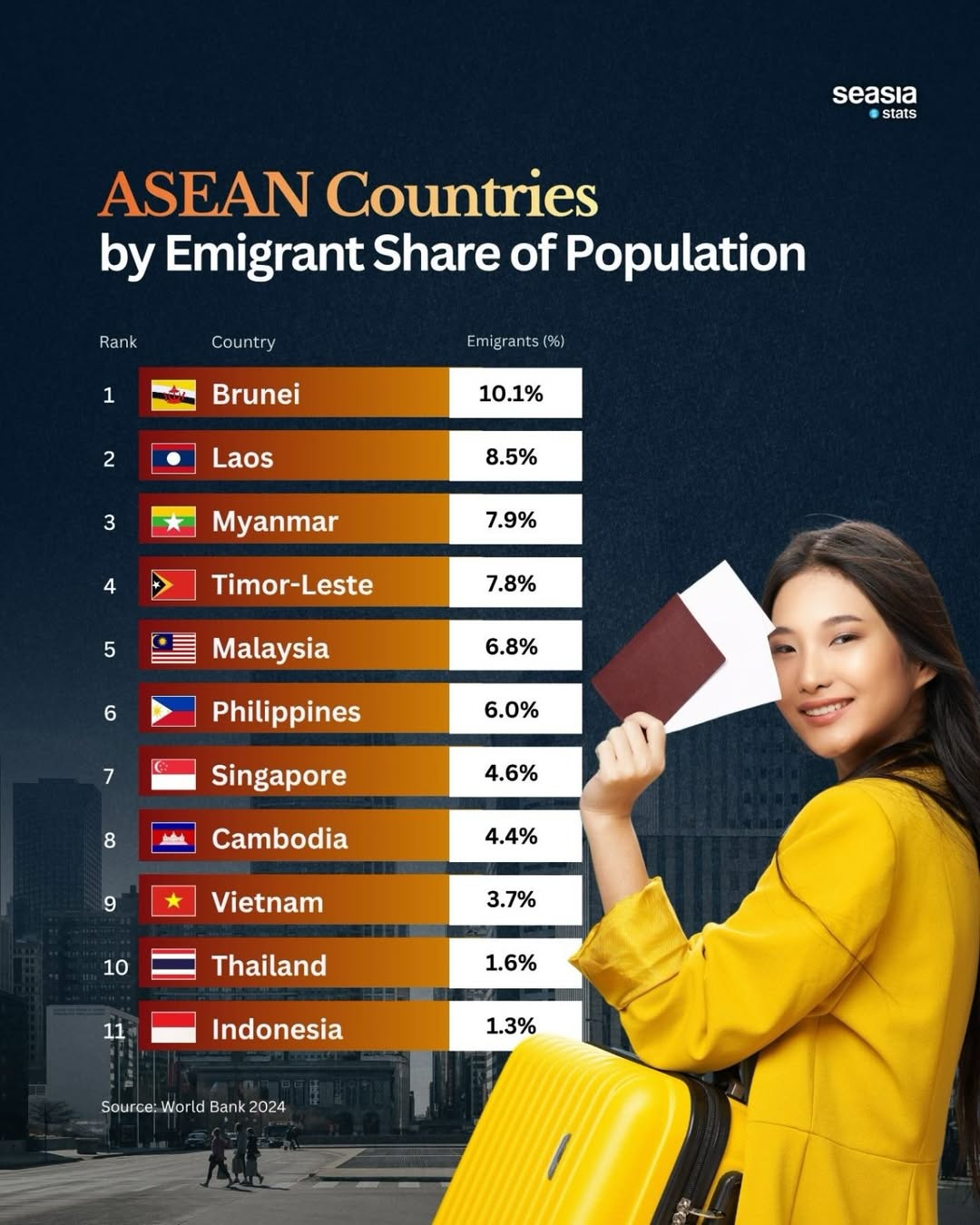
Brunei has the highest percentage of emigrants across Southeast Asia.

Migration has long played an important role in shaping the economies and societies of Southeast Asia. While many countries in the region attract foreign workers and investors, millions of Southeast Asians also choose to live and work abroad.
The percentage of emigrants—people residing outside their country of birth—varies significantly across the region, reflecting differences in economic opportunities, labor markets, demographics, and historical migration patterns.
Among Southeast Asian nations, Brunei has the highest proportion of emigrants, with 10.1% of its population living abroad. Despite its high income levels, Brunei's relatively small population contributes to a higher share of citizens and residents seeking educational, professional, or personal opportunities overseas.
Laos ranks second with 8.5% of its population living abroad. Cross-border migration has long been a feature of Lao society, particularly to neighboring countries where employment opportunities may be more abundant.
Myanmar follows closely at 7.9%, reflecting decades of labor migration driven by economic factors, political instability, and the search for better livelihoods.
Timor-Leste records an emigration rate of 7.8%. As one of Southeast Asia's youngest nations, many citizens have pursued work, education, and employment opportunities overseas, contributing to a significant diaspora population.
Malaysia, with an emigration rate of 6.8%, has a substantial number of citizens living abroad, particularly in neighboring countries and major global economic centers. Many Malaysians seek educational advancement, professional careers, and business opportunities overseas.
The Philippines is well known for its global diaspora, with 6.0% of its population residing abroad. Overseas Filipino workers play a vital role in the country's economy through remittances, which support millions of households and contribute significantly to national income.
Singapore, despite being a major destination for international migrants, has an emigration rate of 4.6%. Many Singaporeans pursue careers, education, and international experiences in countries around the world while maintaining strong ties to their homeland.
Cambodia and Vietnam record emigration rates of 4.4% and 3.7%, respectively. In both countries, migration has been influenced by economic development, labor opportunities, and family connections abroad.
At the lower end of the spectrum are Thailand and Indonesia, with emigration rates of 1.6% and 1.3%, respectively. Their large populations and expanding domestic economies provide opportunities that reduce the relative proportion of citizens seeking permanent residence abroad.
Overall, these figures highlight the diverse migration experiences across Southeast Asia. While the motivations differ from country to country, emigration remains an important force connecting the region to the wider global economy and society.