

How Many Times Do You Say "I Love You" In A Week?
Love may be universal, but the way people say it is anything but.

Love may be universal, but the way people say it is anything but. In some cultures, “I love you” is spoken easily and often—woven into daily routines, family life, and romance. In others, love is communicated more quietly, through loyalty, food, presence, sacrifice, or simply showing up. That is what makes this ranking so fascinating: it is not really just about words, but about culture.
The Philippines Leads, and Southeast Asia Speaks Loudly
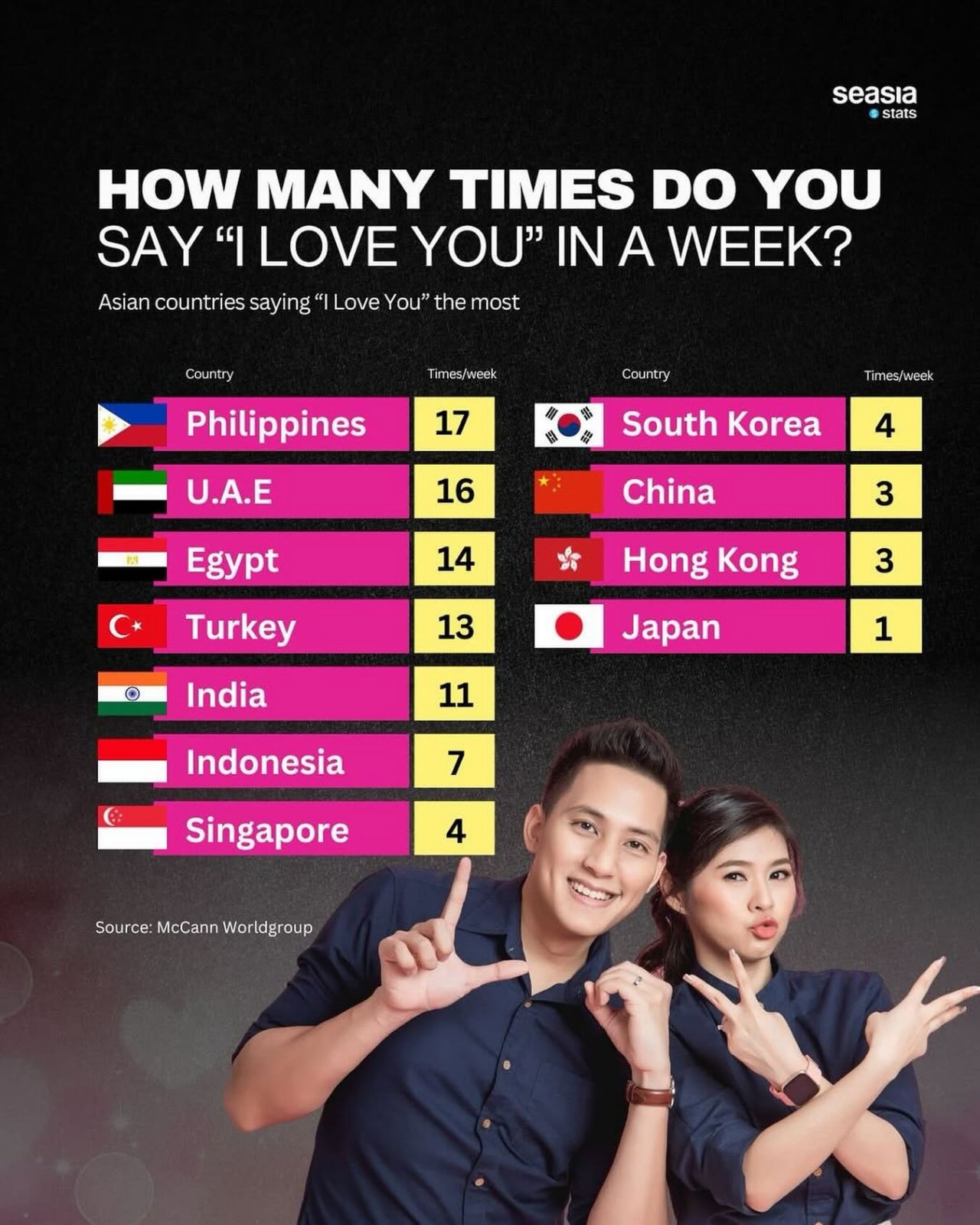
According to the Seasia Stats infographic based on McCann Worldgroup data, the Philippines tops the list among the selected Asian countries, with people saying “I love you” 17 times per week on average. That places it not just at the top of Southeast Asia, but at the top of the entire chart.
It is not especially surprising. Filipino culture is known for emotional openness, close family ties, and expressive communication. Affection is often verbal, visible, and deeply embedded in everyday life—from parents and siblings to partners and close friends. In many Filipino households, warmth is not implied; it is spoken.
Indonesia also ranks relatively high at 7 times per week, placing it well above several East Asian societies. That says something important about Southeast Asia: while the region is culturally diverse, it often places strong value on relational closeness and emotional interdependence. People may not always be demonstrative in the same way, but affection tends to remain central to social life.
Singapore, by contrast, records 4 times per week, tying with South Korea. That lower number does not necessarily mean Singaporeans are less loving. It may simply reflect a more restrained communication style shaped by urban pace, multilingual social codes, and a culture that often prizes emotional moderation over overt sentiment.
Not All Love Is Spoken the Same Way
The deeper story behind this ranking is that “I love you” is not equally weighted across cultures. In some places, saying it often feels natural. In others, saying it too often can feel excessive, awkward, or even insincere.
A widely cited cross-cultural study published in the International Journal of Intercultural Relations found that the phrase “I love you” fluctuates greatly across cultures, with some societies reserving it for romantic declarations and others using it much more broadly.
That helps explain why Japan, which ranks last at 1 time per week, should not be interpreted as emotionally cold. In Japanese culture, love is often understood as something shown through consistency, devotion, and quiet acts of care rather than repeated verbal declaration. One cultural explainer puts it simply: direct verbal confession is often considered less important than “showing love through actions, understanding, and mutual support.”
The same pattern often appears elsewhere in East Asia. China and Hong Kong, both at 3 times per week, and South Korea at 4, reflect cultures where affection may be felt deeply but spoken more selectively.
Southeast Asia’s Emotional Style Is Distinct
What makes Southeast Asia interesting in this conversation is that it often sits between Western-style verbal expressiveness and East Asian indirectness.
In the Philippines, love is often spoken. In Indonesia, it is frequently spoken but also reinforced through care, service, and family obligation. In Singapore, affection may be less verbally frequent, but emotional closeness still exists in practical and culturally coded forms. Across the region, one truth stands out: love is rarely absent—it is simply translated differently.
That also means comparisons should be handled carefully. A country where people say “I love you” less often is not necessarily less affectionate. It may simply use different emotional grammar.
What This Ranking Really Reveals
This chart is less a scoreboard of romance than a snapshot of how societies imagine intimacy. Some cultures speak love out loud. Others prefer to prove it. Some treat “I love you” as an everyday reassurance; others save it for rare, weighty moments.
Southeast Asia, especially the Philippines and Indonesia, reminds us that affection can still be openly spoken in a world that is increasingly hurried and emotionally guarded. And perhaps that is the quiet lesson here: sometimes, what sounds small—three words repeated through the week—can say a great deal about how a society connects, comforts, and cares.