

How Many Working Years Needed to Buy a House in Southeast Asia?
Malaysia has the most affordable houses in Southeast Asia with only 8.8 working years needed to buy one.

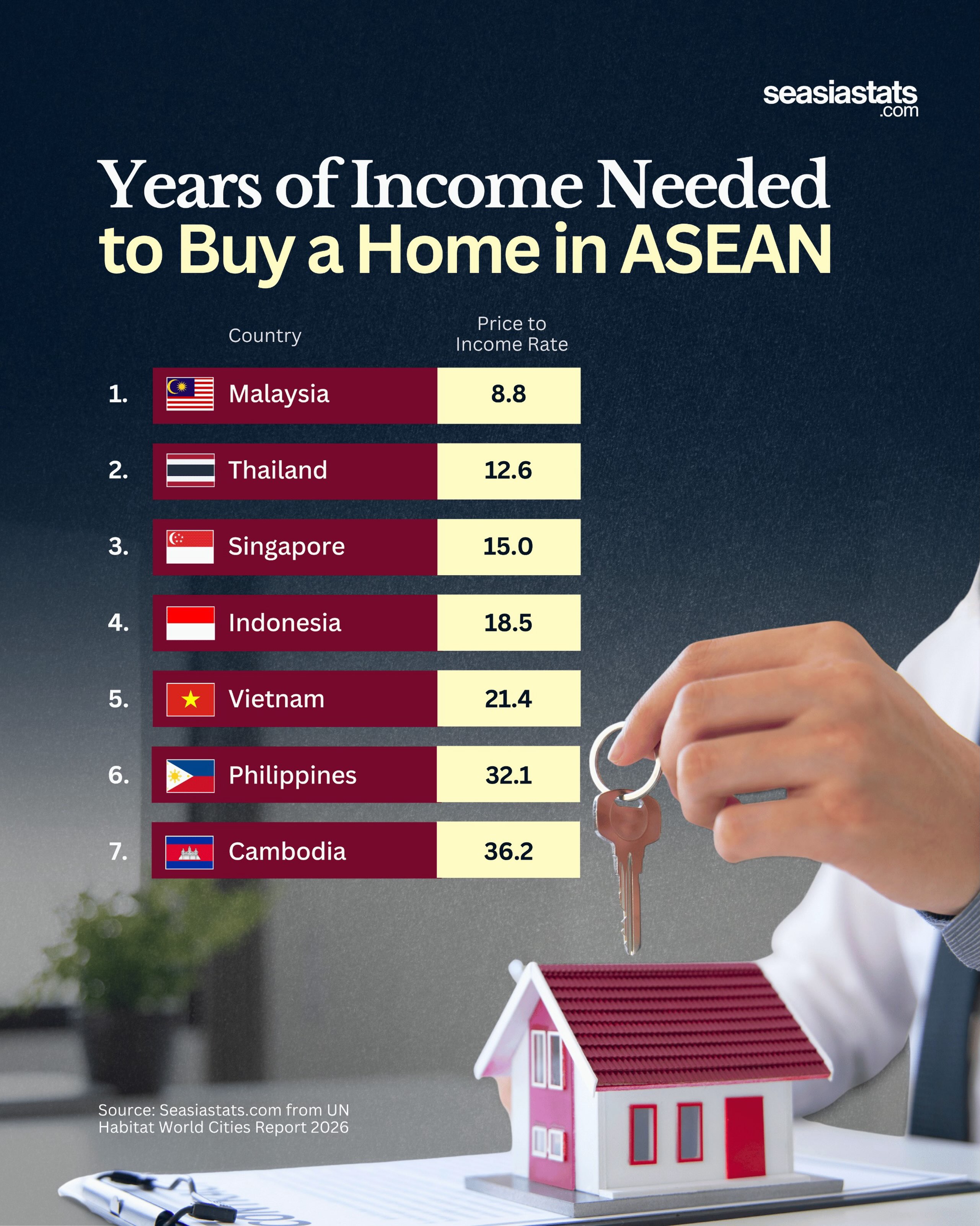
According to the UN-Habitat World Cities Report 2026, housing affordability varies significantly across Southeast Asia, as measured by the number of working years required for an average household to purchase a home.
The report highlights the challenges of balancing rising property prices with income growth, revealing substantial differences among countries in the region.
Malaysia has the most affordable housing among the countries listed, requiring an average of 8.8 working years to buy a house. This comparatively lower figure suggests that, despite rising urban housing costs, homeownership remains more attainable than in many neighboring countries.
Thailand ranks second, with 12.6 working years needed to purchase a home. Although housing prices have increased in major cities such as Bangkok, the country's affordability remains relatively favorable compared with several other Southeast Asian nations.
Singapore requires 15 working years to buy a house. While the city-state has some of the world's highest property prices, extensive public housing programs and government housing policies have helped improve access to homeownership for many residents, contributing to a lower figure than might otherwise be expected.
Indonesia follows with 18.5 working years. Rapid urbanization, particularly in Jakarta and other large cities, has driven strong demand for housing, making homeownership increasingly challenging for many households despite continued residential development.
In Vietnam, purchasing a house requires approximately 21.4 working years. Strong economic growth and rapid urban expansion have contributed to rising property values, especially in Hanoi and Ho Chi Minh City, placing greater financial pressure on prospective homebuyers.
The Philippines records a significantly higher figure of 32.1 working years. High housing costs in metropolitan areas, coupled with income levels that have not kept pace with property price increases, have made homeownership substantially less affordable for many Filipino families.
Among the countries included in the report, Cambodia has the highest housing affordability burden, requiring 36.2 working years to purchase a home. The figure reflects the considerable gap between housing prices and average household incomes, particularly in urban areas experiencing rapid development and increasing real estate investment.
Overall, the UN-Habitat World Cities Report 2026 demonstrates that housing affordability remains a major issue across Southeast Asia. While Malaysia and Thailand exhibit comparatively better affordability, countries such as Cambodia and the Philippines face much greater challenges.
The report underscores the importance of expanding affordable housing, promoting sustainable urban development, and implementing policies that help ensure access to adequate housing as cities continue to grow throughout the region.