

How Much Does the Average Household Owe Across Southeast Asia?
Across Southeast Asia, the financial lives of households tell a story of two very different economic realities.

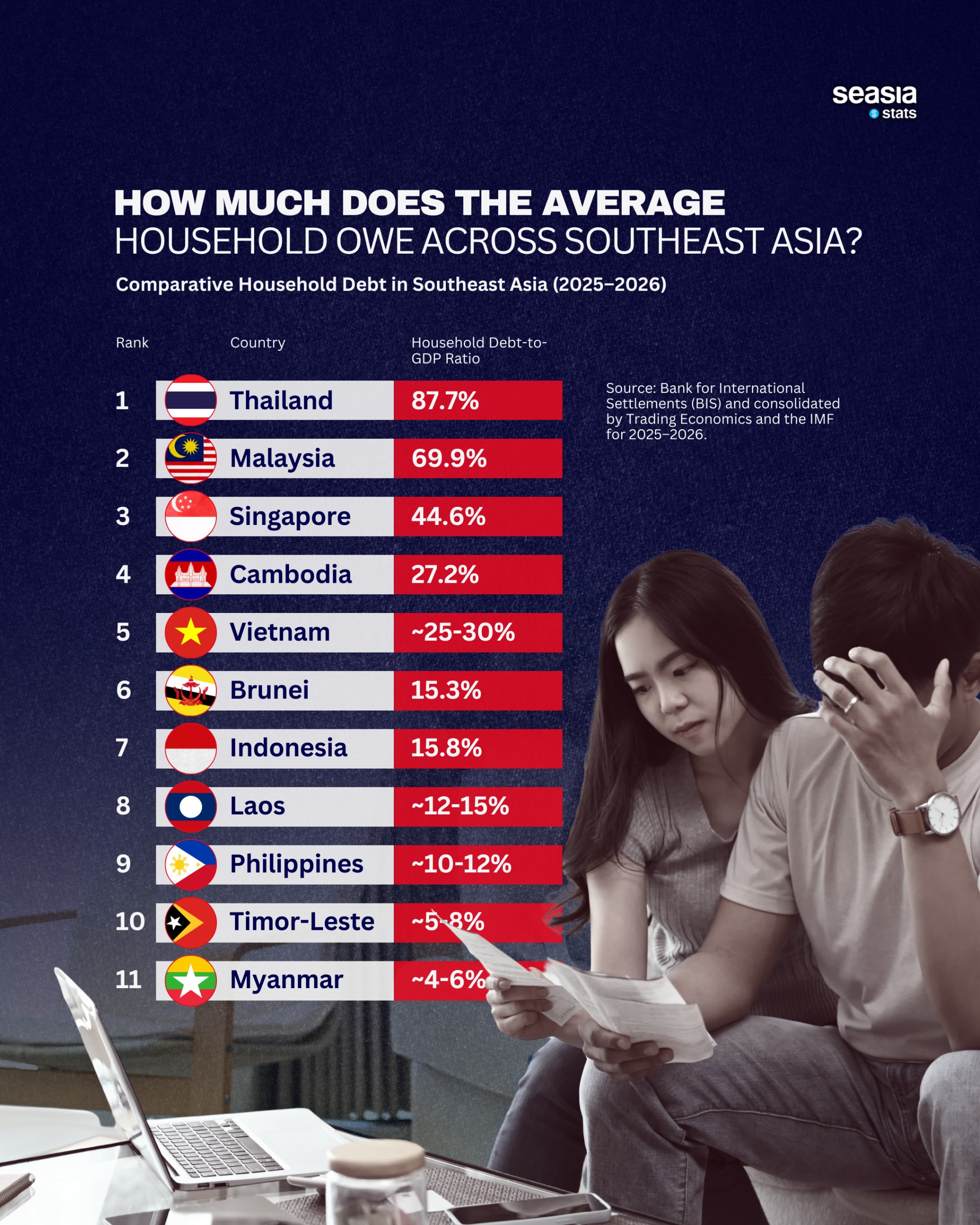
Across Southeast Asia, the financial lives of households tell a story of two very different economic realities. In some countries, families rely heavily on mortgages, car loans, and consumer credit to fuel growth and lifestyle aspirations. In others, borrowing remains limited, with many households still operating largely in cash-based economies. According to consolidated data from the Bank for International Settlements (BIS) and the IMF for 2025–2026, the region’s household debt landscape reflects both rapid modernization and ongoing development gaps.
Thailand Leads a Highly Leveraged Group
Thailand stands at the top of the region with a household debt-to-GDP ratio of 87.7%, one of the highest in the developing world. This figure reflects a deep structural reliance on consumer borrowing, particularly for housing, vehicles, and personal finance. While access to credit has helped support domestic consumption and economic growth, it also leaves Thai households more exposed to economic downturns and rising interest rates.
Malaysia follows at 69.9%, with a similar pattern driven by widespread home ownership financing and a mature banking sector. Singapore, at 44.6%, also ranks high, though its strong income levels, strict lending regulations, and robust financial oversight provide a buffer against excessive risk. In these advanced economies, higher debt levels are often linked to wealth accumulation through property and long-term financial planning.
The Middle Tier: Growing but Controlled Borrowing
In the region’s emerging middle tier, countries such as Cambodia (27.2%) and Vietnam (estimated 25–30%) show rising but still moderate debt levels. These economies are rapidly expanding their financial sectors, with increasing access to microfinance, mortgages, and small business loans.
Vietnam, in particular, has seen a rapid expansion of consumer lending as its urban middle class grows. Cambodia’s microfinance sector has also expanded significantly, providing access to credit for rural households, though concerns about over-indebtedness in some communities have begun to emerge.
Low Debt, Limited Access
At the lower end of the spectrum are countries where household debt remains relatively small, including Indonesia (15.8%), Brunei (15.3%), Laos (around 12–15%), and the Philippines (10–12%). Even lower ratios are seen in Timor-Leste (5–8%) and Myanmar (4–6%).
While these figures may suggest financial stability on the surface, they often reflect limited access to formal banking systems. Many households in these countries still rely on informal lending or operate without credit entirely, which can restrict opportunities for investment in housing, education, or small businesses.
Indonesia, the region’s largest economy, is a notable case. Despite its size and growing middle class, its household debt ratio remains relatively low compared to regional peers, indicating both cautious borrowing behavior and a still-developing consumer finance sector.
A Region of Contrasts and Convergence
The contrast between high-debt and low-debt economies in Southeast Asia highlights the region’s diversity. Advanced financial systems enable growth but also create vulnerability, while low debt levels can indicate resilience but also limited opportunity.
Across the region, governments are increasingly focused on striking the right balance—expanding access to credit while ensuring financial stability. Initiatives to promote responsible lending, improve financial literacy, and strengthen banking oversight are becoming central to long-term economic planning.
As Southeast Asia continues to grow, household debt will remain a key indicator of both opportunity and risk—shaping the financial future of millions of families from Bangkok to Jakarta and beyond.