

In These Southeast Asian Countries, There Are More Men than Women
These six Southeast Asian countries have a male surplus.

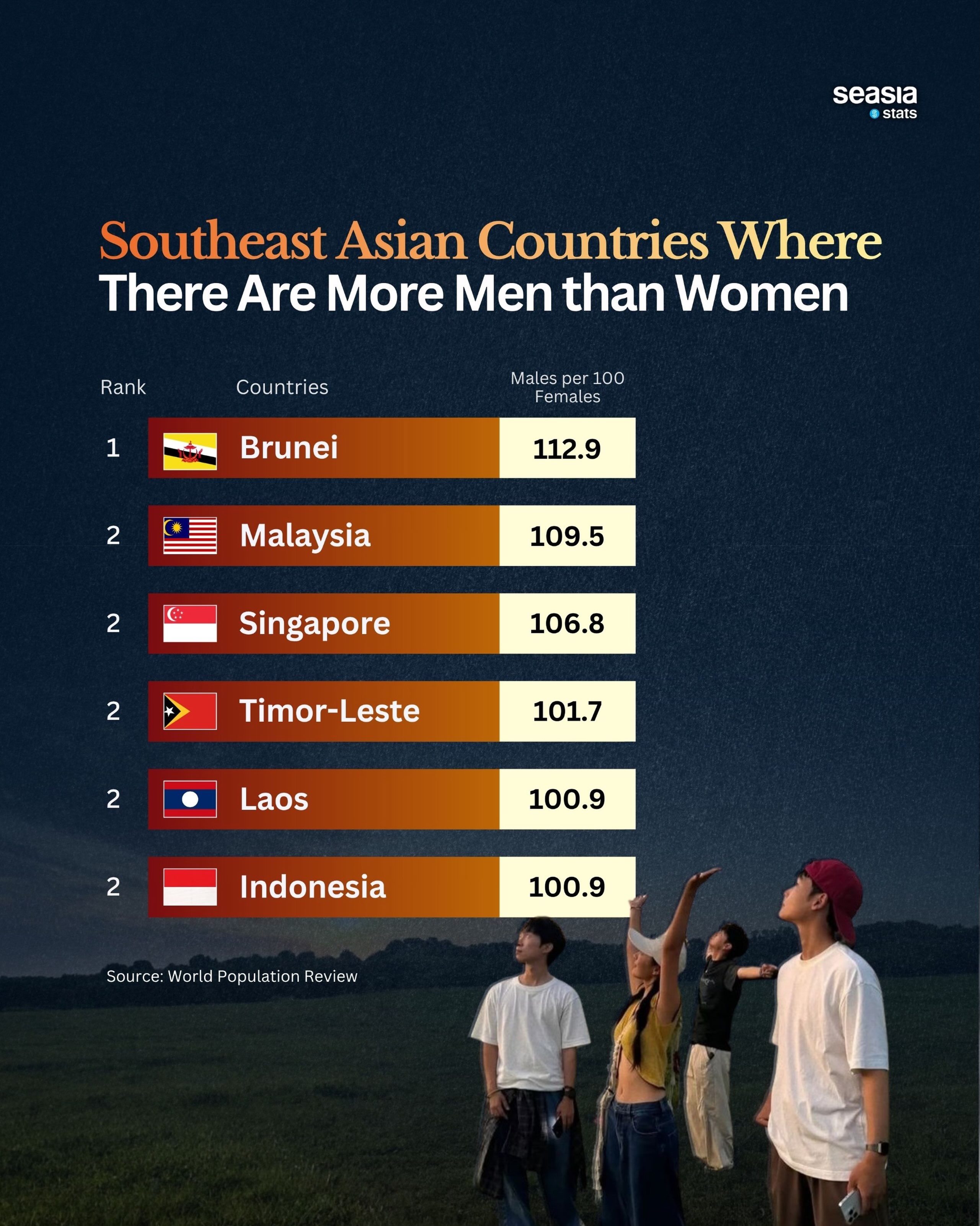
Several Southeast Asian countries have more men than women when measured by the number of men per 100 women, according to World Population Review.
While many countries around the world have more women than men due to differences in life expectancy, a number of nations in Southeast Asia show the opposite pattern. The countries with a male surplus in the region are Brunei, Malaysia, Singapore, Timor-Leste, Laos, and Indonesia.
Brunei has the highest male-to-female ratio in Southeast Asia, with 112.9 men for every 100 women. This significant imbalance is often associated with the country's large expatriate workforce, particularly in the oil and gas industry, where many foreign workers are men. As a result, the overall population reflects a noticeably higher proportion of males.
Malaysia ranks second with 109.5 men per 100 women. Similar to Brunei, Malaysia attracts a substantial number of male migrant workers employed in sectors such as construction, manufacturing, and agriculture. These labor migration patterns contribute to the country's relatively high male population.
Singapore records 106.8 men for every 100 women. As a global financial and business hub, the city-state also relies on foreign workers, many of whom are men working in construction, shipbuilding, and other labor-intensive industries. This has influenced the country's overall sex ratio.
Timor-Leste has 101.7 men per 100 women, representing a modest male surplus. Unlike the more economically developed countries in the region, Timor-Leste's near-balanced ratio is more reflective of its natural population structure, although migration and demographic trends may also play a role.
Laos and Indonesia each report 100.9 men per 100 women, indicating almost equal numbers of men and women with only a slight male majority. These figures suggest relatively balanced populations compared with countries that experience larger gender disparities. Even so, small differences in birth rates, mortality, and migration can influence national sex ratios over time.
Sex ratio statistics provide valuable insights into a country's demographic profile, labor market, and migration patterns. However, these figures do not necessarily indicate gender inequality or social conditions on their own.
Instead, they reflect a combination of biological, economic, and demographic factors. In Southeast Asia, countries with a surplus of men illustrate how workforce migration and population dynamics can shape national demographics.
Understanding these trends helps policymakers, researchers, and businesses better assess future challenges and opportunities related to employment, healthcare, urban planning, and long-term population development.