

Indonesia’s Foreign Policy Priorities in 2026
Indonesia has 6 priorities on its foreign policy for 2026.

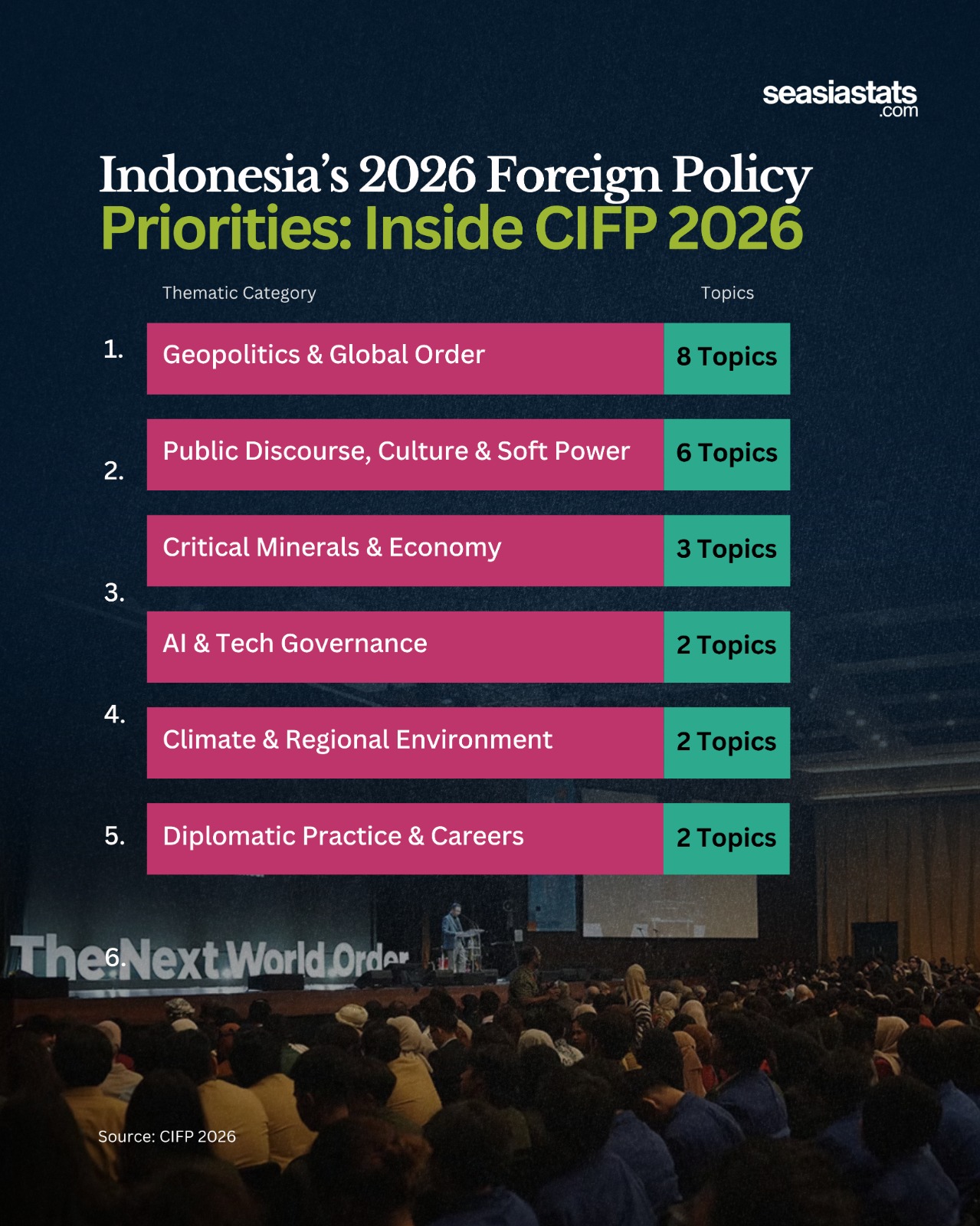
Indonesia’s foreign policy in 2026 reflects an increasingly complex international environment shaped by geopolitical competition, economic uncertainty, technological transformation, and environmental challenges. These developments were central to the 2026 Conference on Indonesian Foreign Policy (CIFP 2026), organized by the Foreign Policy Community of Indonesia (FPCI) under the theme “Independent and Active Foreign Policy: How to Keep Indonesia and the World Order Moving in the Right Direction.”
The conference provides an important platform for understanding Indonesia’s diplomatic priorities and its role as an emerging middle power. Based on its six thematic areas and 23 discussion topics, several priorities emerge.
First, Geopolitics and Global Order, encompassing eight topics, represents the most prominent priority. Indonesia must navigate intensifying great-power competition, reconsider the future of the international order, strengthen ASEAN centrality, and maintain its strategic autonomy. Reviving the Bandung Spirit and reinforcing the principles of international cooperation are also essential to preserving Indonesia’s bebas aktif (independent and active) foreign policy.
Second, Public Discourse, Culture, and Soft Power, covering six topics, highlights the importance of domestic engagement in international affairs. Combating misinformation, addressing political polarization, strengthening public understanding of foreign policy, and promoting Indonesian cultural influence can improve the country's international image. Diplomacy should therefore extend beyond government institutions and involve citizens, media, and younger generations.
Third, Critical Minerals and Economy, with three topics, emphasizes economic diplomacy and resource management. Indonesia must maximize opportunities from its critical mineral reserves, particularly through downstream industrial development, while attracting responsible investment and strengthening its position in global supply chains. Economic resilience and investor confidence are equally important.
Fourth, AI and Tech Governance, consisting of two topics, demonstrates the growing importance of technological sovereignty. Indonesia needs effective artificial intelligence regulations, international cooperation, and responsible digital governance to ensure technological development benefits society.
Fifth, Climate and Regional Environment, also covering two topics, underscores the need for regional cooperation. Addressing climate change, preparing for extreme weather events, and preventing transboundary haze require stronger ASEAN coordination and environmental diplomacy.
Finally, Diplomatic Practice and Careers, with two topics, emphasizes professional diplomatic capacity, institutional knowledge, and the development of future diplomats.
Overall, CIFP 2026 illustrates that Indonesia's foreign policy must balance strategic independence with international cooperation. Its success will depend on translating diplomatic principles into practical policies that strengthen national interests, regional stability, and global engagement.