

Inflation Across G20 Economies in 2026
Among G20 countries, Argentina and Turkey record the highest rates of inflation.

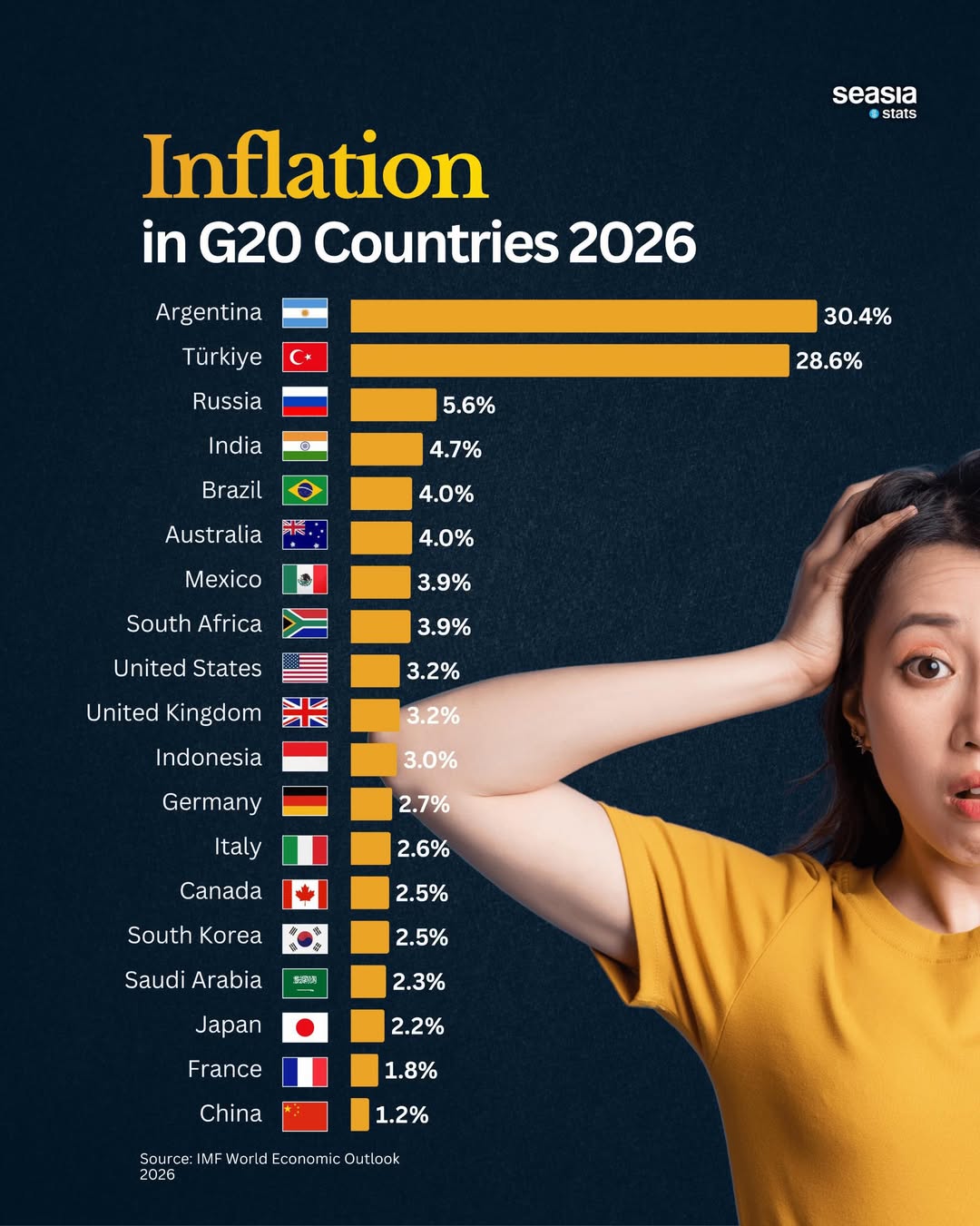
Inflation remains a key indicator of economic stability and purchasing power across the world's largest economies. In 2026, inflation rates among G20 countries vary significantly, reflecting differences in monetary policy, economic growth, energy costs, and domestic market conditions.
While many countries have succeeded in bringing inflation under control following the disruptions of the early 2020s, some continue to face elevated price pressures.
Argentina records the highest inflation rate among G20 members at 30.4%, followed closely by Turkey at 28.6%. Although both countries have made progress compared to previous periods of extremely high inflation, rising prices continue to challenge households and businesses.
High inflation can reduce purchasing power, create uncertainty for investors, and complicate economic planning.
Russia ranks third with an inflation rate of 5.6%, while India records 4.7%. These figures remain above the levels targeted by many central banks but are considerably lower than those seen in the highest-inflation economies. Brazil and Australia each post inflation rates of 4.0%, followed closely by Mexico and South Africa at 3.9%.
Among advanced economies, the United States and the United Kingdom both register inflation rates of 3.2%. While these levels are above the traditional 2% target often favored by central banks, they suggest that inflation has moderated significantly compared with the peaks experienced earlier in the decade.
Indonesia reports inflation of 3.0%, reflecting relatively stable consumer prices and balanced economic conditions.
Several major European economies maintain moderate inflation rates. Germany records 2.7%, while Italy stands at 2.6%. Canada and South Korea each report 2.5%, and Saudi Arabia follows at 2.3%. These figures indicate a generally stable price environment, allowing policymakers to focus on sustaining economic growth while preserving price stability.
Japan records inflation of 2.2%, a notable achievement for a country that historically struggled with very low inflation and periods of deflation.
France reports a lower rate of 1.8%, while China has the lowest inflation among the listed G20 economies at just 1.2%. Low inflation can support consumer confidence, although excessively low rates may also signal weaker demand in some circumstances.
Overall, inflation in the G20 during 2026 presents a mixed picture. While most member countries have succeeded in maintaining inflation within a moderate range of 2% to 5%, Argentina and Turkey remain clear outliers with substantially higher rates.
The wide variation highlights the diverse economic challenges faced by G20 members and the importance of effective monetary and fiscal policies in maintaining price stability.