

Islamic Kingdoms and Sultanates Still Thriving in Southeast Asia
Southeast Asia still has several sultanates and Islamic kingdoms in Malaysia, Indonesia, and Brunei.

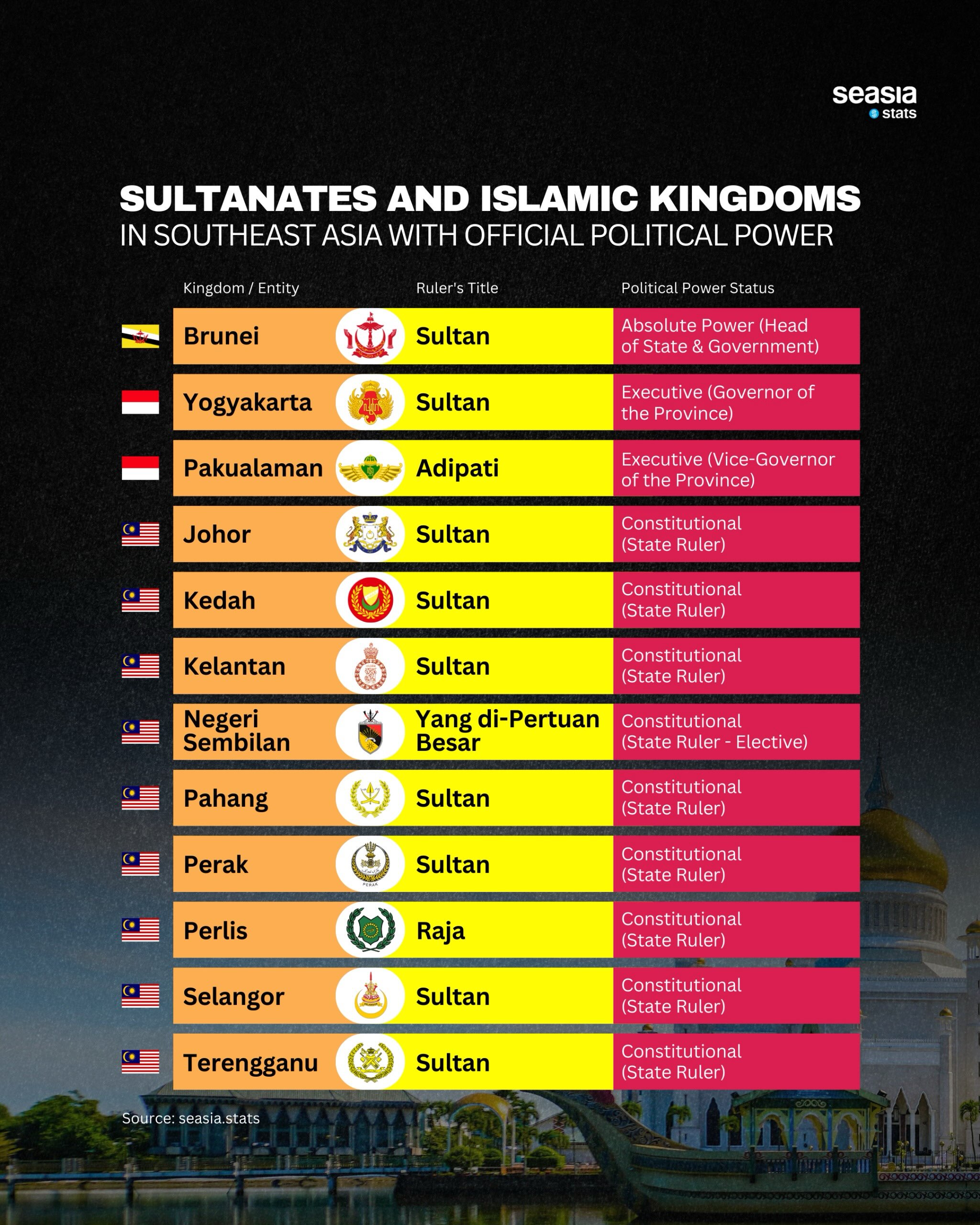
Sultanates continue to serve as significant political and cultural institutions across Southeast Asia, particularly in Brunei, Indonesia, and Malaysia.
While many traditional monarchies disappeared during the colonial era and the wave of modernization, several royal families have endured and still hold meaningful positions within their respective governments.
Their authority differs from country to country, ranging from absolute rule to largely constitutional or ceremonial responsibilities within democratic frameworks.
The region's most powerful royal institution is the Sultanate of Brunei, headed by Sultan Hassanal Bolkiah. He exercises absolute authority as both head of state and head of government while also holding the portfolios of prime minister, defense minister, and finance minister.
Brunei operates under an absolute monarchy, where the Sultan possesses ultimate executive power and oversees the country's administration without constitutional limitations.
Indonesia presents a unique example through the Special Region of Yogyakarta, where the monarchy remains integrated into the republic's political system. The reigning Sultan of Yogyakarta, Hamengkubuwono X, automatically serves as the province's governor, giving him direct executive authority under Indonesia's decentralized system of government.
Supporting the Sultan is the Adipati of Pakualaman, Paku Alam X, who holds the office of vice governor. This special arrangement recognizes the historic contributions of both the Yogyakarta Sultanate and the Pakualaman Duchy to Indonesia's struggle for independence, allowing them to retain their distinctive autonomous status.
Malaysia is home to the largest number of surviving Malay monarchies. The Sultans of Johor, Kedah, Kelantan, Pahang, Perak, Selangor, and Terengganu all reign as constitutional rulers within their respective states.
These monarchs are Ibrahim Iskandar, Sallehuddin of Kedah, Muhammad V of Kelantan, Abdullah of Pahang, Nazrin Shah, Sharafuddin of Selangor, and Mizan Zainal Abidin.
Although day-to-day executive authority rests primarily with elected chief ministers and state administrations, the rulers continue to exercise important constitutional responsibilities. These include appointing governments, serving as guardians of Islam and Malay customs, and acting as enduring symbols of unity within their states.
Malaysia also has two distinctive royal systems. Perlis is led by Raja Syed Sirajuddin, who serves as the state's constitutional monarch despite using the title "Raja" instead of "Sultan."
Meanwhile, Negeri Sembilan is ruled by Yang di-Pertuan Besar, an elected monarch chosen by traditional chiefs in accordance with centuries-old adat traditions. This unique system makes Negeri Sembilan one of the few remaining elective monarchies in the world.
Together, these surviving royal institutions illustrate how Southeast Asia's historic sultanates have successfully adapted to modern political structures. Whether through absolute, constitutional, federal, or democratic systems, they continue to preserve centuries of royal heritage while remaining relevant in contemporary governance.