

Languages on the Internet
As expected, English is the most common language used on the internet.

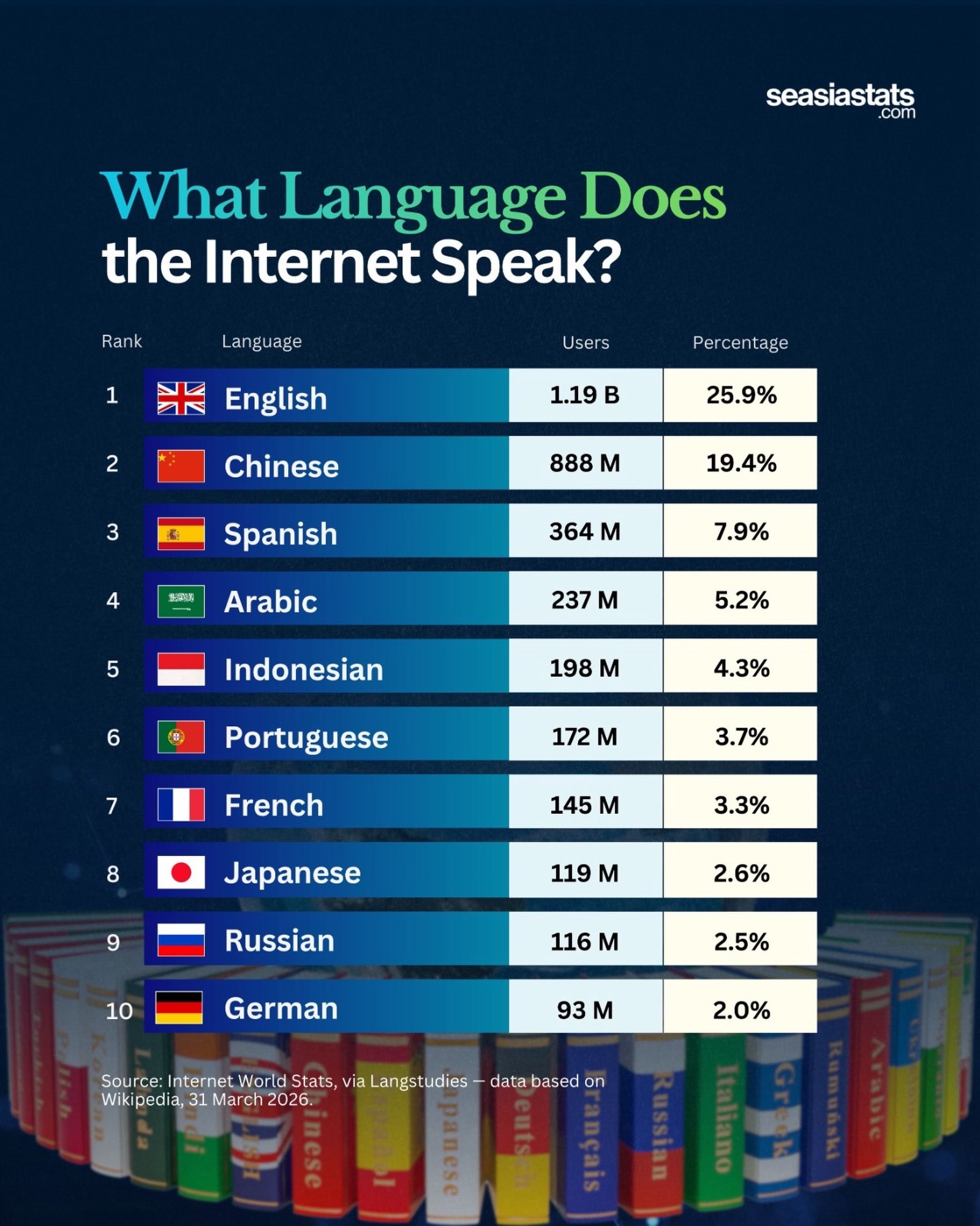
The Internet has become a global communication platform where people from different countries and cultures can connect, share information, study, work, and entertain themselves. Although thousands of languages are spoken around the world, only a smaller number account for a large proportion of Internet users.
English has the largest number of Internet users, with approximately 1.19 billion users, representing 25.9% of Internet users. Its widespread use is connected to the international role of English in education, business, science, technology, and entertainment. Chinese is the second most widely used Internet language, with approximately 888 million users, or 19.4%.
Spanish ranks third, with about 364 million users, representing 7.9% of Internet users. It is followed by Arabic, which has approximately 237 million users, or 5.2%. Indonesian is also an important Internet language, with around 198 million users, accounting for 4.3% of Internet users.
Portuguese is used by approximately 172 million Internet users, representing 3.7%. French follows with around 145 million users, or 3.3%. These figures demonstrate that Internet communication is not limited to English and other traditionally dominant languages; languages spoken across Africa, Asia, Europe, and the Americas have significant online communities.
Japanese has approximately 119 million users, representing 2.6% of Internet users. Russian follows closely, with around 116 million users, or 2.5%. Finally, German has approximately 93 million Internet users, accounting for 2.0%.
These figures show the linguistic diversity of the Internet. English remains the largest language by number of users, but Chinese, Spanish, Arabic, Indonesian, Portuguese, French, Japanese, Russian, and German also represent substantial online populations.
Together, these languages illustrate how the Internet has developed into a multilingual environment serving people from many different regions.
The distribution of Internet users by language is also important for websites, businesses, educators, and content creators. Providing information in multiple languages can make online content accessible to a much wider audience.
As Internet access continues to expand around the world, the linguistic landscape of the Internet may continue to change, reflecting the growth of online communities in different countries and regions.