

Languages with the Most Speakers That Are Not National Languages
These languages has millions of speakers but are not used as official languages in their country of origin.

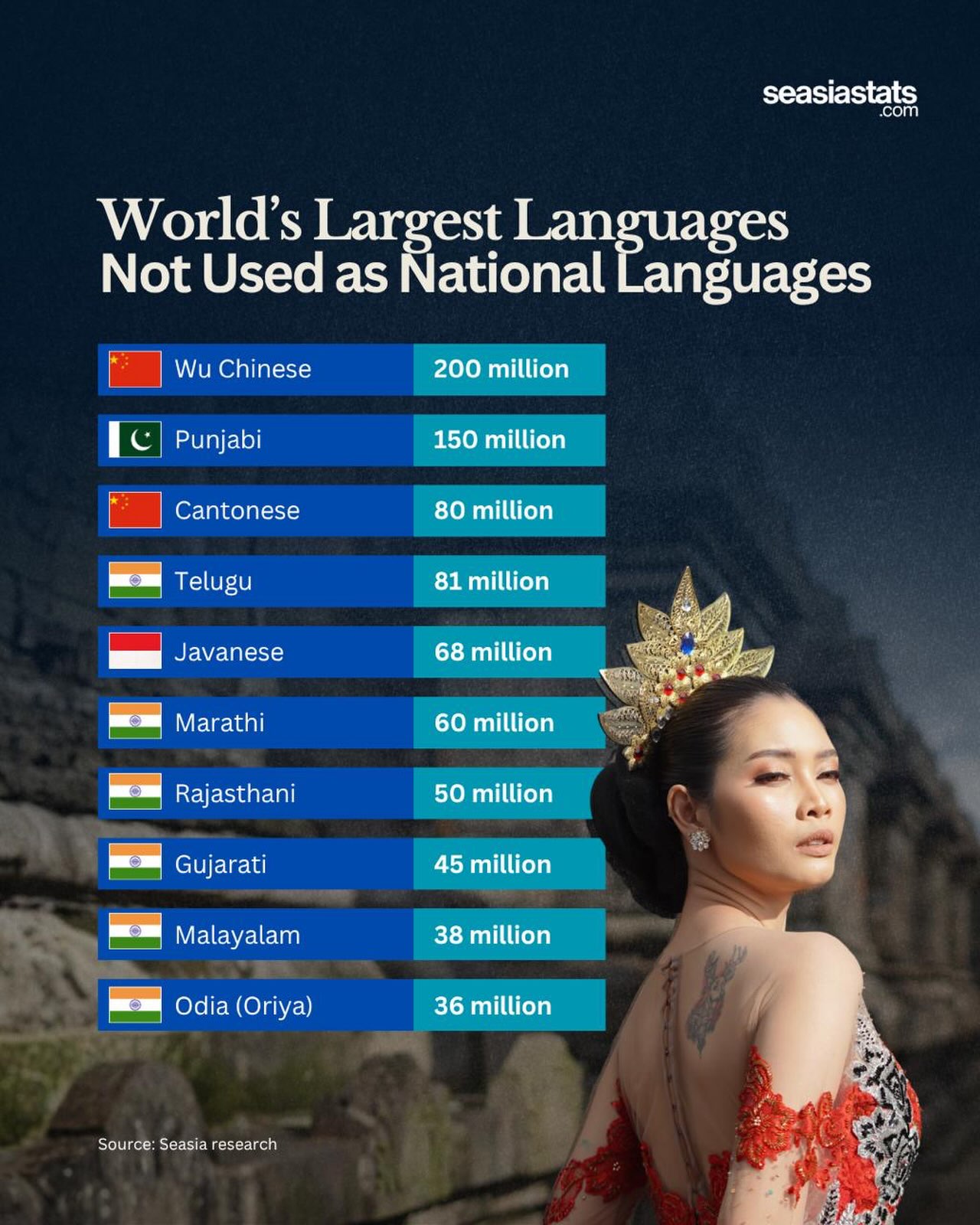
Language is one of the most important parts of human culture, connecting people through history, identity, traditions, and everyday communication.
While some languages are recognized as national or official languages of countries, many others have enormous numbers of speakers without having national-language status. Some of these languages are spoken by tens or even hundreds of millions of people.
Among the largest of these languages is Wu Chinese, spoken by approximately 200 million people. It is mainly used in eastern China, particularly around Shanghai and Zhejiang. Despite its huge number of speakers, Wu Chinese does not have national-language status in China, where Standard Chinese is the official national language.
Punjabi, with around 150 million speakers, is another major language. It is widely spoken in Pakistan and India and has great cultural importance, especially in the Punjab region. However, it is not the national language of either country.
Telugu, spoken by approximately 81 million people, is primarily used in the Indian states of Andhra Pradesh and Telangana. Cantonese, with about 80 million speakers, is widely spoken in southern China, Hong Kong, Macau, and overseas Chinese communities. Both languages have strong regional identities but do not serve as national languages.
Other large languages include Javanese, spoken by about 68 million people, mainly on the Indonesian island of Java, and Marathi, spoken by approximately 60 million people, particularly in the Indian state of Maharashtra. Rajasthani, with around 50 million speakers, is used across Rajasthan and surrounding areas in India.
Gujarati, spoken by about 45 million people, is another important Indian language with a large worldwide community. Malayalam, spoken by approximately 38 million people, is concentrated mainly in Kerala and neighboring regions. Finally, Odia (or Oriya) has around 36 million speakers, primarily in the Indian state of Odisha.
These languages demonstrate that national status is not the only measure of a language's importance. A language can have millions of speakers and a rich literary, historical, and cultural tradition while remaining primarily regional.
The large populations speaking Wu Chinese, Punjabi, Cantonese, Telugu, Javanese, Marathi, Rajasthani, Gujarati, Malayalam, and Odia show the remarkable linguistic diversity of Asia. Protecting and celebrating these languages is essential because each one carries unique traditions, stories, and ways of understanding the world.