

Largest Religions in the World Based on Number of Adherents
These religions and their branches have the most followers in the world.

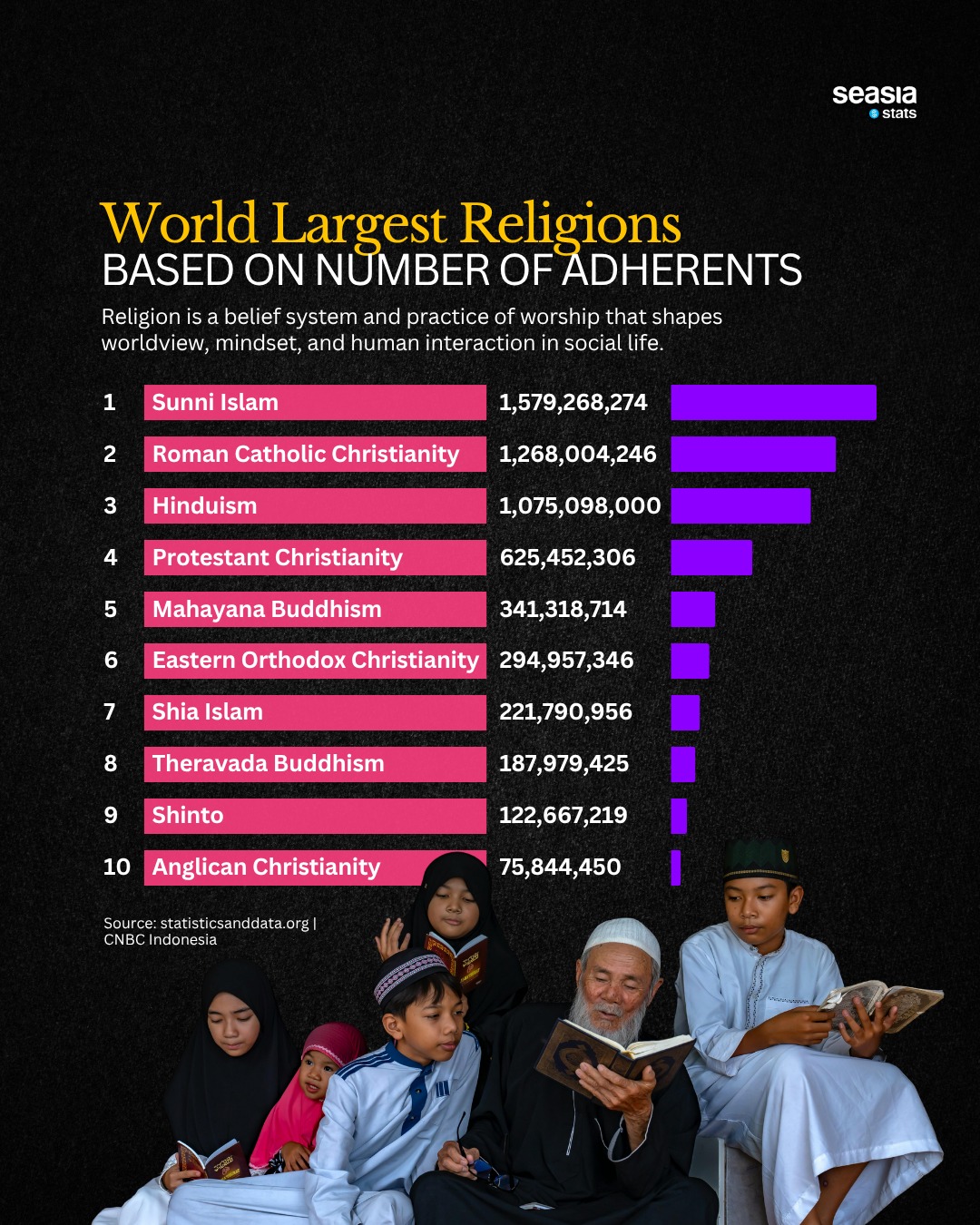
Religion continues to shape the cultures, ethics, and social structures of billions of people around the world. Among the many faith traditions and denominations, several branches stand out because of their enormous number of adherents and their historical influence on civilization, politics, and culture.
The largest religious branch in the world is Sunni Islam, with approximately 1,579,268,274 followers. Sunni Muslims represent the majority of the global Islamic community and are spread across the Middle East, South Asia, Southeast Asia, and Africa.
Sunni traditions emphasize the authority of the Prophet Muhammad’s companions and the consensus of the Muslim community.
The second largest branch is Roman Catholic Church, with around 1,268,004,246 adherents. Led by the Pope in Vatican City, Roman Catholicism is the world’s largest Christian denomination and has had a profound influence on education, philosophy, art, and global humanitarian work.
Hinduism ranks next with about 1,075,198,000 followers. As one of the world’s oldest religious traditions, Hinduism encompasses diverse beliefs centered on concepts such as dharma, karma, and reincarnation. It is especially dominant in India and Nepal.
Protestant Christianity follows with approximately 625,452,306 adherents. Emerging from the Protestant Reformation of the sixteenth century, Protestantism includes numerous denominations that emphasize scripture, personal faith, and reform of church traditions.
Within Buddhism, Mahayana Buddhism has around 341,318,714 followers. Mahayana traditions are especially influential in East Asia, including China, Japan, and South Korea. Mahayana teachings emphasize the bodhisattva ideal, encouraging believers to seek enlightenment for the benefit of all beings.
Another major Christian tradition, Eastern Orthodoxy, has about 294,957,346 adherents and remains particularly strong in Eastern Europe and parts of the Middle East. Orthodox Christianity preserves ancient liturgical practices and theological traditions dating back to the early church.
Shia Islam, with approximately 221,790,956 followers, represents the second-largest branch of Islam. Shia Muslims emphasize the leadership of the Prophet Muhammad’s family, especially Imam Ali and his descendants.
Theravada Buddhism, followed by around 187,979,425 people, is dominant in mainland Southeast Asia and emphasizes monastic discipline and the earliest Buddhist teachings.
Shinto, with 122,667,219 adherents, is Japan’s indigenous spiritual tradition focused on kami, nature, and ancestral reverence. Finally, Anglicanism has approximately 75,844,450 followers worldwide and originated from the Church of England during the English Reformation.
Together, these religious branches illustrate the immense diversity of global spirituality and the continuing influence of faith in shaping human civilization.