

Life Expectancy in Southeast Asia
Singapore has the highest life expectancy in Southeast Asia, reaching 84.4 years.

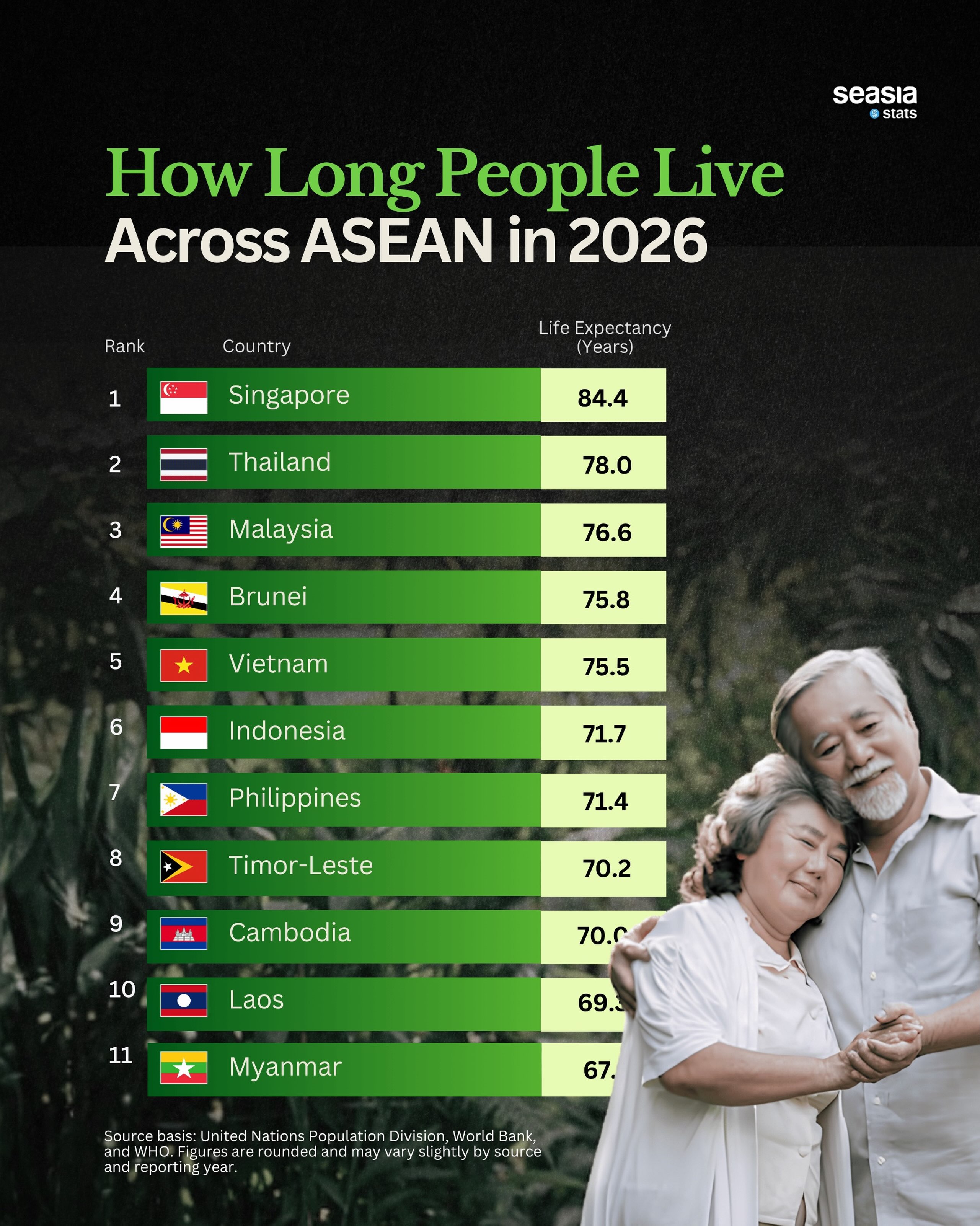
Life expectancy is an important indicator of the health and quality of life of people in a country. In Southeast Asia, life expectancy differs considerably from one country to another.
Based on the figures provided, Singapore has the highest life expectancy while Myanmar has the lowest at. These differences can be influenced by healthcare, living standards, economic conditions, education, nutrition, and public health policies.
Singapore ranks first in the region with a life expectancy of 84.4 years. Its high standard of living, advanced healthcare system, and strong emphasis on preventive healthcare contribute to its long lifespan.
Thailand follows with 78.0 years, while Malaysia records 76.6 years. Brunei has a life expectancy of 75.8 years, and Vietnam is close behind at 75.5 years. These countries generally have relatively developed healthcare systems and improving living conditions.
The middle of the ranking includes Indonesia and the Philippines. Indonesia has a life expectancy of 71.7 years, while the Philippines has 71.4 years.
Although both countries have made progress in healthcare and development, differences in access to medical services, income, nutrition, and living conditions can affect overall life expectancy. Official regional data also show that life expectancy varies across Southeast Asian countries and that women generally live longer than men.
Timor-Leste has a life expectancy of 70.2 years, followed by Cambodia at 70.0 years and Laos at 69.2 years. Myanmar has the lowest figure at 67.8 years. Lower life expectancy in some countries can be associated with limited access to healthcare, economic challenges, and other social and environmental factors.
Overall, the figures show a significant gap of about 16.6 years between Singapore and Myanmar. This highlights the different levels of health and socioeconomic development across Southeast Asia.
Improving healthcare access, education, nutrition, sanitation, and living conditions could help countries with lower life expectancy improve the health and well-being of their populations. Life expectancy is therefore not only a measure of how long people live, but also an important reflection of the conditions in which people live.