

Life Expectancy in Southeast Asia
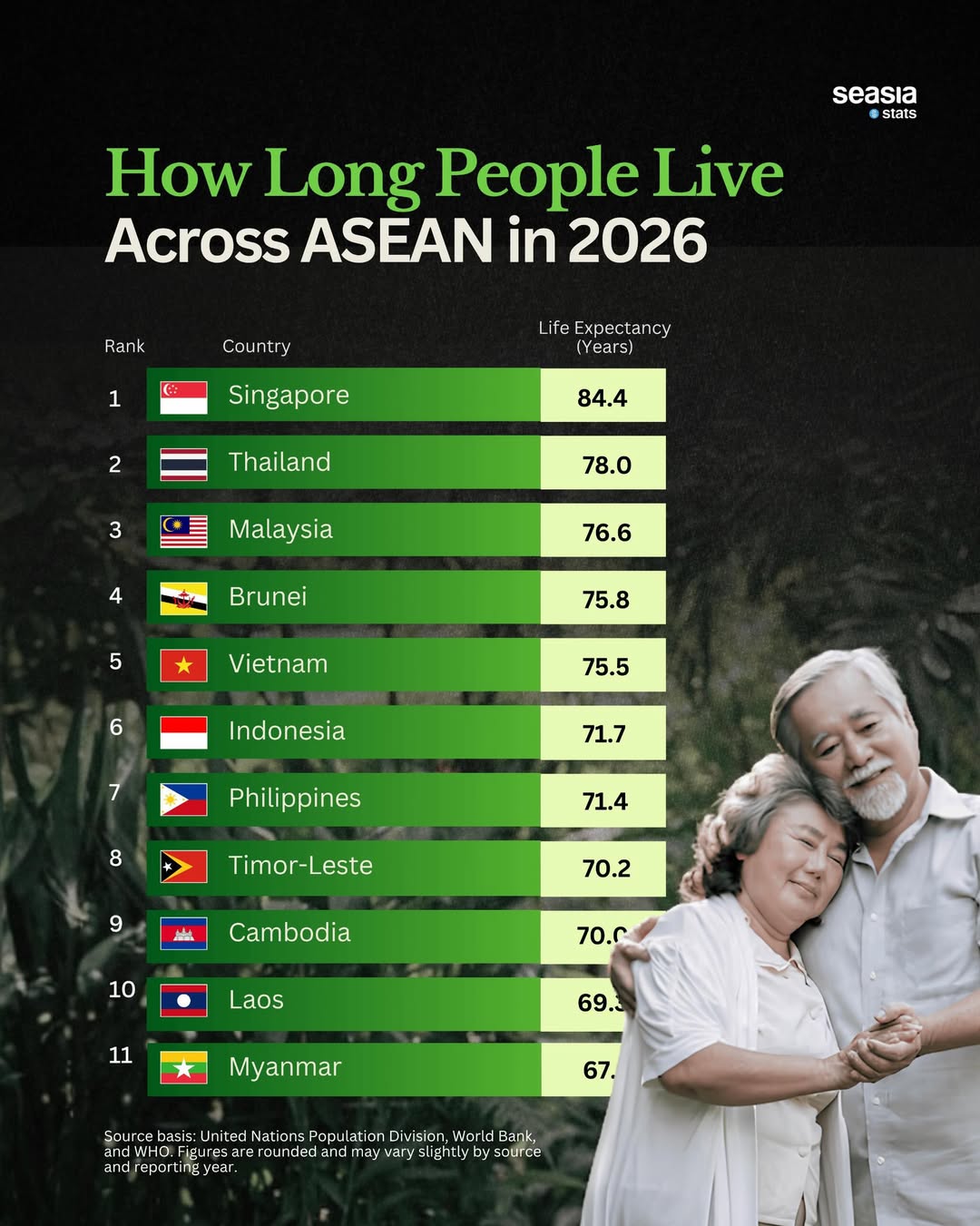
How long do Southeast Asians live? Singaporeans live the longest with life expectancy of 84.4 years.

Life expectancy is one of the most important indicators of a country's health, economic development, and quality of life. In 2026, Southeast Asia continues to show significant differences in longevity among its nations, reflecting varying levels of healthcare access, living standards, education, and public health policies.
Singapore leads the region with a life expectancy of 84.4 years, making it not only the highest in Southeast Asia but also one of the highest in the world.
The city-state's advanced healthcare system, high income levels, and strong emphasis on preventive medicine contribute to its exceptional longevity. Singapore's success demonstrates how effective healthcare and healthy lifestyles can extend life expectancy.
Thailand ranks second with 78.0 years. The country has benefited from decades of improvements in healthcare coverage and medical services.
Malaysia follows closely at 76.6 years, supported by a well-developed healthcare network and relatively high standards of living. Brunei records a life expectancy of 75.8 years, while Vietnam reaches 75.5 years, reflecting notable progress in public health and economic development over recent decades.
Indonesia, the largest country in the region by population, has a life expectancy of 71.7 years in 2026. The Philippines follows closely at 71.4 years. Both countries have made steady gains in healthcare and living conditions, although challenges remain in ensuring equal access to quality medical services across all regions.
Timor-Leste records a life expectancy of 70.2 years, while Cambodia stands at 70.0 years. These nations have achieved significant improvements compared with previous generations, thanks to better healthcare access, reduced child mortality, and economic growth. However, they still face obstacles related to healthcare infrastructure and public health resources.
Laos has a life expectancy of 69.3 years, and Myanmar records the lowest figure in Southeast Asia at 67.0 years. Factors such as healthcare limitations, economic challenges, and ongoing social and political issues can affect health outcomes and longevity in these countries.
Overall, Southeast Asia presents a diverse picture of human longevity in 2026. The gap between Singapore's 84.4 years and Myanmar's 67.0 years highlights the impact of healthcare quality, economic prosperity, and social stability on life expectancy.
As countries continue to invest in healthcare, education, and public welfare, life expectancy across the region is expected to improve further, contributing to healthier and longer lives for millions of people.