

Life Expectancy in Southeast Asia: Singapore Is Still Leading in 2026
Singapore still has the best life expectancy in Southeast Asia for 2026.

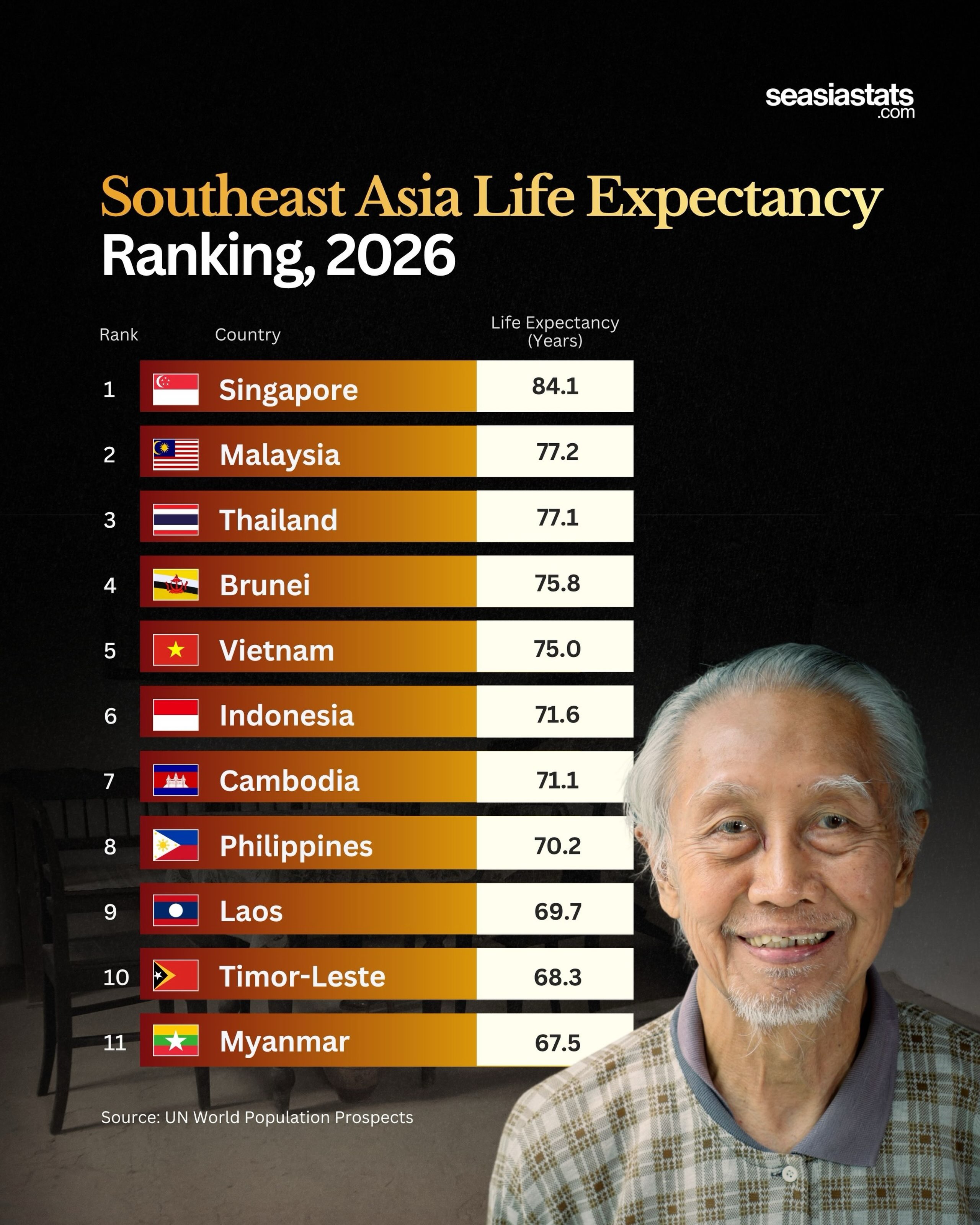
Life expectancy is an important indicator of a country's health, living conditions, healthcare system, and overall quality of life. According to the United Nations World Population Prospects, Singapore is projected to have the highest life expectancy in Southeast Asia in 2026, at 84.1 years.
The figures are based on the UN Population Division's demographic estimates and projections, with life expectancy at birth representing the average number of years a hypothetical newborn would be expected to live under the mortality conditions of the relevant period.
Singapore's leading position is followed by Malaysia, where life expectancy is estimated at 77.2 years. Thailand ranks extremely close behind at 77.1 years, putting the two countries among Southeast Asia's strongest performers in longevity.
Brunei comes next at 75.8 years, while Vietnam records an estimated life expectancy of 75.0 years. These figures place the region's more developed economies and countries with relatively strong healthcare systems toward the top of the ranking.
Indonesia ranks sixth among Southeast Asian countries, with a life expectancy of 71.6 years. Although this is considerably lower than Singapore's figure, Indonesia's large and diverse population has experienced substantial improvements in health and longevity over the long term. Cambodia follows at 71.1 years, while the Philippines records 70.2 years.
Further down the ranking, Laos has a projected life expectancy of 69.7 years, followed by Timor-Leste at 68.3 years. Myanmar records the lowest figure among the countries listed, at 67.5 years. The gap between Singapore and Myanmar is therefore 16.6 years, illustrating the considerable differences in longevity across Southeast Asia.
The ranking also highlights that life expectancy should not be viewed simply as a measure of individual health.
It reflects a combination of factors, including access to healthcare, disease prevention, nutrition, sanitation, education, income, working and living conditions, and public health policies. Differences between countries can therefore provide a broader picture of social and economic development.
It is important to note that the figures are UN projections rather than guarantees of how long individuals will live. The latest UN World Population Prospects is the 2024 Revision, which provides demographic estimates for 1950–2023 and projections from 2024 through 2100.
Overall, the 2026 ranking shows a wide spectrum of longevity across Southeast Asia. Singapore stands clearly at the top, while Malaysia, Thailand, Brunei, and Vietnam form the next group. Meanwhile, the lower-ranked countries continue to face opportunities to improve healthcare access, living conditions, and other factors that can contribute to longer and healthier lives.