

Lifetime Physical and/or Sexual Violence Against Women by an Intimate Partner in Southeast Asia
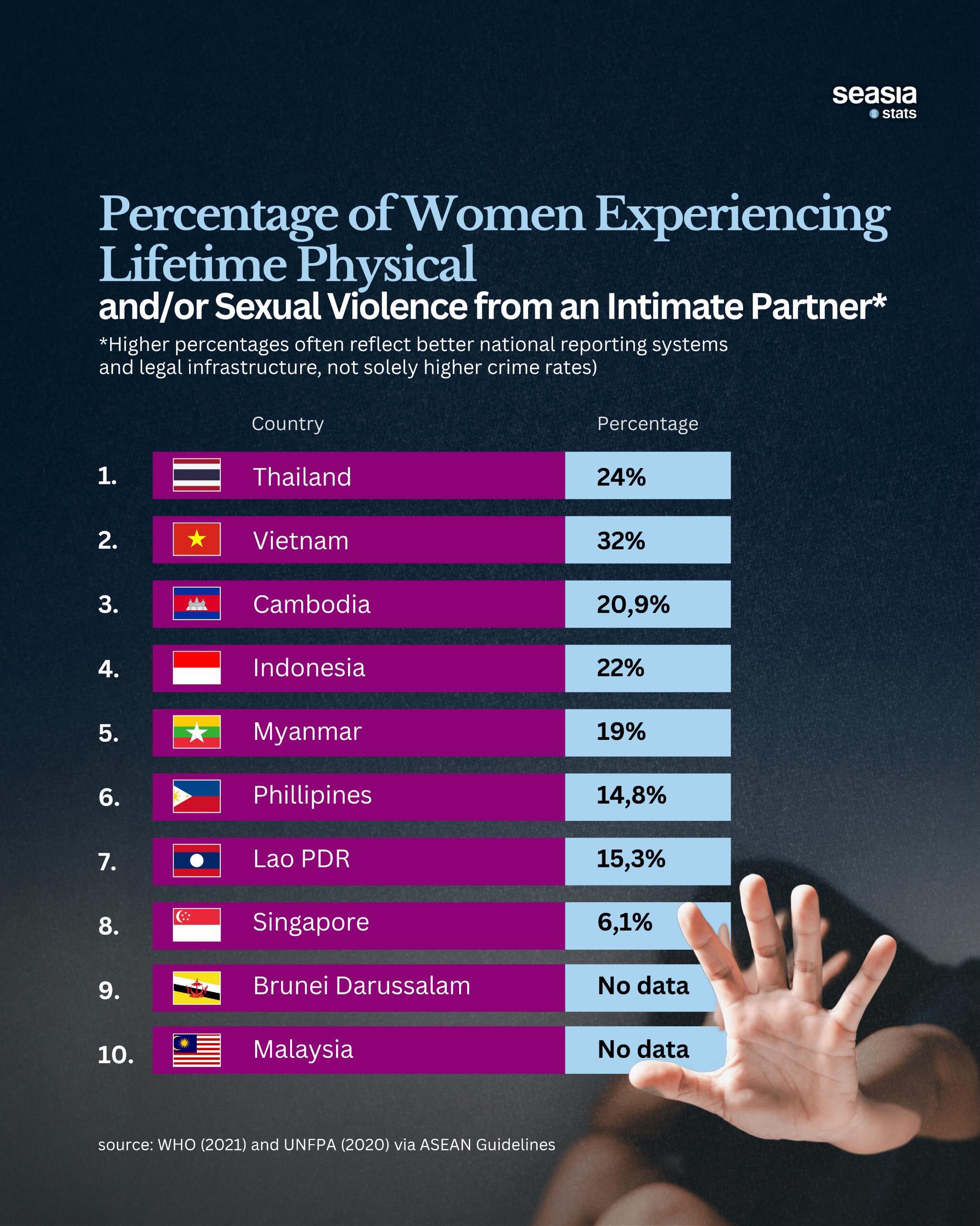
Vietnam records the highest percentage of women experiencing lifetime physical and/or sexual violence from an intimate partner.

Violence against women remains a significant public health and human rights issue across Southeast Asia. According to data compiled by the World Health Organization (WHO) and the United Nations Population Fund (UNFPA), millions of women in the region have experienced physical and/or sexual violence by an intimate partner at some point in their lives.
While the prevalence varies considerably between countries, the statistics highlight the continuing need for prevention, legal protection, and support services.
Among Southeast Asian countries with available data, Vietnam records the highest reported prevalence, with 32% of women experiencing lifetime physical and/or sexual violence from an intimate partner.
Thailand follows with 24%, while Indonesia reports 22%. Cambodia's prevalence stands at 20.9%, and Myanmar records 19%. These figures indicate that roughly one in five to one in three women in these countries have experienced intimate partner violence during their lifetime.
Lower reported prevalence rates are found in several other countries. Laos records 15.3%, while the Philippines reports 14.8%. Singapore has the lowest reported prevalence among countries with available data at 6.1%.
Differences between countries may reflect a combination of social norms, legal protections, reporting practices, survey methodologies, and access to support services. Lower reported figures do not necessarily indicate the complete absence of violence, as underreporting remains a challenge worldwide.
For Brunei and Malaysia, no comparable lifetime prevalence estimates are currently available in the WHO and UNFPA dataset referenced here. The absence of standardized data does not imply that intimate partner violence does not occur, but rather that sufficient nationally comparable survey data are unavailable for inclusion.
The statistics demonstrate that intimate partner violence remains a widespread concern throughout Southeast Asia. Survivors often experience long-term physical injuries, psychological trauma, economic hardship, and negative effects on their families and communities.
Governments, healthcare providers, civil society organizations, and international agencies continue working to strengthen legal protections, improve survivor services, promote gender equality, and encourage prevention through education and community engagement.
Although progress has been made in raising awareness and expanding support systems, eliminating violence against women requires sustained commitment across every sector of society. Reliable data also remain essential for understanding the scale of the problem and evaluating the effectiveness of policies and interventions.
Continued research and improved reporting will help ensure that governments and organizations can develop evidence-based strategies to reduce intimate partner violence and better protect women throughout Southeast Asia.