

Living Under the Clouds: The World’s Rainiest Countries Revealed
For many people, rain is an occasional inconvenience. For others, it’s a way of life.

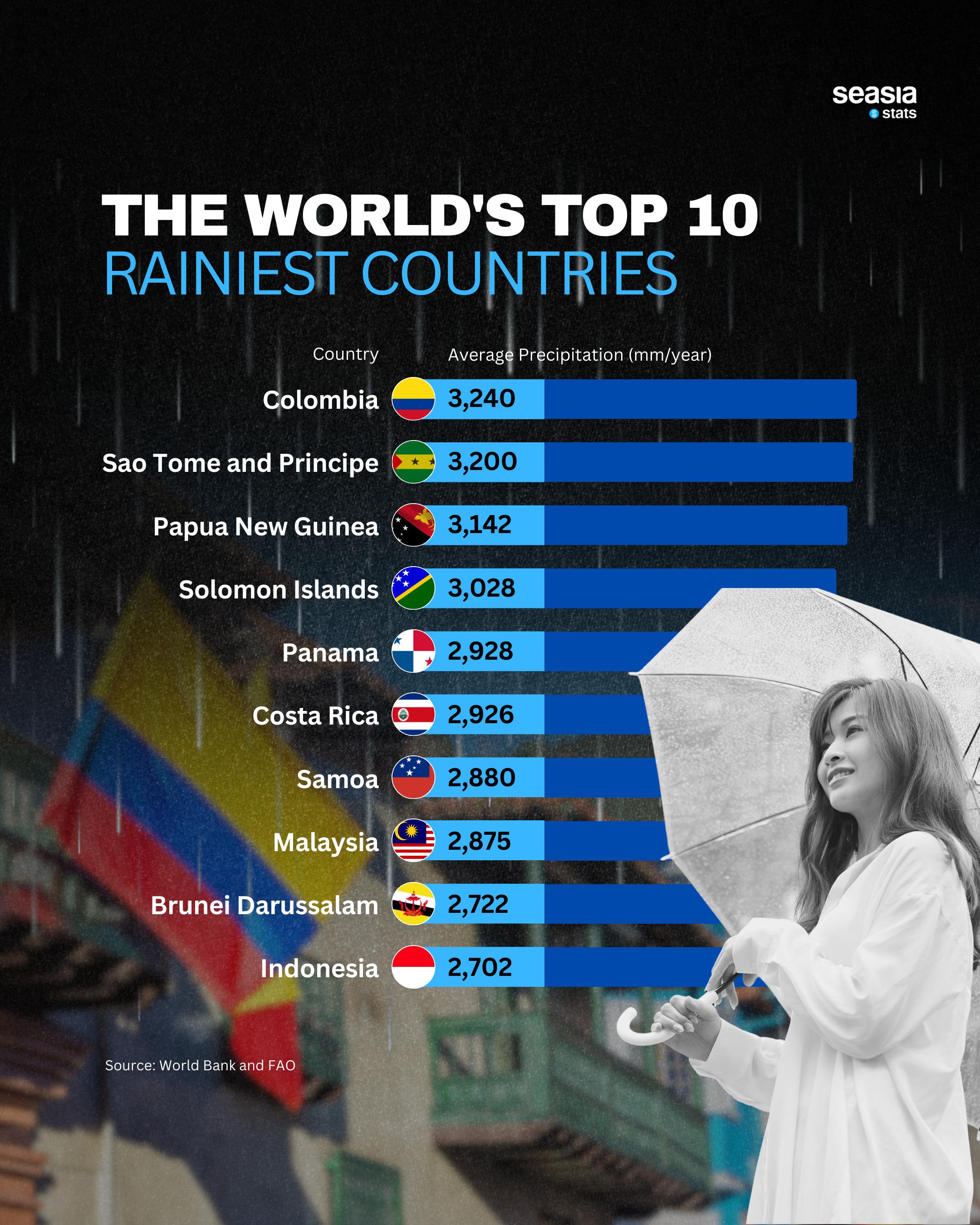
For many people, rain is an occasional inconvenience. For others, it’s a way of life. Across the tropics, entire nations are shaped—economically, culturally, and environmentally—by relentless rainfall. New global precipitation data highlights the countries where rain is not just frequent, but defining, with Southeast Asia standing out as one of the wettest regions on Earth.
Why the Tropics Get So Much Rain
The world’s rainiest countries cluster near the equator, where warm temperatures cause oceans to evaporate massive amounts of moisture into the atmosphere. When this humid air collides with land—especially mountains—it rises, cools, and falls as rain. This process, known as orographic lift, explains why tropical, mountainous, and island nations dominate rainfall rankings year after year.
Colombia: The World’s Wettest Nation
At the top of the list sits Colombia, averaging more than 3,200 millimeters of rainfall per year. Its geography is uniquely suited to extreme precipitation. Wedged between the Pacific and Atlantic oceans, and sliced by the Andes mountains, Colombia traps moisture with remarkable efficiency. Regions such as Chocó receive rain almost daily, making them some of the wettest places on Earth.
Island Nations Drenched Year-Round
Following Colombia are São Tomé and Príncipe and Papua New Guinea, both island nations where tropical storms and mountainous interiors amplify rainfall. According to climate studies, their elevated terrain forces moisture-laden air upward, producing intense and frequent downpours throughout the year.
The Solomon Islands and Samoa also feature prominently. Located in the South Pacific, these countries experience powerful convergence of trade winds and warm seas, resulting in consistent heavy rainfall that sustains lush rainforests but challenges infrastructure and agriculture.
Southeast Asia’s Rainfall Powerhouses
Southeast Asia dominates the global rankings, with Malaysia, Brunei Darussalam, and Indonesia all appearing among the world’s top ten rainiest countries.
-
Malaysia, averaging around 2,875 mm annually, experiences heavy rainfall driven by the northeast and southwest monsoons. The country’s rain supports rich biodiversity but also increases flood risks in urban centers like Kuala Lumpur.
-
Brunei, though small, receives more than 2,700 mm of rain per year, sustaining dense rainforest cover and high freshwater availability.
-
Indonesia, with its vast archipelago straddling the equator, averages over 2,700 mm annually. Rainfall varies widely across its thousands of islands, but monsoon cycles and warm seas ensure persistent precipitation year-round.
Other Southeast Asian nations such as Thailand, Vietnam, and the Philippines may not rank in the global top ten by national averages, but many of their regions—especially coastal and mountainous zones—experience rainfall levels comparable to the wettest countries during monsoon seasons.
Rainforests, Rivers, and Resilience
In Central America, Panama and Costa Rica round out the list, joined by heavily forested nations where rainfall sustains biodiversity hotspots. World Bank data shows that even their so-called dry seasons often receive more rainfall than the annual totals of many temperate countries.
While abundant rain fuels agriculture, hydropower, and ecosystems, it also presents challenges—from landslides to urban flooding. As climate change intensifies weather patterns, rainfall in already-wet countries is expected to become more extreme.
A World Shaped by Water
From Colombia’s rain-soaked jungles to Southeast Asia’s monsoon-fed cities, these nations demonstrate how geography and climate shape daily life. In the world’s rainiest countries, water is not just weather—it’s destiny.