

Malaysia Leads Asia in English Proficiency
Malaysians are the best at speaking English in all of Asia.

English proficiency plays an important role in connecting people across countries, particularly in education, business, technology, and international communication.
According to the EF English Proficiency Index (EF EPI) 2025, Asian countries demonstrate varying levels of English proficiency, reflecting differences in educational systems, language policies, and opportunities to use English in everyday life.
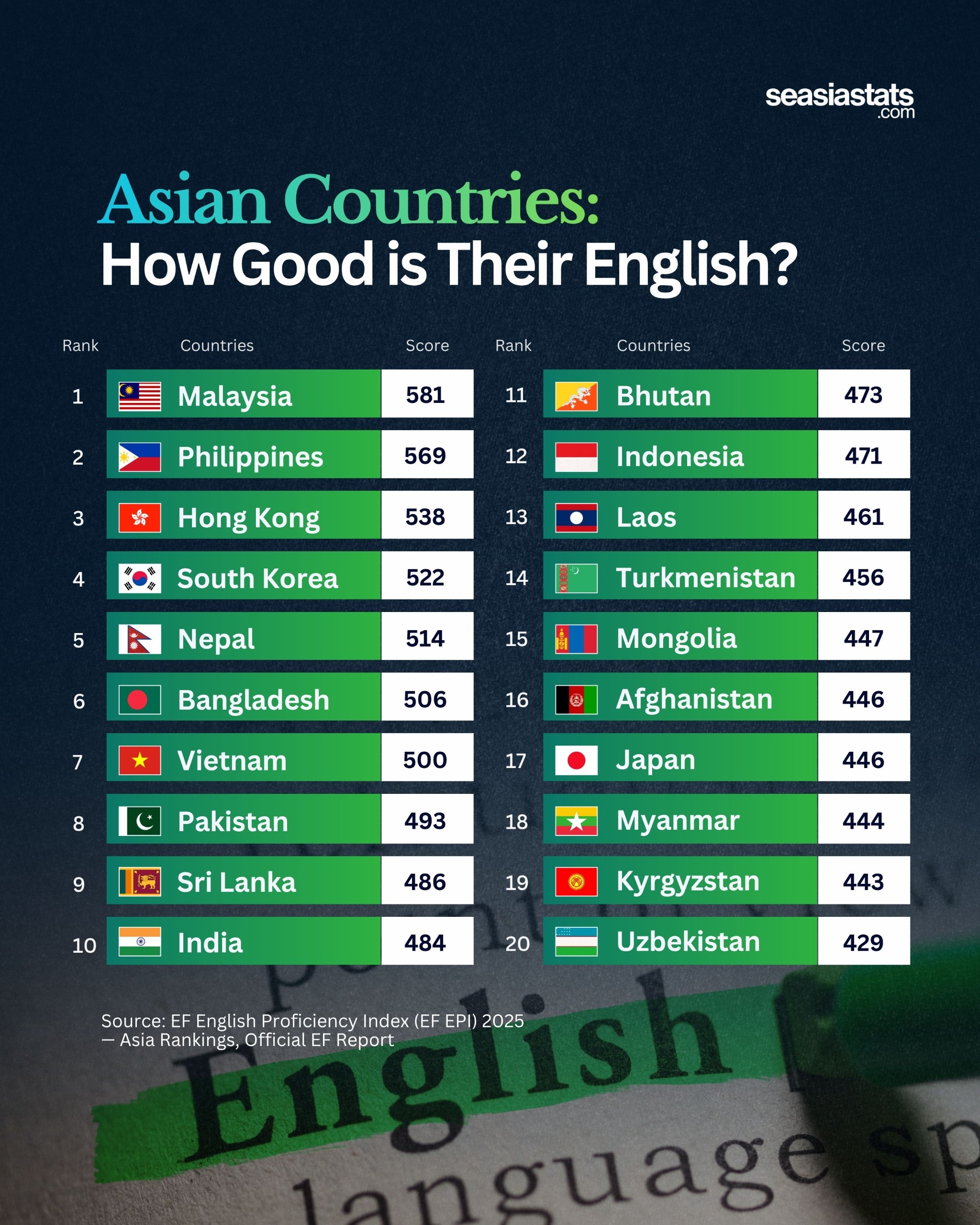
Malaysia ranks first among the listed Asian countries, with a score of 581, followed by the Philippines with 569. Hong Kong ranks third with 538, while South Korea records 522. These results place the four countries and territories at the top of the list, highlighting their relatively strong English proficiency.
English is widely used in Malaysia and the Philippines for education, business, and communication, while South Korea and Hong Kong also benefit from the growing importance of English in international trade and academic activities. Nepal scores 514, followed by Bangladesh with 506 and Vietnam with 500.
Pakistan obtains 493, while Sri Lanka and India record 486 and 484, respectively. These countries occupy the middle section of the ranking, showing different levels of English proficiency.
English remains important in higher education, professional opportunities, and international communication across much of South Asia and Southeast Asia. Meanwhile, Bhutan scores 473, Indonesia 471, Laos 461, and Turkmenistan 456. Mongolia follows with 447, while Afghanistan and Japan both score 446.
Myanmar records 444, Kyrgyzstan 443, and Uzbekistan ranks last among the listed countries with 429. The differences between these scores illustrate the diversity of English proficiency across Asia. However, a country's score alone does not explain all the factors that influence its population's language abilities.
Several factors may contribute to these differences, including the quality of English instruction, teacher training, access to learning materials, exposure to English-language media, and opportunities to practice speaking and writing.
Countries where English is frequently used in education or professional settings may provide learners with more opportunities to develop practical communication skills.
Overall, the EF English Proficiency Index 2025 data highlight significant variations in English proficiency across Asian countries. Malaysia and the Philippines lead the provided list, while Uzbekistan records the lowest score.
These findings emphasize the importance of improving English education and expanding opportunities for language practice. Strengthening English proficiency can help individuals access international knowledge, pursue better career opportunities, and participate more effectively in an increasingly interconnected world.