

Median Age of Southeast Asian Countries
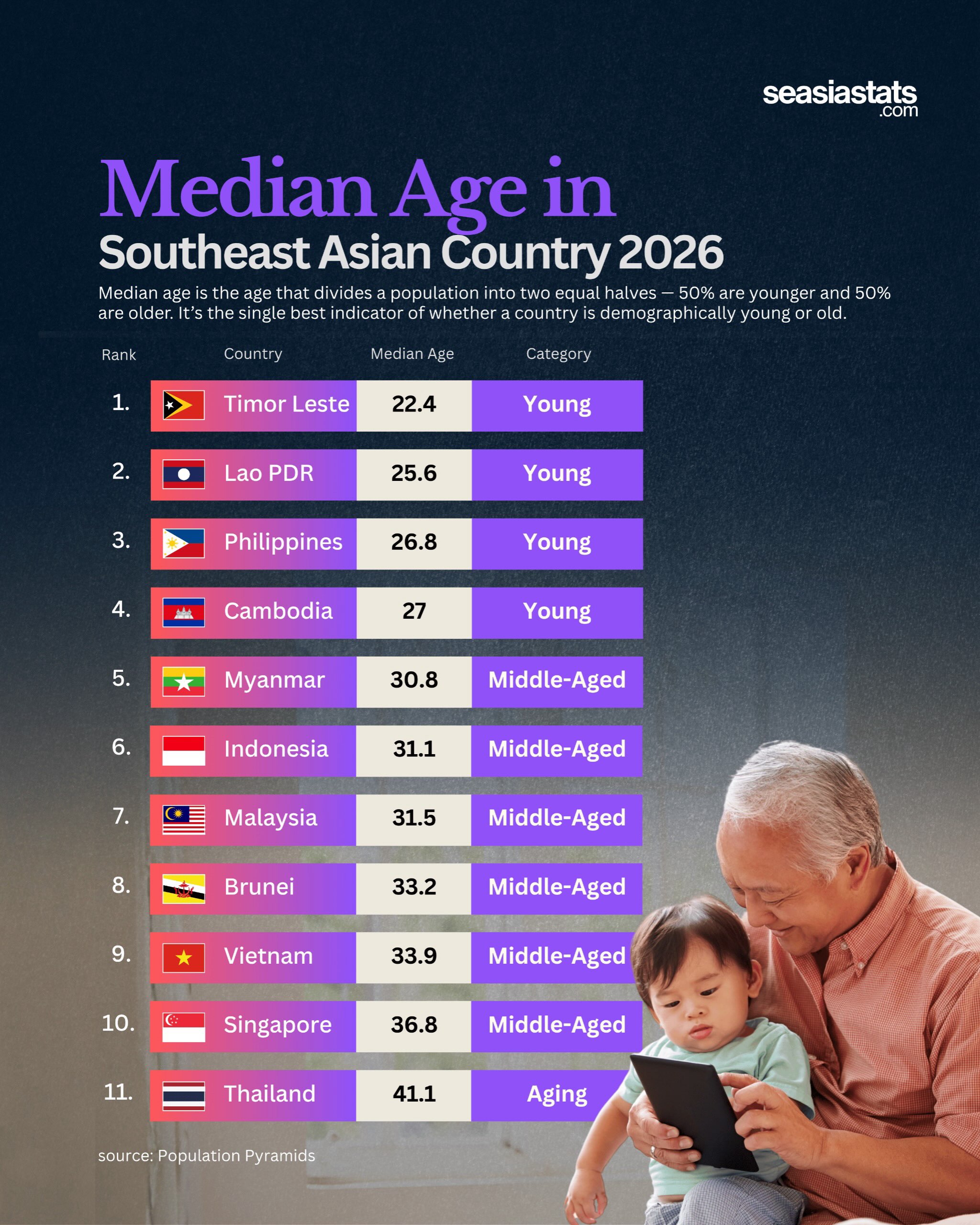
Timor-Leste has the youngest population in Southeast Asia, while Thailand has the oldest.

The median age of a population is an important indicator of a country's demographic structure, reflecting whether its population is predominantly young, middle-aged, or aging. Across Southeast Asia, countries show considerable differences in their median ages, highlighting varying demographic conditions and stages of population development.
Timor-Leste ranks first as the country with the youngest median age in Southeast Asia, at just 22.4 years, placing it in the young population category. Laos follows with a median age of 25.6 years, also classified as young.
The Philippines comes next at 26.8 years, narrowly ahead of Cambodia, which records a median age of 27 years. These four countries share relatively young population structures, indicating that a considerable proportion of their populations are in younger age groups.
Moving into the middle-aged population category, Myanmar ranks fifth with a median age of 30.8 years. Indonesia follows closely at 31.1 years, while Malaysia records 31.5 years.
Brunei Darussalam has a slightly higher median age of 33.2 years, followed by Vietnam at 33.9 years. Singapore, meanwhile, records a median age of 36.8 years, making it the country with the oldest population among those classified as middle-aged in the region.
Thailand stands out as the only Southeast Asian country in the aging population category, with a median age of 41.1 years. This figure makes Thailand the oldest country in Southeast Asia in terms of median age, reflecting a demographic structure that is considerably older than those of its regional neighbors.
The differences across Southeast Asia illustrate the region's diverse demographic landscape. Countries with younger populations, such as Timor-Leste, Laos, the Philippines, and Cambodia, may benefit from a growing working-age population in the coming years.
However, they also need to invest in education, healthcare, and employment opportunities to maximize this demographic potential.
On the other hand, countries with older populations, particularly Thailand, face different challenges, including increasing demand for elderly healthcare, pension systems, and social protection.
Overall, the data from Population Pyramids demonstrates that Southeast Asia is experiencing different stages of demographic transition. While some countries still have relatively young populations, others are gradually moving toward an aging society, creating different economic and social priorities across the region.