

Median Ages Among These Six ASEAN Countries
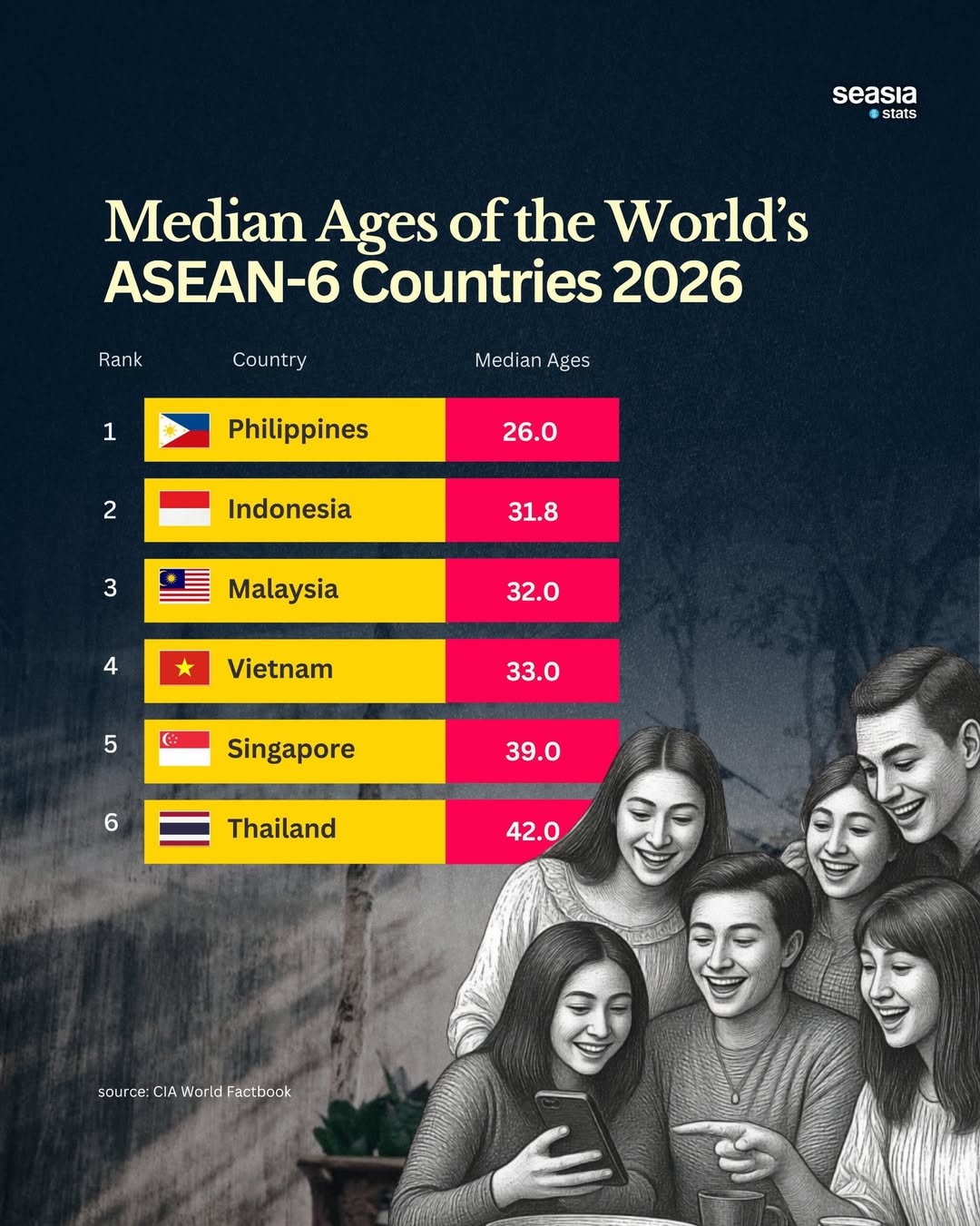
The Philippines has the youngest median age among these six ASEAN countries.

The median age of a population is an important indicator of demographic structure, economic potential, and future social challenges. It represents the age that divides a population into two equal halves: one half is younger and the other half is older.
Among six major ASEAN countries—Philippines, Indonesia, Malaysia, Vietnam, Singapore, and Thailand—the median age varies significantly, reflecting different stages of demographic development.
The Philippines has the youngest population among the six countries, with a median age of 26.0 years. This youthful demographic provides a large labor force and strong potential for future economic growth. However, it also creates pressure on the government to provide sufficient education, healthcare, and employment opportunities for its growing population.
Indonesia follows with a median age of 31.8 years. As the largest economy in Southeast Asia, Indonesia benefits from a relatively young workforce that supports productivity and consumer demand.
The country is currently experiencing a demographic dividend, where the working-age population is larger than the dependent population, creating favorable conditions for economic expansion.
Malaysia has a median age of 32.0 years, slightly higher than Indonesia. This reflects a population that is gradually maturing while still maintaining a substantial working-age segment. Malaysia’s demographic profile supports its ambitions for continued economic development and technological advancement.
Vietnam’s median age stands at 33.0 years. Over recent decades, the country has experienced rapid economic growth alongside declining birth rates. As a result, Vietnam is transitioning toward an older population structure while still benefiting from a productive workforce.
Singapore has a significantly higher median age of 39.0 years. As one of the most developed economies in Asia, Singapore faces the challenges associated with an aging population, including rising healthcare costs and increased demand for retirement support.
The government has implemented various policies to encourage workforce participation and manage long-term demographic changes.
Thailand has the oldest population among the six countries, with a median age of 42.0 years. The country’s low birth rates and increasing life expectancy have accelerated population aging. While this reflects improvements in healthcare and living standards, it also presents challenges related to labor shortages and social welfare sustainability.
Overall, the median age differences among these ASEAN countries highlight the region’s demographic diversity. Younger nations such as the Philippines and Indonesia may enjoy demographic advantages for growth, while older societies such as Singapore and Thailand must adapt to the realities of population aging.
Understanding these demographic trends is essential for policymakers and businesses planning for the future.