

Most of the World's Babies Will Be Born in Asia and Africa
Asia and Africa are the most likely places for a baby to be born.

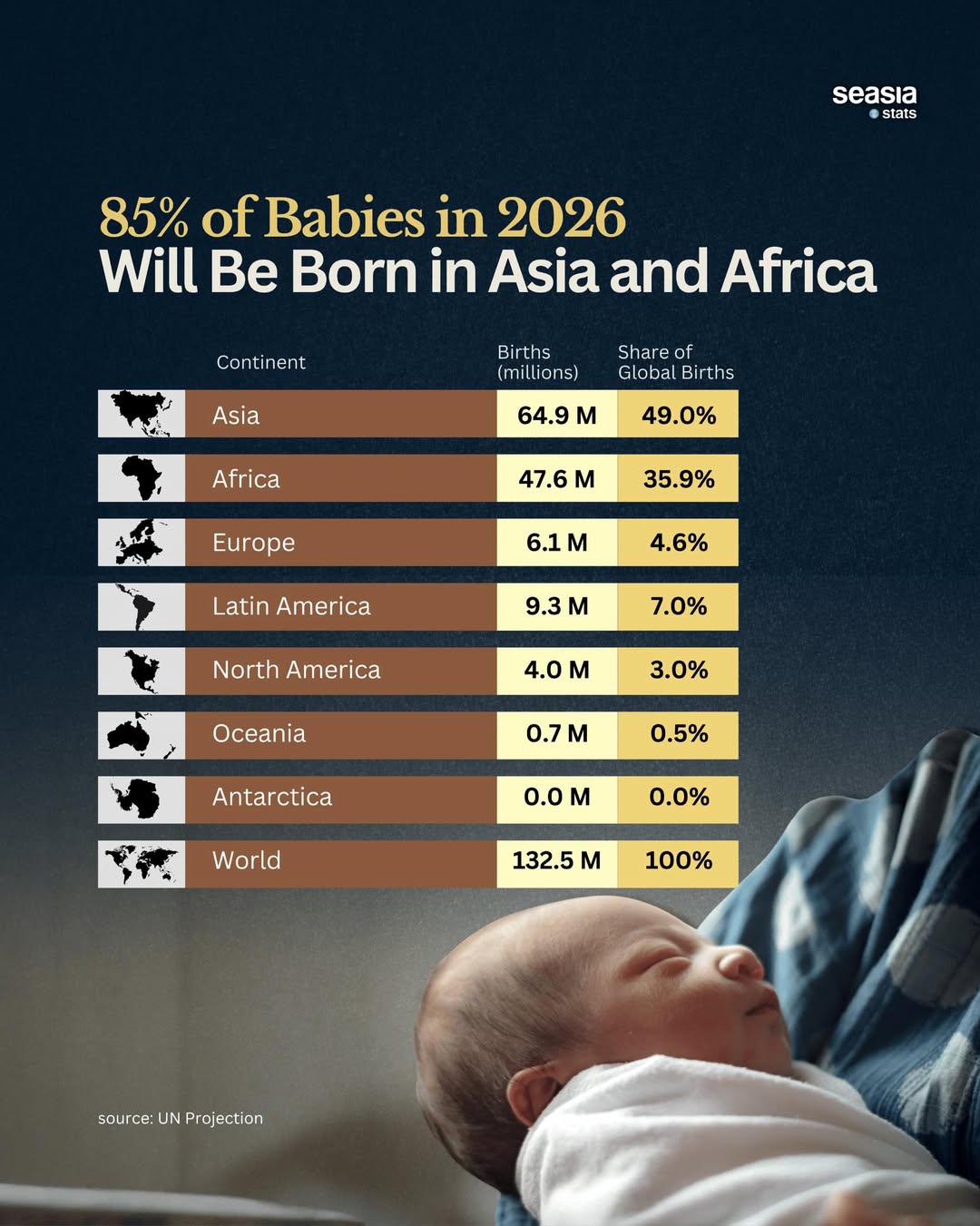
According to projections based on the United Nations’ World Population Prospects 2024, approximately 132.6 million babies are expected to be born worldwide in 2026. These births are distributed very unevenly across the globe, reflecting significant differences in population size, age structure, and fertility rates among the continents.
Asia remains the largest contributor to global births, with an estimated 64.9 million births in 2026. This represents 49.0 percent of all births worldwide, meaning nearly one out of every two babies born in the world will be born in Asia.
Although fertility rates have declined substantially across many Asian countries in recent decades, the continent’s large population base continues to generate the highest number of births.
Africa is projected to record 47.6 million births, accounting for 35.9 percent of the global total. Africa’s share is particularly notable because it is much larger than the continent’s share of the world population.
Higher fertility rates and a youthful population structure make Africa the fastest-growing source of new births. More than one-third of all babies born in 2026 are expected to be born on the African continent.
Latin America is projected to have 9.3 million births, representing 7.0 percent of global births. While fertility rates in many Latin American countries have fallen significantly over the past few decades, the region still contributes a substantial number of births due to its large population.
Europe is expected to record 6.1 million births, equal to 4.6 percent of the world total. Low fertility rates and aging populations across much of Europe continue to limit the number of births despite the continent’s high level of economic development.
North America is projected to have 4.0 million births, accounting for 3.0 percent of global births. Birth numbers in the region are influenced by relatively low fertility rates, although migration helps sustain population growth in several countries.
Oceania is expected to register approximately 0.7 million births, contributing 0.5 percent of the global total. Despite its vast geographic area, Oceania contains a relatively small population compared with other continents.
Antarctica, which has no permanent civilian population, is projected to have no births and therefore contributes 0.0 percent of global births.
Overall, Asia and Africa together are expected to account for 84.9 percent of all births in 2026, highlighting the growing demographic importance of these two continents in shaping the world’s future population.