

Muslim-Majority Countries That Back Sanctions Against Israel Over Illegal Settlement Expansion
These 16 Muslim-majority countries backed sanctions against Israel's settlement expansion.

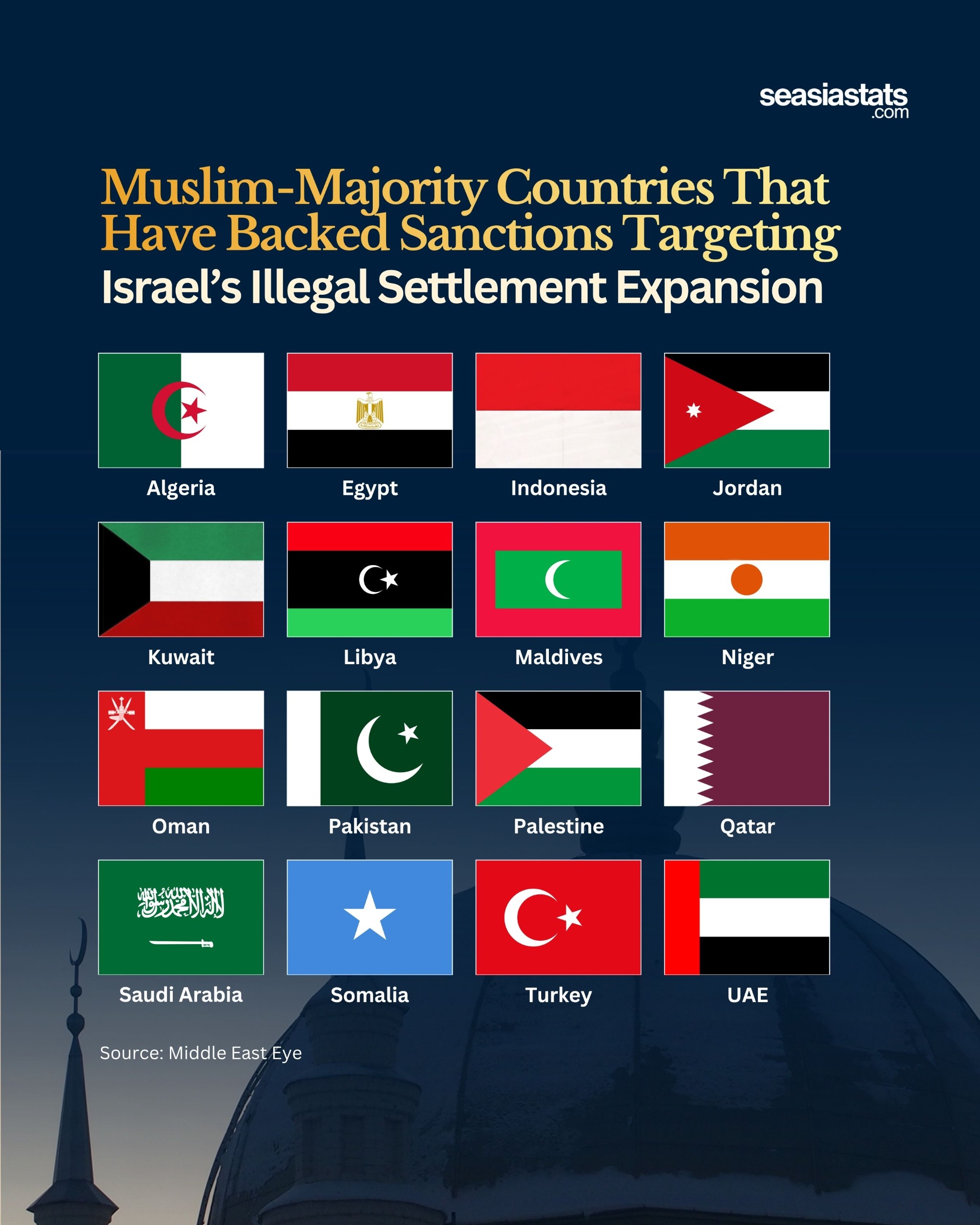
A united diplomatic position has emerged among sixteen Muslim-majority countries in response to Israel's continued expansion of illegal settlements in the occupied Palestinian territories. According to Middle East Eye, the countries have welcomed sanctions imposed by the United Kingdom and Australia against Israeli settlement activities, particularly measures targeting companies involved in the construction and expansion of settlements.
The sixteen countries are Algeria, Egypt, Indonesia, Jordan, Kuwait, Libya, the Maldives, Niger, Oman, Pakistan, Palestine, Qatar, Saudi Arabia, Somalia, Türkiye, and the United Arab Emirates. Their collective position represents a significant expression of diplomatic opposition to Israel's settlement policies and demonstrates growing support for international accountability over actions affecting Palestinian land and sovereignty.
In their joint statement, the foreign ministers welcomed the decisions by the British and Australian governments to impose sanctions in response to illegal Israeli settlement activities in the occupied Palestinian territory. They also supported Britain's decision to sanction an Israeli organisation accused of obstructing humanitarian aid deliveries to the Gaza Strip.
A particular concern raised by the sixteen countries was Israel's planned E1 settlement project, located east of occupied East Jerusalem. The project has attracted considerable international criticism because its implementation could divide the occupied West Bank geographically, further fragment Palestinian communities, and undermine the possibility of establishing a viable and territorially connected Palestinian state.
Beyond welcoming the existing sanctions, the ministers called for stronger international action against individuals, companies, and organisations responsible for supporting, facilitating, or implementing settlement expansion and annexation policies. They emphasised that accountability should extend to all entities contributing to the continuation of these activities.
The countries also referred to United Nations Security Council Resolution 2334, adopted in 2016, and the International Court of Justice's advisory opinion of 19 July 2024. These international legal references reinforce their position that Israeli settlements in occupied Palestinian territory have no legal validity and that other states must not recognise or assist in maintaining the unlawful situation arising from the occupation.
Furthermore, the ministers reaffirmed their support for Palestinian independence through a two-state solution based on the borders of 4 June 1967, with East Jerusalem as the capital of Palestine. They also stressed that Gaza remains an integral part of the occupied Palestinian territory.
Ultimately, their joint declaration sends a clear diplomatic message: settlement expansion cannot be separated from questions of international law, Palestinian rights, and regional peace. By supporting sanctions and demanding broader international accountability, these sixteen countries are urging the international community to take more concrete action toward a just and lasting resolution of the Palestinian issue.