

National Animals of Southeast Asia
These are the official and unofficial national animals of Southeast Asian countries. Which one is your favorite?

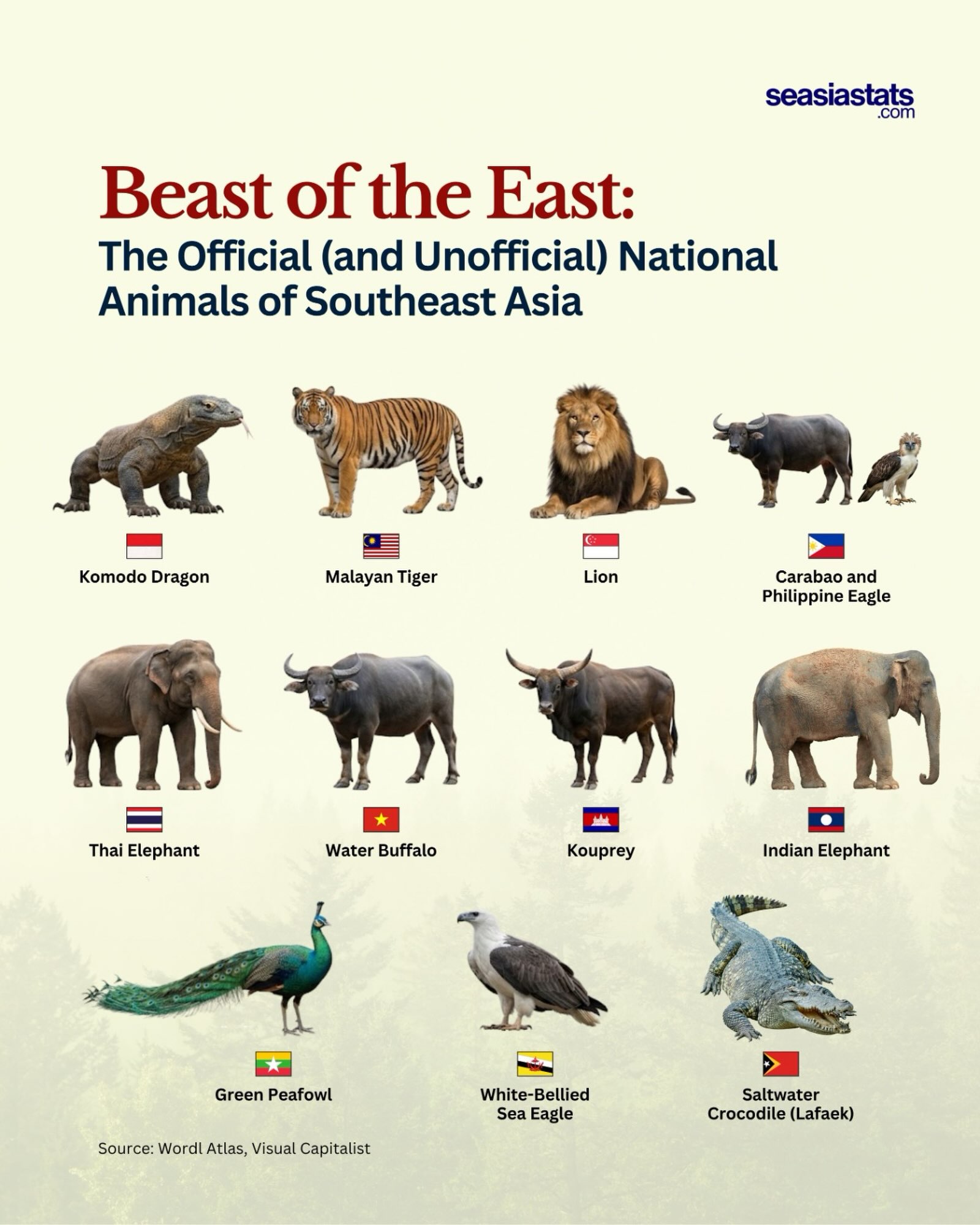
Southeast Asia is home to extraordinary wildlife, and many of its countries are closely associated with particular animals. Some of these animals have official national status, while others are regarded as unofficial national symbols because of their cultural importance, history, or connection with the country.
In Indonesia, the Komodo dragon is a powerful national symbol. Native to Indonesia’s islands, this ancient reptile is famous for its enormous size and distinctive appearance. Malaysia is represented by the Malayan tiger, an endangered animal admired for its strength, courage, and importance in Malay culture.
The lion is the national animal of Singapore. Although wild lions have never lived naturally in Singapore, the animal is strongly connected to the country’s name and its history.
In the Philippines, the carabao, or water buffalo, is widely regarded as a national animal and symbolizes strength, hard work, and rural life. The Philippine eagle, meanwhile, is the country’s national bird and represents the Philippines’ rich biodiversity.
In Thailand, the Thai elephant is one of the nation’s most important symbols. Elephants have played significant roles in Thai history, religion, transportation, and warfare.
Vietnam is strongly associated with the water buffalo, an animal traditionally important to agriculture and village life. It symbolizes patience, strength, and the hardworking spirit of Vietnamese farmers.
The kouprey is traditionally regarded as Cambodia’s national animal. This rare wild bovine represents the country’s natural heritage, although it is believed to be critically endangered and may already be extinct in the wild. In Laos, the Indian elephant is an important national symbol and reflects the country’s historical and cultural relationship with elephants.
The green peafowl is associated with Myanmar, where it has long been admired for its beauty and cultural significance. In Brunei, the white-bellied sea eagle represents the country’s connection with its tropical forests, rivers, and coastal environments.
Finally, Timor-Leste is commonly associated with the saltwater crocodile, a formidable reptile that has an important place in local traditions and the country’s natural environment.
Together, these animals show the remarkable diversity of Southeast Asia. Whether officially designated or simply celebrated as national symbols, they reflect the history, culture, landscapes, and natural heritage of the region. Protecting these animals and their habitats is therefore an important part of preserving Southeast Asia’s identity for future generations.