

New UNESCO Global Parks in 2026
If you're a fan of natural beauty, these new UNESCO Global Parks should be on your bucket list.

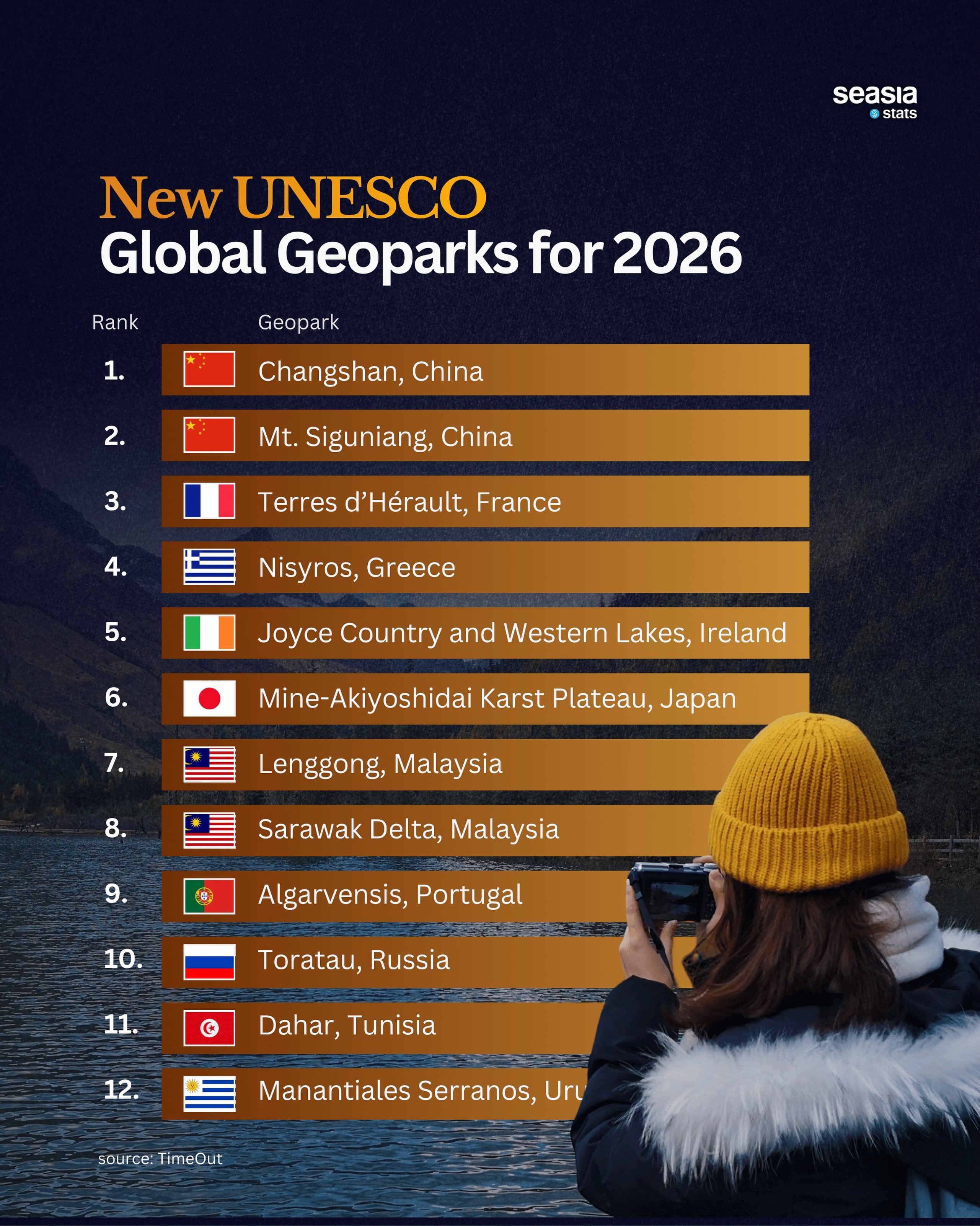
In 2026, UNESCO added 12 new sites to its Global Geoparks Network, highlighting some of the world’s most remarkable geological landscapes while supporting conservation, education, sustainable development, and local communities.
The new additions bring the network to 241 UNESCO Global Geoparks across 51 countries, covering more than 882,000 square kilometres. Time Out described the new sites as destinations that showcase everything from dramatic mountains and volcanic landscapes to limestone caves, ancient archaeological sites, and mangrove ecosystems.
China received two new geoparks: Changshan and Mt. Siguniang. Changshan features mountainous subtropical landscapes, while Mt. Siguniang is known for spectacular glacial landforms and distinct vertical climate zones. Together, they demonstrate the geological and ecological diversity of China’s mountain regions.
In France, the Terres d’Hérault UNESCO Global Geopark joins the network, while Nisyros becomes a new geopark in Greece. Nisyros is particularly notable for its volcanic character, providing visitors with an opportunity to experience landscapes shaped by powerful geological processes.
Ireland is represented by Joyce Country and Western Lakes Global Geopark. The area contains evidence of the Grampian-Taconic Orogeny, a major mountain-building period that occurred roughly 450 million years ago.
It is also part of a Gaeltacht region where the Irish language remains an important part of cultural life. Interestingly, the glaciological term “drumlin” derives from the Irish word droimainn.
Japan’s Mine-Akiyoshidai Karst Plateau is another important addition. It contains Japan’s largest karst plateau and an extensive network of caves. Meanwhile, Malaysia gained two geoparks: Lenggong, famous for its prehistoric and archaeological importance, and Sarawak Delta, which combines mangrove ecosystems, caves, and numerous geological sites.
The remaining additions are Algarvensis in Portugal, Toratau in Russia, Dahar in Tunisia, and Manantiales Serranos in Uruguay. These sites further expand the geographical reach of UNESCO’s geopark network across Europe, Africa, and South America.
Overall, the 12 new geoparks demonstrate that geological heritage is closely connected with biodiversity, history, culture, and local livelihoods.
UNESCO Global Geoparks are not simply protected natural attractions; they are places where conservation and education are combined with sustainable development and community participation.
The 2026 additions therefore offer both new opportunities for responsible tourism and stronger international recognition of the importance of protecting Earth’s geological heritage.