

News Fatigue in Asia-Pacific
In Asia-Pacific, Indians are the most likely to turn away from the news.

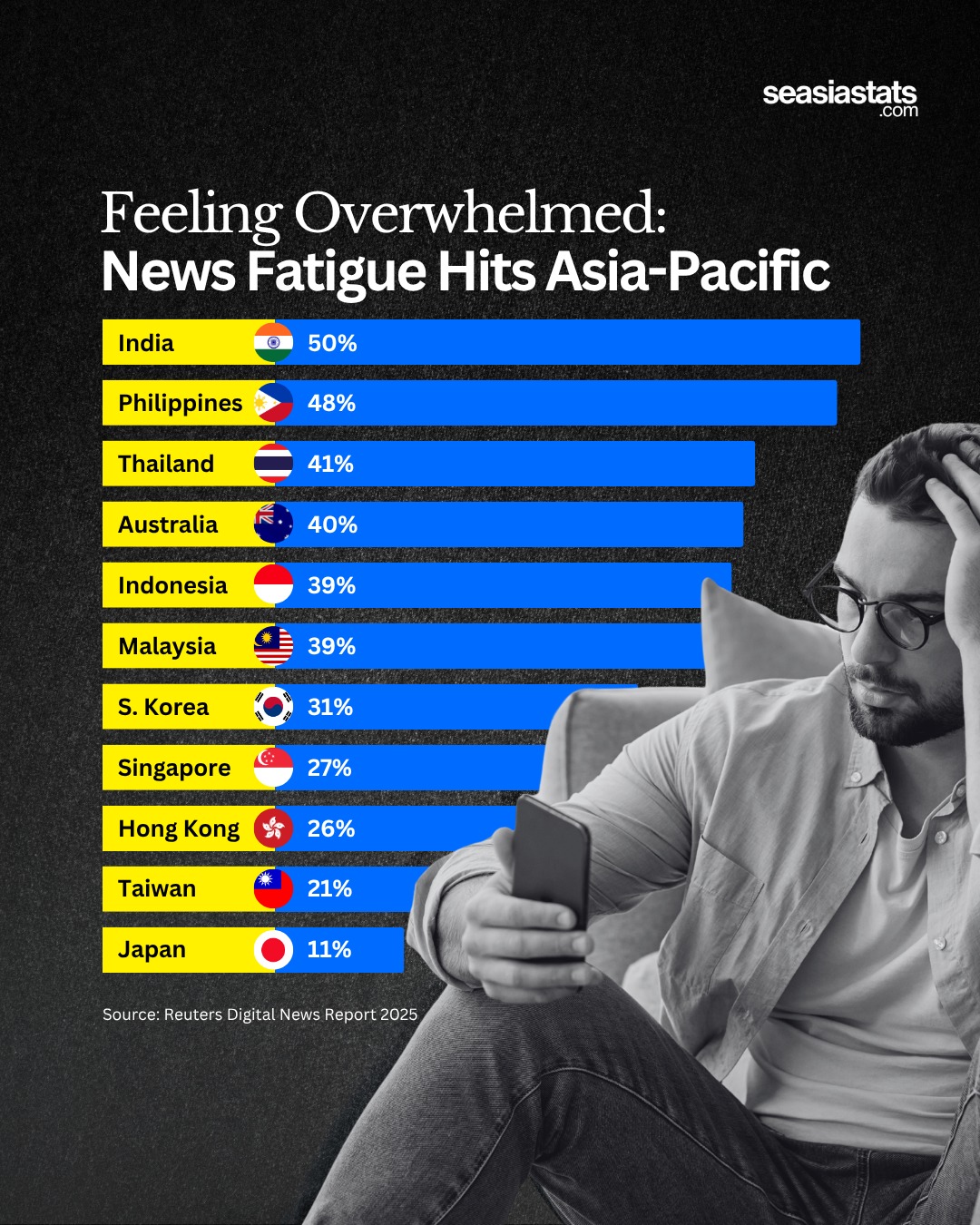
The way people consume news is changing rapidly across the Asia-Pacific region, and one of the clearest trends highlighted by the Reuters Institute’s Digital News Report 2025 is the growing tendency to avoid news.
Across the markets surveyed, many people say they sometimes or often stay away from the news, reflecting what is commonly described as news fatigue. Globally, the report found that four in ten people sometimes or often avoid the news, one of the highest levels recorded by the Reuters Institute.
Within Asia-Pacific, India records the highest level among the countries in this comparison, at 50 percent. The Philippines follows at 48 percent, while Thailand stands at 41 percent. Australia is next at 40 percent, followed by Indonesia and Malaysia, both at 39 percent.
South Korea records 31 percent, while Singapore is at 27 percent and Hong Kong at 26 percent. Taiwan records 21 percent, while Japan has the lowest figure in this group, at just 11 percent. The Reuters Institute specifically identifies Taiwan and Japan as having among the lowest levels of news avoidance in its 2025 report.
The figures suggest that news fatigue is not experienced equally across the region. In countries such as India, the Philippines and Thailand, large proportions of respondents report avoiding news. The report points to several possible reasons behind this broader pattern.
People may feel overwhelmed by the constant flow of information, particularly when news focuses heavily on conflict, political disputes, economic difficulties or other distressing events. Younger people are also more likely to say that news can feel difficult to follow, irrelevant to their lives, or capable of creating toxic arguments.
At the same time, avoiding traditional news does not necessarily mean people have stopped receiving information. The 2025 report describes a continued shift toward social media, video platforms and online personalities.
In several Asian countries, including India, the Philippines and Thailand, more people say they prefer watching news online rather than reading it. This reflects a broader transformation in which audiences increasingly encounter news through videos, creators and social platforms rather than traditional newspapers or television broadcasts.
The differences between countries highlight how varied news habits are across Asia-Pacific. While half of the surveyed respondents in India report sometimes or often avoiding news, the corresponding figure for Japan is only 11 percent. These differences may reflect variations in media environments, culture, technology use and people's relationships with news.
Ultimately, the 2025 findings show that news fatigue is an important challenge for media organisations across the region. As audiences become more selective about when, where and how they consume information, news providers face the challenge of remaining relevant without overwhelming the people they are trying to reach.