

Nicknames for Southeast Asians with Chinese Ancestry
Chinese huge influence in Southeast Asia produced a lot of nicknames for Southeast Asians with Chinese heritage.

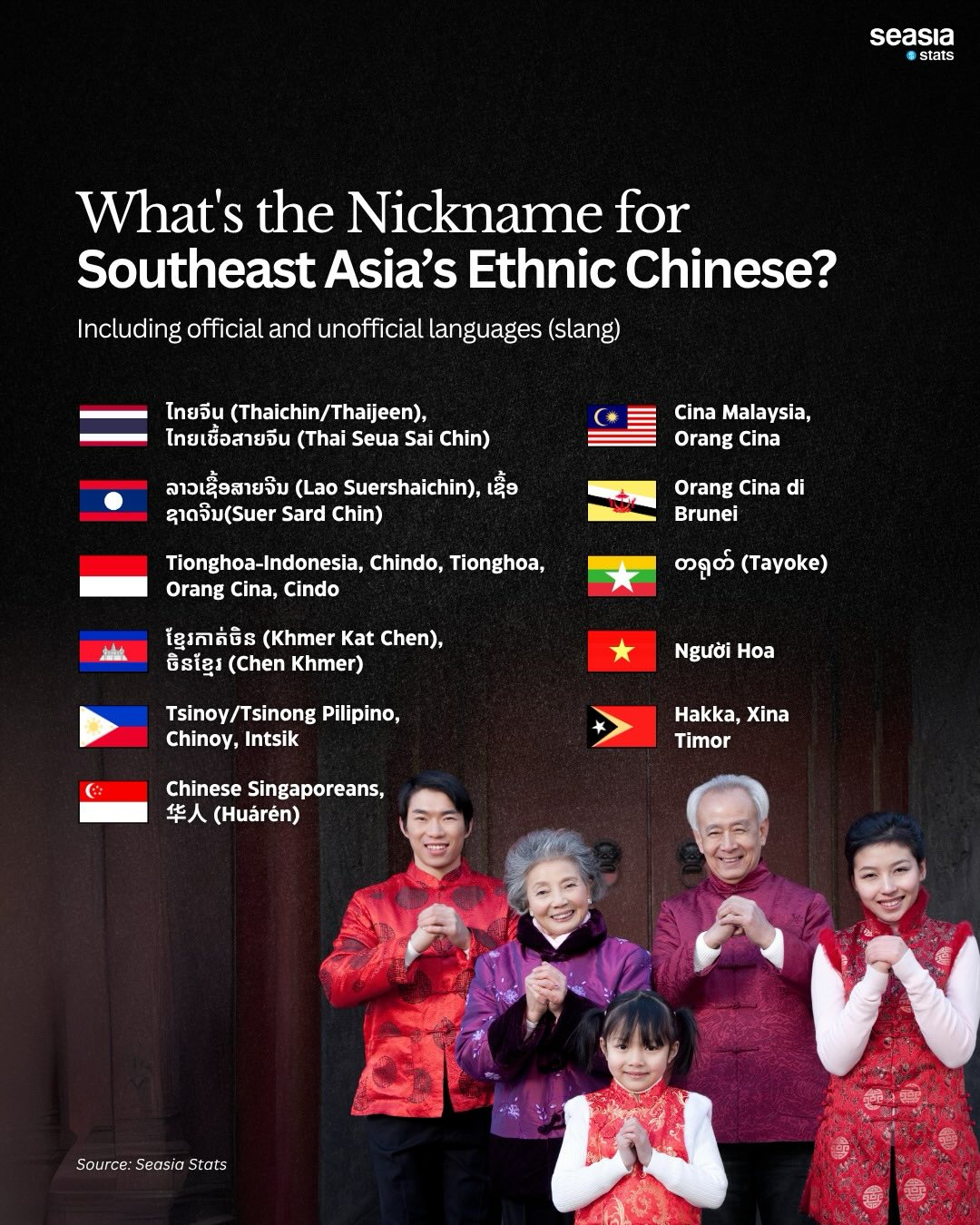
Ethnic Chinese communities have played an important role in the history, trade, and cultural development of Southeast Asia for centuries. Across the region, local societies have developed unique terms and nicknames to describe citizens of Chinese ancestry.
These names often reflect historical migration patterns, linguistic influences, and the blending of Chinese heritage with local national identities.
In Thailand, people of Chinese descent are commonly called “Thaichin” or “Thaijeen,” combining Thai national identity with Chinese ancestry. Another expression, “Thai Seua Sai Chin,” literally means “Thai people with Chinese lineage,” highlighting the deep assimilation of Chinese communities into Thai society.
In neighboring Laos, similar terms such as “Lao Suershaichin” or “Suer Sard Chin” are used to refer to Lao citizens with Chinese roots.
Indonesia has one of the largest Chinese-descended populations in Southeast Asia. The most formal term is “Tionghoa-Indonesia” or simply “Tionghoa,” both widely used in media and official discussions. Informally, terms like “Chindo,” short for Chinese-Indonesian, are especially popular among younger generations and online communities.
Another older term, “Orang Cina,” literally meaning “Chinese people,” is still used in everyday conversation, although its tone may depend on context.
In Cambodia, people of Chinese ancestry are often referred to as “Khmer Kat Chen” or “Chen Khmer,” emphasizing the integration between Khmer and Chinese identities. Meanwhile, in the Philippines, the Chinese-Filipino community is known by several names, including “Tsinoy,” “Tsinong Pilipino,” and “Chinoy.”
These labels combine Filipino and Chinese linguistic influences and are widely embraced by the community itself. Another older colloquial term, “Intsik,” remains recognizable in Filipino society.
Singapore, where ethnic Chinese form the majority population, commonly uses the term “Chinese Singaporeans” in English, while “Huaren” is frequently used in Mandarin to describe ethnic Chinese citizens. In Malaysia and Brunei, the phrase “Orang Cina” or “Orang Cina di Brunei” is widely used to identify local Chinese communities.
In Myanmar, ethnic Chinese are commonly called “Tayoke,” while in Viet Nam the term “Nguoi Hoa” refers to Vietnamese citizens of Chinese descent. Both communities have long histories connected to commerce and migration across the region.
Finally, in Timor-Leste, people of Chinese ancestry are sometimes referred to as “Hakka,” reflecting the dominant Chinese subgroup there, or “Xina Timor,” meaning “Timorese Chinese.”
These various nicknames demonstrate the diversity of Chinese communities in Southeast Asia. Although the terms differ by language and history, they all reflect the longstanding presence and cultural influence of Chinese descendants throughout the region.