

Number of Public Libraries Across Southeast Asia
When it comes to public library, Vietnam leads Southeast Asia by a landslide.

Public libraries are essential institutions that support education, encourage reading, provide access to information, and promote lifelong learning. Throughout Southeast Asia, however, the number of public libraries differs significantly among countries, reflecting variations in library infrastructure and service networks.
Figures attributed to the Online Computer Library Center (OCLC) highlight the gap between countries with extensive public-library systems and those with considerably fewer facilities. These statistics focus exclusively on public libraries, excluding academic libraries and other specialized institutions.
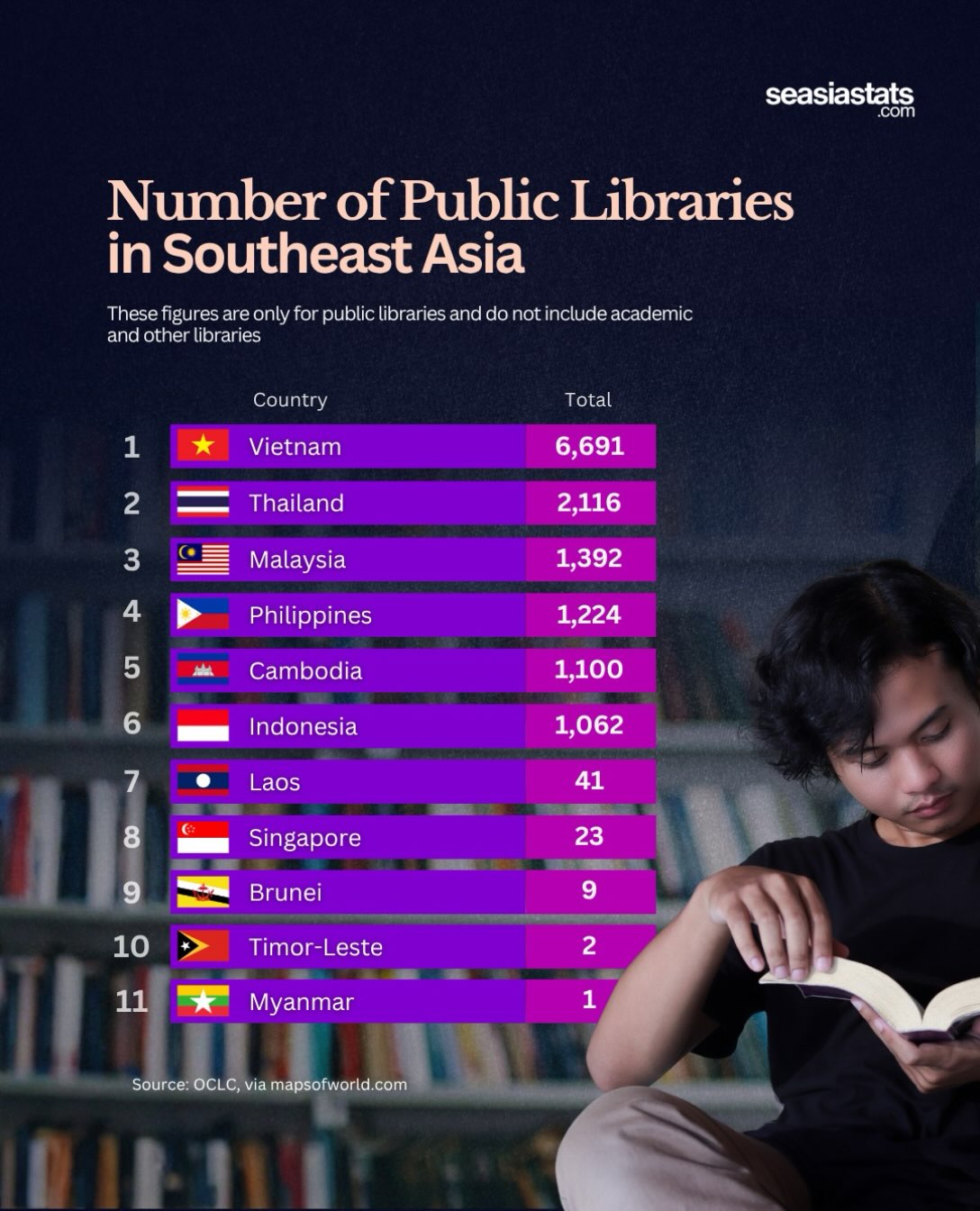
Vietnam leads the region with 6,691 public libraries, placing it well ahead of its Southeast Asian neighbors. Thailand comes second with 2,116 libraries, followed by Malaysia with 1,392. Together, these three countries represent a considerable portion of the public libraries included in the dataset.
The Philippines occupies fourth place, with 1,224 public libraries, while Cambodia follows with 1,100. Both countries maintain networks of public libraries that can help communities access books, educational materials, and other valuable information resources.
Indonesia ranks sixth, recording 1,062 public libraries in the dataset. Despite being the most populous country in Southeast Asia and one of the largest countries in the world by population, Indonesia has fewer recorded public libraries than several of its regional counterparts.
This comparison illustrates that population size does not necessarily correspond to the number of public libraries available.
Beyond these countries, the figures drop considerably. Laos has 41 public libraries, while Singapore records 23. Although Singapore's total is relatively low, its library services are recognized for modern facilities and digital resources.
This demonstrates that the number of physical libraries alone cannot fully reflect the quality, efficiency, or accessibility of a country's library system.
Brunei has nine public libraries, followed by Timor-Leste with two. Myanmar records the smallest number in the dataset, with just one public library listed. These figures highlight the substantial differences in recorded public-library infrastructure across the region.
Overall, the data illustrates an uneven distribution of public libraries throughout Southeast Asia. Countries with extensive library networks may be better positioned to provide physical access to books, learning materials, and information across different communities.
Nevertheless, the number of libraries does not necessarily indicate how frequently they are used or how effectively they serve the public.
Meanwhile, countries with smaller networks can expand access through digital collections, online learning resources, mobile libraries, and centralized information services.
As Southeast Asia continues to develop, investment in both physical and digital libraries could play an important role in improving literacy, strengthening education, and ensuring that more people have equal opportunities to access knowledge.