

Online Laughter Around the World
This is how people all over the world laugh when they're online.

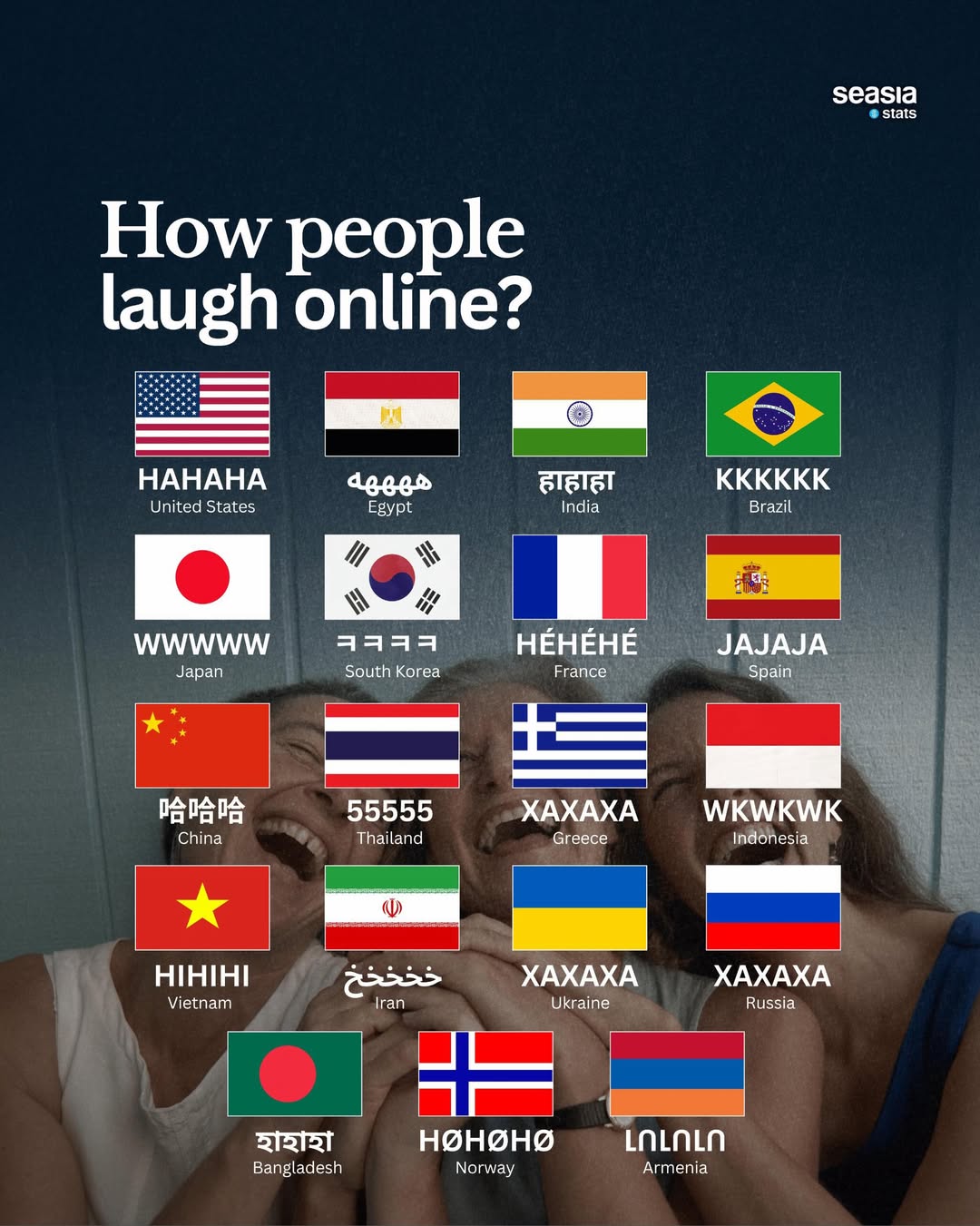
The internet has connected people from every corner of the globe, but one interesting difference remains: the way people express laughter online.
While laughter is universal, the written forms used in text messages, social media posts, and online chats often reflect the language, culture, and pronunciation habits of each country. These unique expressions offer a fascinating glimpse into how different societies communicate humor in the digital age.
In the United States and many English-speaking countries, the most common expression of laughter is "HAHAHA." It imitates the sound of spoken laughter and is widely recognized around the world. Similar versions can be found in other countries, often adapted to local alphabets and languages.
In Egypt, internet users commonly write "ههههه" (hahaha in Arabic script), while in Iran many people use "خخخخخ." The latter originated from Arabic keyboards, where the letter "خ" is often used as a shorthand for laughter in online conversations.
South Asia has its own variations. In India, people may write "हाहाहाह" in the Devanagari script, while in Bangladesh the equivalent is "হাহাহা" in Bengali script. Both expressions closely resemble the sound of laughing in their respective languages.
Latin countries often use different letters to represent the same sound. In Spain, laughter is commonly written as "JAJAJA" because the Spanish letter "J" is pronounced similarly to an English "H."
Brazil stands out with "KKK," a popular online expression that developed from the Portuguese phrase for laughter and has become a recognizable part of Brazilian internet culture.
East Asia offers some of the most distinctive examples. In Japan, people frequently use "WWW," derived from the Japanese word "warau," meaning "to laugh." In Korea, "ㅋㅋㅋ" is extremely common, representing a repeated "k" sound that signals amusement. Chinese internet users generally write "哈哈哈," which directly corresponds to "hahaha" in Mandarin.
Southeast Asia also has unique styles. In Thailand, people often type "555" because the number five is pronounced "ha" in Thai, making "555" sound like "hahaha."
Indonesians frequently use "WKWKW," a playful form of laughter that has become deeply embedded in local online culture. Vietnamese users often write "HIHIHI" to express lighthearted amusement.
Europe provides additional variations. France commonly uses "HÉHÉHÉ," while Greece and Ukraine share the expression "XAXAXA," where the letter "X" produces a sound similar to "H." Norway's "HØHØHØ" and Armenia's "հահահա" further demonstrate how languages shape digital communication.
These diverse expressions show that although people laugh differently online, humor remains a universal language that connects cultures worldwide.