

Overall Gender Parity in ASEAN 2025
Gender equality has become an increasingly important benchmark for social progress and economic development across the world.

Gender equality has become an increasingly important benchmark for social progress and economic development across the world. In Southeast Asia, governments and civil society organizations have spent decades advancing women’s participation in education, the workforce, and public life. While notable improvements have been achieved, the region still faces challenges in closing gaps in leadership representation, income equality, and political empowerment.
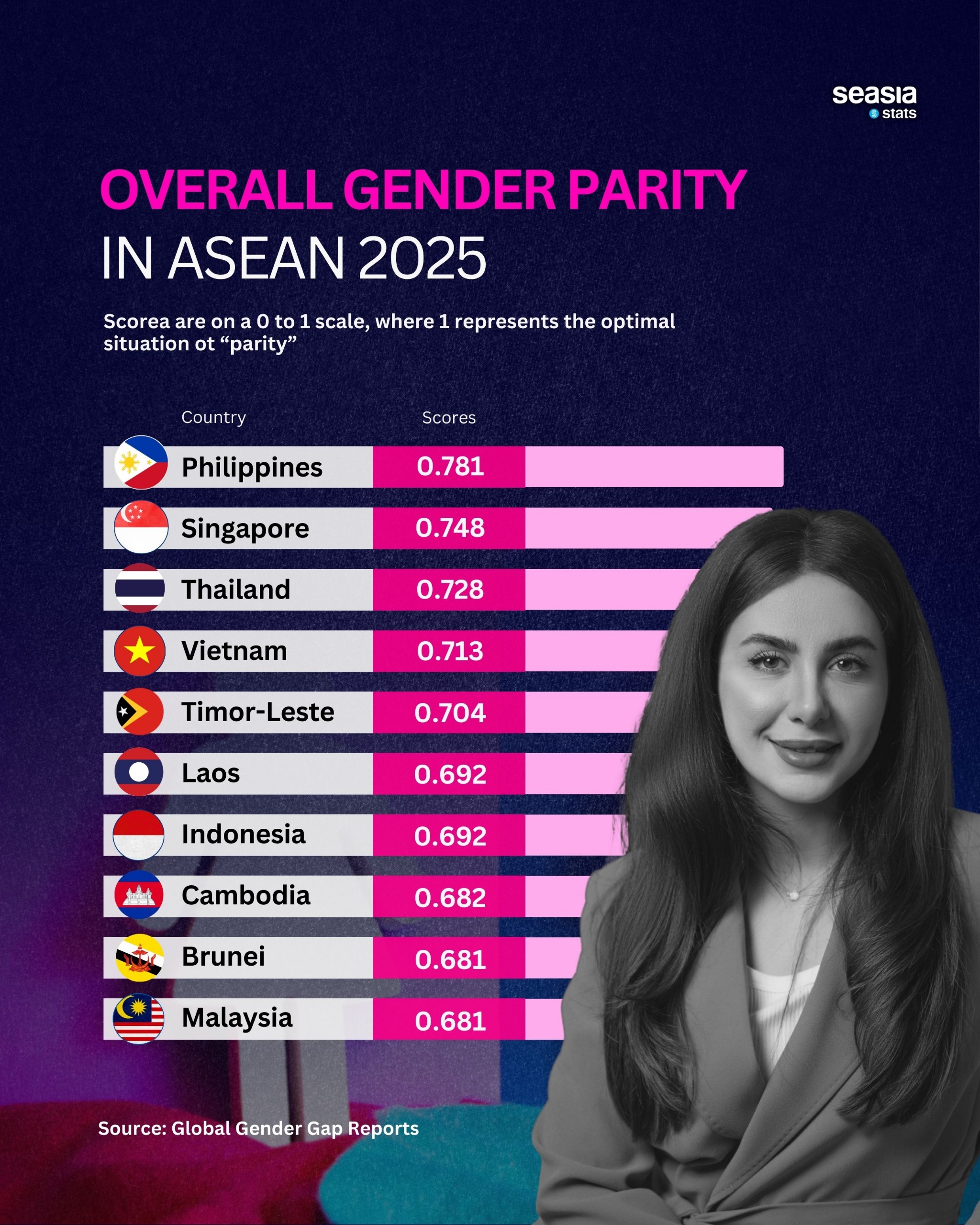
According to the 2025 Global Gender Gap Index published by the World Economic Forum, Southeast Asian countries demonstrate varying levels of progress toward gender parity. The index measures equality across four key dimensions: economic participation, educational attainment, health and survival, and political empowerment. Scores are calculated on a scale from 0 to 1, where 1 represents complete gender parity.
The Philippines Leads Southeast Asia
Among ASEAN countries, the Philippines continues to stand out as the regional leader in gender equality with a score of 0.781. The country has long been recognized for its relatively high levels of female participation in education, government, and professional sectors.
Women in the Philippines hold influential roles across many industries, including finance, healthcare, education, and public administration. Female leadership has also been visible in politics, with the country having elected two female presidents and numerous women serving in legislative and cabinet positions.
In addition, Filipino women have strong representation in higher education and professional employment, helping drive the country’s consistently strong ranking in global gender equality indexes.
Singapore and Thailand Follow Closely
Singapore ranks second in Southeast Asia with a score of 0.748, reflecting its strong economic participation among women and its highly educated workforce. Women in Singapore play key roles in sectors such as finance, technology, healthcare, and government administration.
Singapore’s policies supporting workplace equality, parental leave, and access to education have helped increase female participation in professional careers. However, challenges remain in achieving balanced representation in top corporate leadership positions.
Thailand, ranked third with 0.728, also demonstrates significant progress in gender parity. Thai women are widely active in the labor market and are prominent in sectors ranging from tourism and healthcare to small business entrepreneurship. Thailand’s education system has also achieved near gender parity in school enrollment.
Emerging Progress Across the Region
Several other Southeast Asian nations show encouraging progress in closing gender gaps. Vietnam, with a score of 0.713, has benefited from strong female participation in manufacturing, agriculture, and small business sectors. Vietnamese women have also increasingly entered higher education and technical professions.
Timor-Leste, scoring 0.704, has made notable strides in improving women’s representation in government and education despite its relatively young political institutions.
In the middle of the regional ranking are Laos and Indonesia, both scoring 0.692. While women in both countries participate widely in informal and small business economies, gender gaps remain in areas such as corporate leadership, income equality, and political representation.
Indonesia’s score places it seventh among the ten Southeast Asian countries measured in the index. Experts note that while Indonesian women have achieved strong educational outcomes, these gains have not always translated into equal representation in senior leadership positions.
Remaining Challenges in Gender Equality
The lower end of the regional ranking includes Cambodia, which records a score of 0.682, followed by Brunei Darussalam and Malaysia, both tied at 0.681.
Although these countries have made progress in education and healthcare access for women, gaps remain in economic participation and leadership opportunities. In many cases, women are still underrepresented in senior management roles and political office.
Across the broader East Asia and Pacific region, approximately 69.4% of the gender gap has been closed, placing the region fifth globally. However, the area of political empowerment remains the weakest dimension, with only 15.3% of the gap closed.
The Path Forward for Southeast Asia
While Southeast Asia has made measurable progress toward gender equality, experts emphasize that closing the remaining gaps will require continued policy reform, workplace inclusion, and leadership development for women.
As education and healthcare indicators approach parity, the next major challenge lies in translating these achievements into equal opportunities in politics, business leadership, and economic decision-making. Strengthening women’s participation at these levels will be essential for building more inclusive and resilient societies across the ASEAN region.