

People from These Countries View Language as a Requirement for Nationality
Is language an important aspect for true nationality?

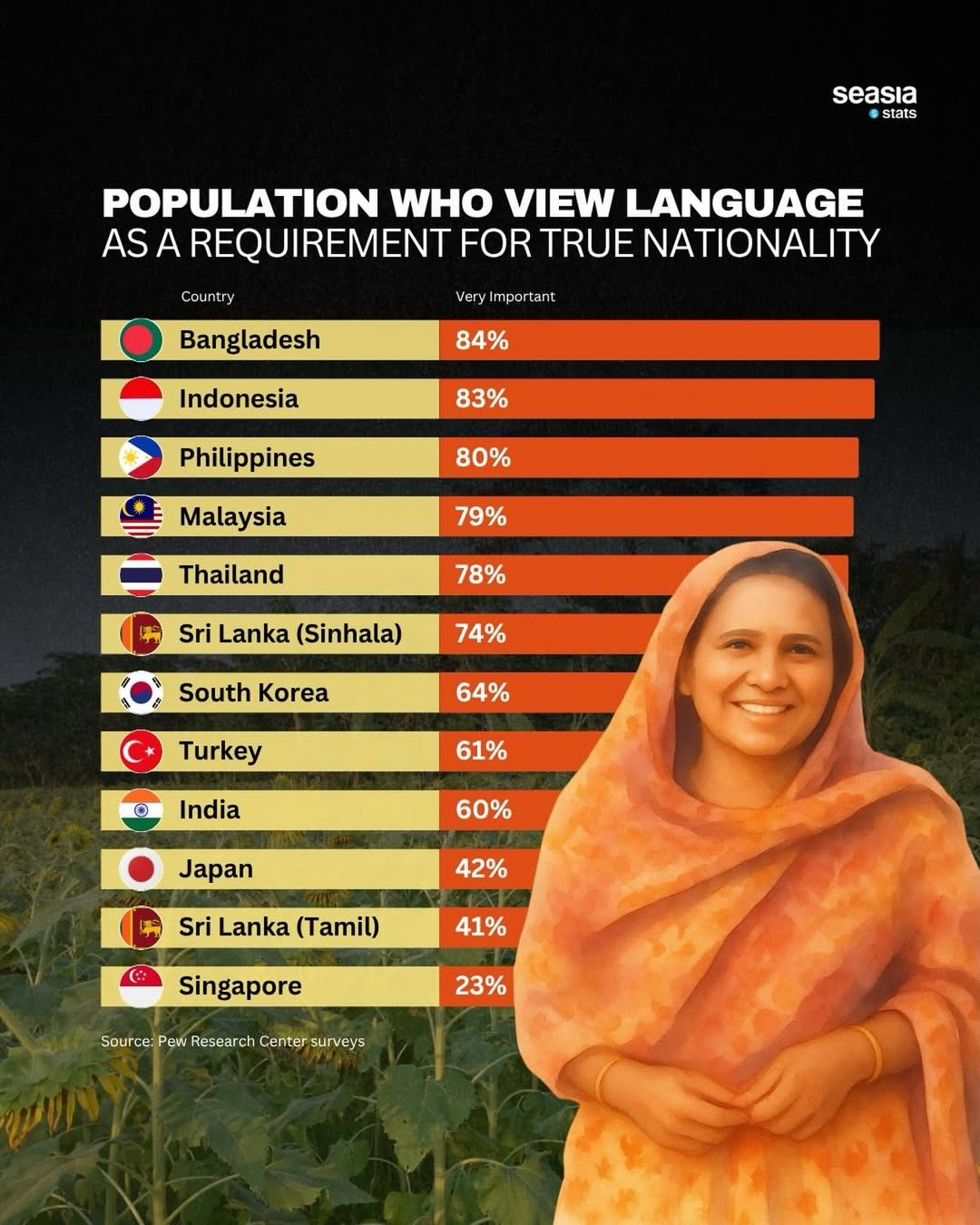
Language is often considered one of the strongest markers of national identity, and in many countries citizens believe that speaking the national language is an important requirement for belonging to the nation.
A recent comparison across Asian countries highlights how attitudes toward language and nationality differ significantly depending on history, culture, and ethnic diversity.
At the top of the list is Bangladesh, where 84% of citizens believe language is an important requirement for nationality. This strong sentiment is closely connected to the country’s historical struggle to preserve the Bengali language, which played a central role in the Bangladeshi independence movement.
Indonesia follows closely with 83%. Despite having hundreds of local languages, the Indonesian language has become a unifying national language since independence. Many Indonesians see the ability to speak the national language as essential for social unity across the archipelago.
In the Philippines, 80% of respondents share the same view. Filipino and English are both widely used, but the national language remains an important cultural symbol that connects diverse regional identities throughout the country.
Malaysia records 79%, reflecting the role of the Malay language in national identity and state policy. Meanwhile, Thailand stands at 78%, where the Thai language is strongly associated with cultural continuity and social integration.
In Sri Lanka, attitudes differ between ethnic communities. Among Sinhala respondents, 74% believe language is essential for nationality, while only 41% of Tamil respondents share the same opinion. These contrasting perspectives reflect the country’s complex linguistic and ethnic history.
South Korea records 64%, showing how the Korean language remains closely tied to ideas of shared heritage and cultural identity. Similarly, 61% in Turkey view language as central to national belonging, influenced by the country’s strong emphasis on Turkish identity since the early republican era.
In India, 60% of citizens agree that language is important for nationality, despite the country’s vast linguistic diversity. India recognizes multiple official languages, yet Hindi and regional languages continue to shape cultural and political identity.
The percentage is lower in Japan at 42%, although Japanese culture still places importance on linguistic and cultural integration. Finally, Singapore has the lowest figure at 23%. As a highly multicultural and multilingual society, Singapore promotes a more inclusive understanding of nationality that is less dependent on speaking a single language.