

Personal Spaces in Southeast Asian Countries
These are the amount of personal spaces one can get in every Southeast Asian country.

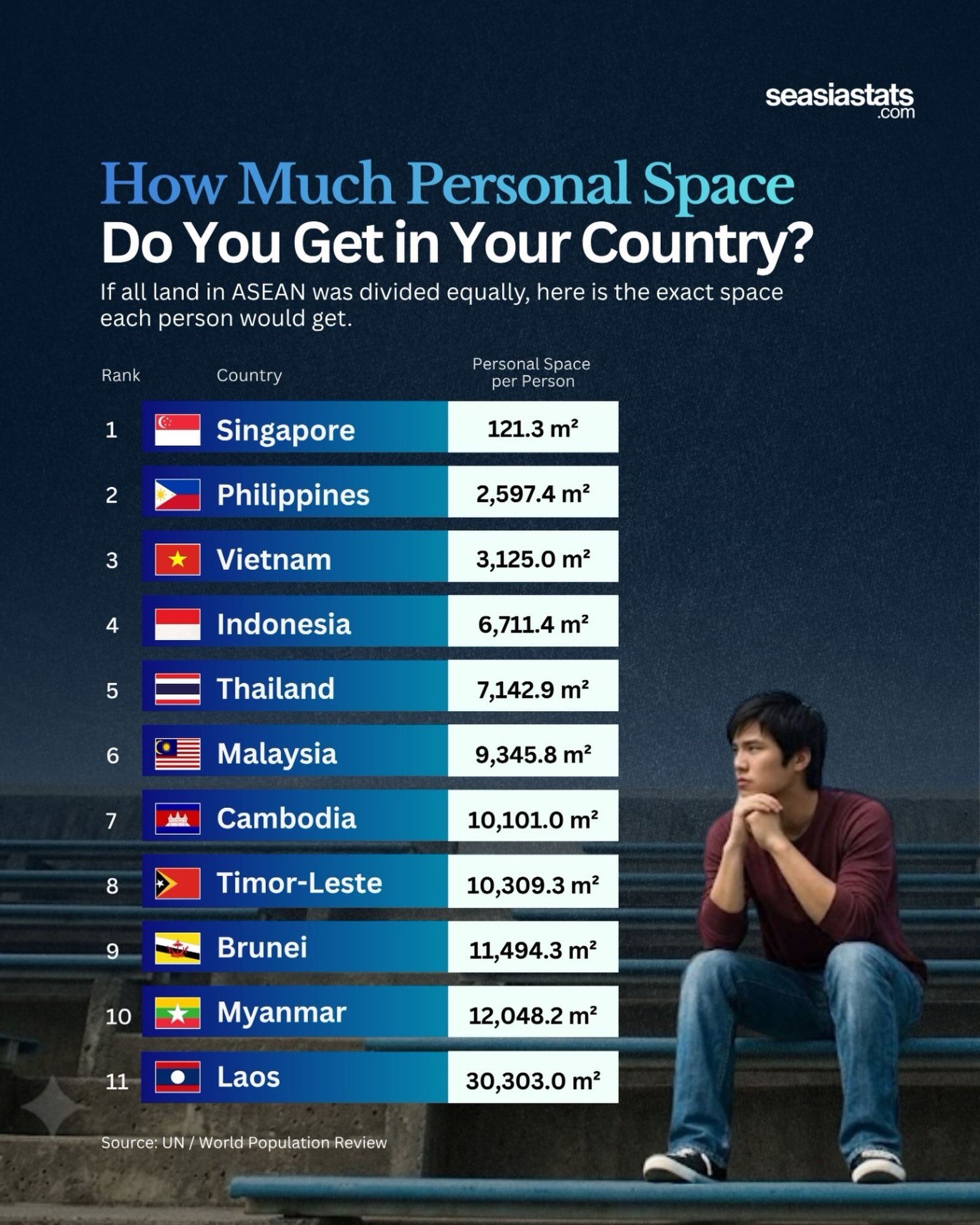
The amount of land available per person offers an interesting perspective on population density and the distribution of living space.
Calculated by dividing a country's total land area by its population, this figure provides an estimate of the average personal space available to each resident. While it does not represent privately owned land, it illustrates how densely or sparsely populated a country is.
Among Southeast Asian nations, Singapore has by far the smallest amount of land per person, with just 121.3 square meters available for each resident. As one of the world's most densely populated countries, Singapore maximizes its limited land through high-rise housing, efficient urban planning, and extensive public infrastructure.
At the opposite end of the spectrum is Laos, where each resident has an estimated 30,303.0 square meters of land. Its relatively small population and expansive mountainous terrain contribute to the region's highest level of personal land availability.
The Philippines ranks next with 2,597.4 square meters per person, followed by Vietnam at 3,125.0 square meters. Although both countries have large populations, their extensive land areas provide more average space per resident than densely populated city-states.
Indonesia, Southeast Asia's largest country by land area, offers approximately 6,711.4 square meters per person. Despite having the region's largest population, Indonesia's vast archipelago helps maintain a relatively high average amount of land per resident.
Thailand provides 7,142.9 square meters per person, while Malaysia offers 9,345.8 square meters. Both countries benefit from substantial land resources compared with their population sizes, resulting in lower overall population density.
The remaining countries on the list are among the region's least densely populated. Cambodia provides 10,101.0 square meters per resident, followed by Timor-Leste with 10,309.3 square meters.
Brunei offers 11,494.3 square meters, reflecting its small population and relatively large land area. Myanmar follows with 12,048.2 square meters per person, combining a sizeable territory with a moderate population density.
These figures highlight the remarkable diversity of Southeast Asia. From the highly urbanized environment of Singapore to the expansive landscapes of Laos, each country faces different opportunities and challenges in land management, urban development, environmental conservation, and infrastructure planning.
Understanding land availability per person provides valuable insight into how geography and population shape living conditions and long-term development across the region.