

Poorest Countries in Asia in 2025
These ten countries have GDP per capita lower than $3,000 in 2025.

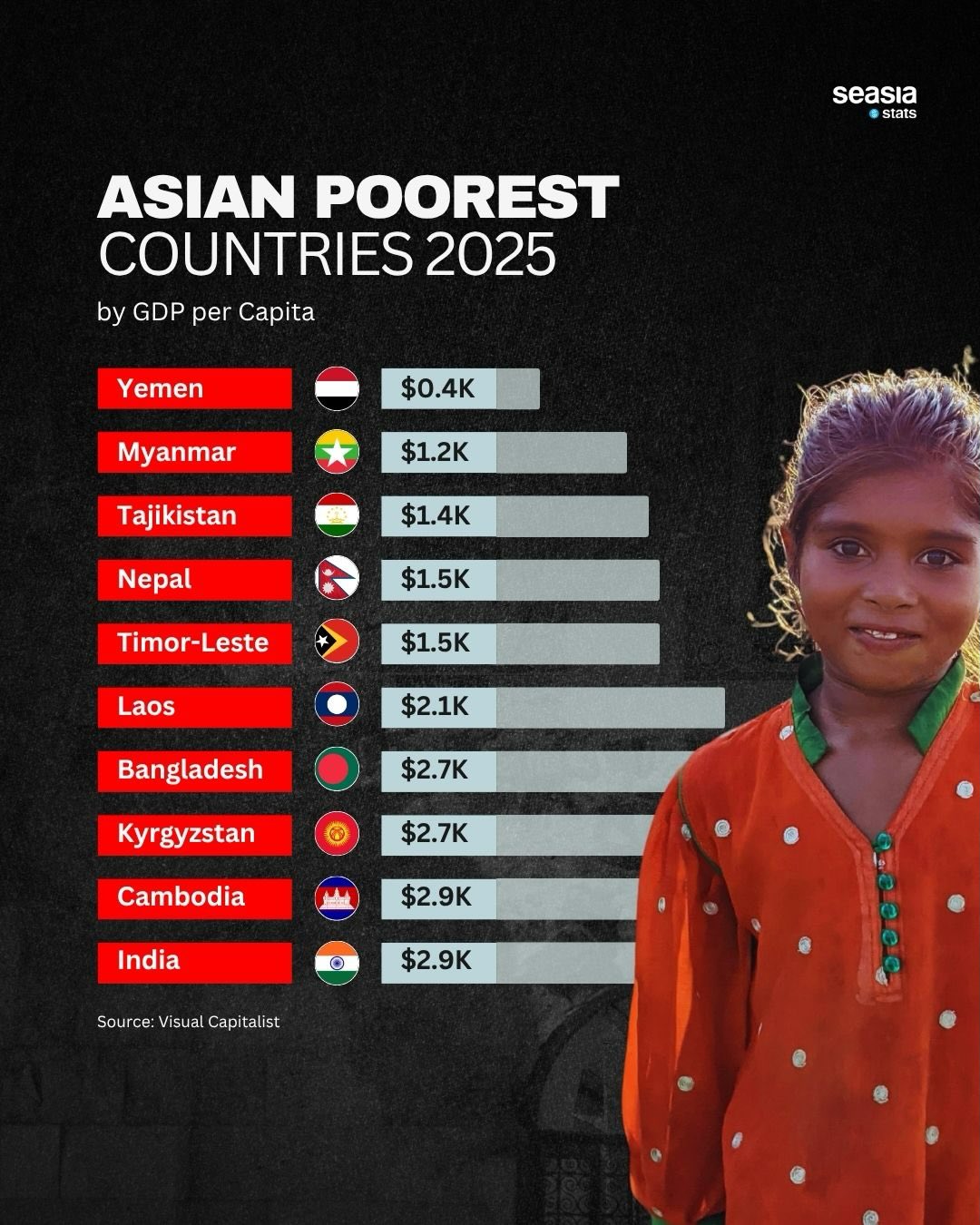
Gross Domestic Product (GDP) per capita is one of the most commonly used indicators for measuring a country's average economic output per person. While it does not fully reflect living standards or income distribution, it provides valuable insight into the relative economic development of nations.
In 2025, several Asian countries continue to face significant economic challenges, resulting in some of the lowest GDP per capita levels on the continent.
The poorest one in Asia is Yemen, with a GDP per capita of approximately $400. Years of conflict, political instability, and humanitarian crises have severely damaged the country's economy and infrastructure. As a result, millions of Yemenis continue to face poverty and limited access to basic services.
Myanmar ranks second with a GDP per capita of $1,200. Political turmoil and economic disruptions have slowed growth and discouraged investment, contributing to the country's low income levels. Tajikistan follows closely with $1,400 per person. Despite gradual economic progress, the country remains heavily dependent on remittances from workers abroad.
Nepal and Timor-Leste each record a GDP per capita of $1,500. Nepal's economy relies heavily on agriculture, tourism, and remittances, while Timor-Leste continues to work toward diversifying an economy historically dependent on energy revenues.
Laos ranks next with a GDP per capita of $2,100. Although the country has experienced periods of economic growth, challenges such as debt burdens and limited industrial development continue to affect income levels.
Bangladesh and Kyrgyzstan both have GDP per capita figures of $2,700. Bangladesh has made notable progress in manufacturing and exports, particularly in the garment industry, while Kyrgyzstan remains dependent on mining and remittance inflows.
Completing the list are Cambodia and India, each with a GDP per capita of $2,900. Cambodia has benefited from growth in tourism, manufacturing, and construction, but many citizens still face economic hardships.
India, despite being one of the world's largest economies, continues to have a relatively low GDP per capita due to its massive population and ongoing development challenges.
These figures highlight the economic disparities that exist across Asia. While some countries have made significant progress in reducing poverty and expanding economic opportunities, many continue to face structural challenges that limit income growth.
Sustained investment in education, infrastructure, healthcare, and economic diversification will be crucial for improving living standards and supporting long-term development in these nations.