

Public Libraries in Southeast Asian Countries
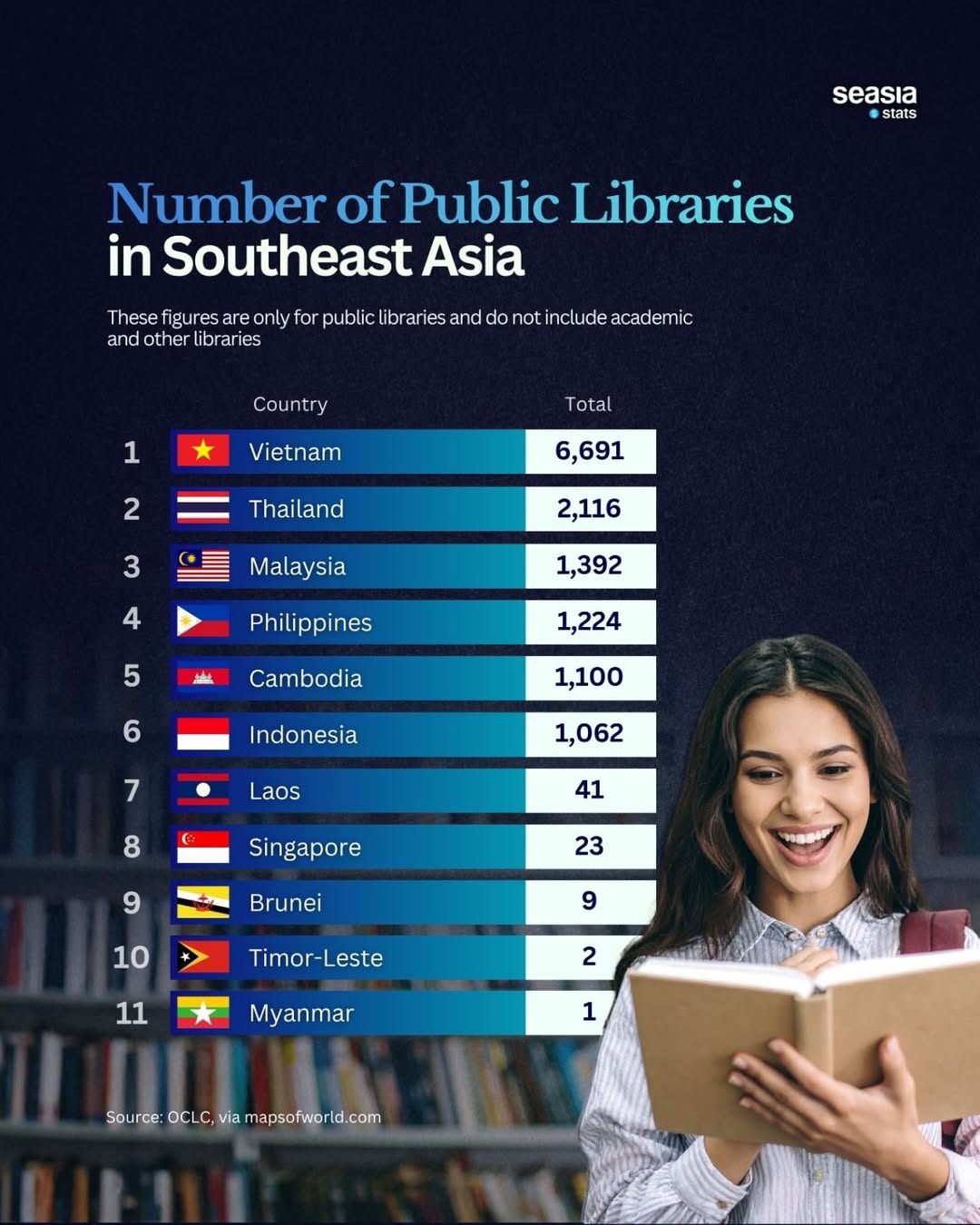
The number of public libraries in Southeast Asia shows great disparities between its countries.

Public libraries continue to play an essential role in promoting literacy, education, and community engagement across Southeast Asia. Despite the rise of digital technology and online learning, libraries remain important public spaces where people can access knowledge, study materials, and cultural resources free of charge.
According to data from the Online Computer Library Center (OCLC), Southeast Asian countries show significant differences in the number of public libraries they operate.
Among all Southeast Asian nations, Viet Nam has the largest number of public libraries, with 6,691 libraries nationwide. This remarkable figure reflects the country’s strong commitment to education and public access to information.
Thailand ranks second with 2,116 public libraries, while Malaysia holds third place with 1,392 libraries. These countries have invested heavily in literacy programs and public educational infrastructure over the years.
The Philippines follows with 1,224 public libraries, slightly ahead of Cambodia, which has 1,100 libraries. Indonesia, the region’s most populous country, has 1,062 public libraries. Although Indonesia has a lower number compared to Vietnam and Thailand, libraries continue to expand across the archipelago to support literacy and lifelong learning.
Meanwhile, several smaller Southeast Asian nations have relatively limited library networks. Laos has 41 public libraries, while Singapore operates 23 libraries. Despite the smaller number, Singapore’s libraries are widely recognized for their advanced facilities, digital services, and modern learning spaces.
Brunei has 9 public libraries, whereas Timor-Leste has only 2. At the bottom of the list is Myanmar with just 1 public library recorded in the data.
Overall, the distribution of public libraries in Southeast Asia highlights both educational progress and existing disparities within the region. Countries with larger and more accessible library systems often demonstrate stronger support for reading culture and public learning opportunities.
As Southeast Asia continues to develop, expanding public libraries could help improve literacy, digital inclusion, and equal access to education for millions of people.